
Is Gaming Wasting Your Time? The Honest Breakdown
Is gaming wasting your time or providing genuine mental relief? Explore dopamine traps, cognitive benefits, opportunity cost, and healthy boundaries.

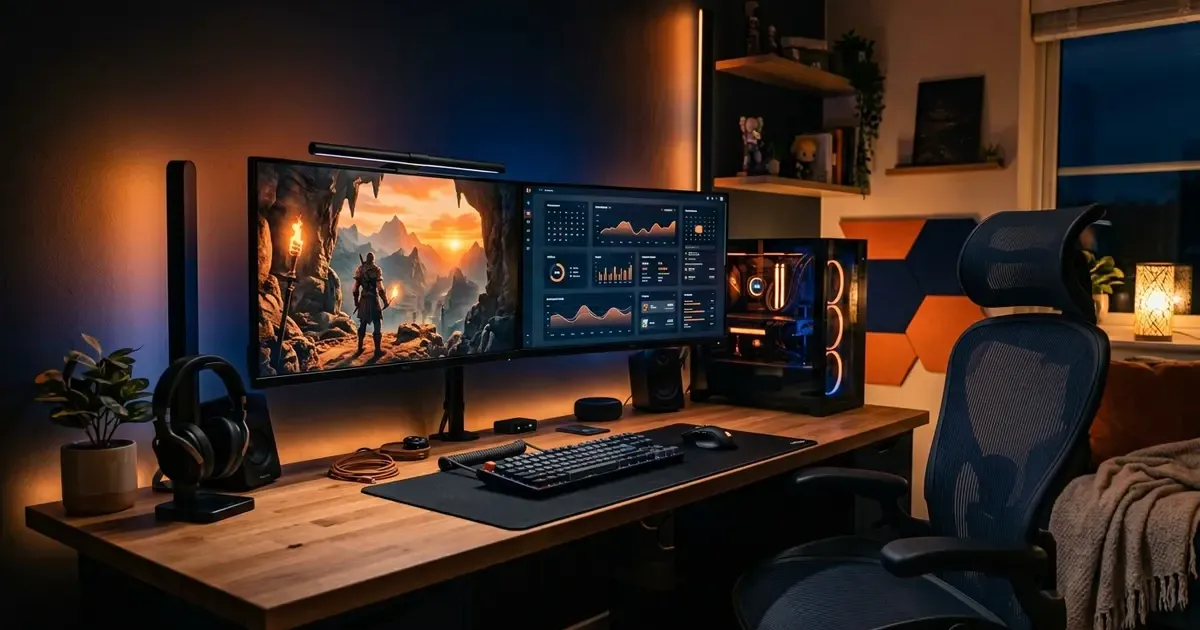
You shut down your computer or console after a three-hour session. The room is quiet. Instead of feeling energized, refreshed, or satisfied, a familiar knot tightens in your chest: a dull mixture of guilt, regret, and the lingering question of what else you could have built with those hours.
We live in a culture obsessed with optimization. Every spare moment is analyzed for its return on investment, personal branding potential, or career trajectory. In this climate, gaming often gets labeled as the ultimate adult vice: an unproductive black hole that burns precious hours without leaving anything tangible behind.
Yet tens of millions of intelligent, ambitious professionals spend their evenings exploring virtual worlds, solving cooperative puzzles, or mastering precision mechanics. Are they throwing their potential away, or is modern gaming simply the scapegoat for deeper struggles with burnout and unstructured leisure?
Here is the honest, unvarnished breakdown of whether gaming is truly wasting your time, how predatory mechanics exploit your brain, and how to reclaim play as genuine restoration.
Quick Summary: Restorative Gaming vs. The Dopamine Trap
Before examining the psychological mechanics, here is how intentional leisure contrasts with mindless escapism:
| Factor | Restorative Gaming (Active Leisure) | Dopamine Trap (Mindless Escapism) |
|---|---|---|
| Game Architecture | Finite campaigns, clear endings, narrative craft | Infinite loops, daily login bonuses, battle passes |
| Primary Motivation | Immersion, narrative curiosity, skill mastery | Avoidance of real-world friction, boredom, FOMO |
| Session Control | Pre-decided start and end points (1 to 2 hours) | “Just one more match” syndrome lasting past midnight |
| Post-Session Feeling | Recharged, inspired, relaxed, clear-headed | Sluggish, guilty, mentally foggy, anxious |
| Real-World Impact | Protects mental bandwidth for career and creative work | Cannibalizes sleep, exercise, reading, and relationships |
| Typical Genres | Narrative RPGs, puzzle adventures, indie gems | Competitive matchmaking, gacha, live-service shooters |
The Evolutionary Trap: The Illusion of Competence
To understand why gaming produces such intense guilt, we first have to examine human reward architecture.
For hundreds of thousands of years, dopamine evolved to motivate survival behaviors: hunting, building shelters, learning complex tools, and navigating social hierarchies. When you mastered a spear or learned to identify edible plants, your brain rewarded you with satisfaction because you had genuinely increased your competence and survival odds.
Video games represent the most sophisticated artificial dopamine delivery system ever built.
When you conquer a difficult raid boss in an MMO, rank up in a competitive shooter, or unlock a rare piece of armor, your brain registers authentic achievement. Your prefrontal cortex and striatum do not distinguish between leveling up a character in a virtual realm and learning to code, speaking a new language, or finishing a marathon. The hormonal payoff feels identical.
This phenomenon is known as the illusion of competence:
- Clear Objectives: Real life rarely gives you unambiguous quest markers. In contrast, games offer clear pathways to success with instant feedback.
- Guaranteed Fairness: In games, effort correlates directly with reward. If you hit the required input, the combo executes. Real-world careers and projects involve unfair variables, delays, and unexpected friction.
- Rapid Progression Loops: You can see your numeric stats rise every twenty minutes, satisfying our innate desire for measurable progress.
Gaming becomes dangerous when it acts as an emotional surrogate. If your daily work feels stagnant, your creative projects are stuck, or your social life feels challenging, games provide a sanctuary where you can feel powerful, capable, and acknowledged without risking failure in the real world. When gaming replaces ambition rather than supplementing rest, it ceases to be leisure and turns into avoidance coping.
The Cognitive and Emotional Benefits of Purposeful Play
Dismissing all gaming as a childish waste of time ignores three decades of cognitive neuroscience. When approached with intention, interactive entertainment provides psychological benefits that passive consumption (such as scrolling short-form video feeds or binge-watching television) cannot match.
1. The Power of Active Engagement
Watching television is passive: your brain drops into lower alpha wave states, requiring minimal active problem-solving or motor coordination. Gaming, by contrast, demands sustained attention, working memory retrieval, pattern recognition, and rapid decision-making.
Studies consistently demonstrate that action games enhance spatial visualization, visual contrast sensitivity, and executive function. Strategy games train probabilistic thinking and resource management under pressure.
2. Reliable Access to Flow State
Psychologist Mihaly Csikszentmihalyi defined flow as a state of complete absorption where skill level perfectly balances task difficulty. In flow, self-criticism drops away, time distortion occurs, and the mind operates at peak immersion.
Modern life frequently fractures our attention across Slack notifications, emails, and social media feeds. A well-designed game commands 100% of your cognitive bandwidth. For individuals dealing with intense workplace stress or analytical exhaustion, two hours inside an engrossing, self-contained world acts as a complete mental reset, disconnecting cognitive circuits that otherwise run on anxious loops.
3. Shared Social Rituals
For adults juggling remote work and geographically dispersed friendships, cooperative gaming serves as the modern equivalent of playing sports together in the neighborhood park. Tackling a cooperative campaign or gathering online for a weekly session provides structured, low-pressure camaraderie without the logistical friction of coordinating travel.
When Gaming Truly Becomes a Waste of Time
Acknowledging the cognitive upside does not excuse the predatory reality of modern game publishing. The gaming landscape in 2026 is fundamentally different from the cartridge games of the 1990s.
Today, games are not merely sold as closed works of art; they are engineered as “live services” designed by behavioral psychologists to maximize retention metrics, daily active users, and microtransaction spending.
Gaming unequivocally becomes a destructive waste of time when the following patterns emerge:
1. You Play Out of Obligation Rather Than Joy
If you open a game primarily to claim a “daily login reward,” finish daily battle pass challenges before they expire, or maintain an in-game streak, you are no longer playing. You are working an unpaid, low-tier administrative job for a tech conglomerate.
When games introduce artificial scarcity and time-gated chores, they turn play into compulsive maintenance. The moment you feel anxious about missing an in-game event, the software is manipulating your fear of missing out (FOMO) rather than providing genuine recreation.
2. High Opportunity Cost on Core Life Milestones
Time is a non-renewable resource. Spending ten hours a week playing games is roughly 520 hours per year.
Consider what 520 intentional hours can produce:
- Achieving conversational fluency in a foreign language.
- Building a profitable side business or open-source software portfolio.
- Reading 30 to 40 substantial non-fiction books.
- Training from a sedentary baseline to completing a half-marathon.
If you are satisfied with your health, your career, your financial trajectory, and your close relationships, dedicating surplus free time to gaming carries no penalty. But if you constantly lament that you “never have enough time” to work out, cook nutritious meals, read books, or launch your creative projects, yet log 25 hours of gaming each week, the math reveals your real priorities.
3. Emotional Numbing and Avoidance
Pay close attention to the emotional state that drives you to boot up your console. Are you excited to experience an intriguing story, or are you running away from the difficult email you need to send, the exam you need to study for, or the creative project that feels intimidating?
Using entertainment to soften occasional acute stress is normal. Using entertainment as an automated shield against emotional discomfort creates chronic avoidance, guaranteeing that real-world problems compound while you hide in a digital sandbox.
Finite Games vs. Infinite Games: Curating Your Library
The single most effective shift you can make is changing the types of games you choose to play. In philosophy, author James P. Carse made a profound distinction between finite games and infinite games.
Finite Experiences: Clear boundaries, intentional endings, artistic satisfaction.Infinite Loops: Endless ladders, repeatable seasons, algorithmic retention.The Infinite Loop Trap
Competitive multiplayer titles, extraction shooters, and live-service MMOs are designed to never end. There are no closing credits. Every season resets your rank, offers a new skin, and prompts you to grind another 100 levels.
Because the reward ceiling constantly shifts forward, these games rarely provide a clean psychological stopping point. You finish a session feeling depleted, agitated, or irritated by teammates, rather than fulfilled.
The Value of Finite Masterpieces
In contrast, finite narrative titles, puzzle adventures, and indie passion projects operate like interactive literature. Games like Outer Wilds, Disco Elysium, The Witcher 3, Shadow of the Colossus, or Celeste tell self-contained stories.
They demand emotional investment, present fresh perspectives, and eventually come to an unambiguous, definitive end. When you complete a finite game, you experience the same narrative resonance and emotional closure that follows reading an extraordinary novel or watching a cinematic classic.
If you find yourself questioning whether your gaming habit is healthy, audit your library. Eliminating infinite live-service games and restricting your play to rich, finite adventures instantly transforms your relationship with screen time.
5 Practical Rules to Game Guilt-Free
You do not need to purge your consoles, throw away your PC, or adopt an ascetic lifestyle to live an ambitious, productive life. What you need are boundaries that preserve your real-world momentum while allowing leisure to remain joyful and guilt-free.
Rule 1: Earn Your Leisure (The “Produce Before You Consume” Principle)
Never game before noon, and never touch a game when high-priority professional or creative tasks remain unaddressed.
When you play before completing your primary daily responsibilities, the lingering awareness of unfinished business prevents deep immersion. You experience split attention, enjoying neither your game nor your work.
Commit to a simple rule: deep work and physical training come first. Treat gaming as the dessert at the end of an honest day of labor. When your core tasks are finished, you can sit down with zero cognitive residue and enjoy your game without a shred of internal conflict.
Rule 2: Impose Structural Friction
Digital devices make starting a game frictionless. One double-click or button press instantly pulls you into another universe.
Introduce deliberate physical friction:
- Unplug the console controller and store it in a drawer across the room after every session.
- Keep competitive live-service games uninstalled. If you want to play, the three-hour download forces you to make a conscious choice rather than acting on impulse.
- Use a separate profile or partitioned drive for gaming if you use the same machine for remote work and play.
Physical friction disrupts autopilot habits, turning mindless impulses into deliberate decisions.
Rule 3: Set a Hard Session Horizon
Parkinson’s Law states that work expands to fill the time allocated for its completion. The inverse is true for gaming: without a defined endpoint, a session expands until exhaustion forces you to stop.
Decide on your session length before you press start. Set a physical kitchen timer or a phone alarm in another room for 90 minutes or two hours. When the alarm sounds, save at the next logical checkpoint and immediately shut down the system. Do not negotiate with yourself in the heat of an adrenaline surge.
Rule 4: Eliminate “Dead” Gaming Time
Many players maintain a rotation of secondary games that they do not even actively enjoy: casual smartphone games, idle clickers, or repetitive multiplayer queues played while listening to podcasts in the background.
This is “dead” time: you are neither resting deeply nor accomplishing anything valuable.
Be ruthless. If a game feels like killing time rather than sparking wonder, delight, or intense intellectual engagement, delete it immediately. Save your gaming appetite for experiences that genuinely move you.
Rule 5: Balance Virtual Achievements with Real-World Physicality
If all your challenges take place on high-resolution screens, your nervous system becomes lopsided: overstimulated cognitively while physically under-exerted.
Counterbalance every hour of screen immersion with physical movement. Hit the gym, take a long walk without headphones, lift weights, or build something tangible with your hands. When your physical body is genuinely tired from real exertion, evening relaxation feels earned and deeply restorative.
The Verdict: Tool, Art, or Trap?
Is gaming wasting your time?
The answer depends entirely on your intent and your boundaries:
- Gaming is a waste of time when it serves as a substitute for real-world courage, an escape from neglected responsibilities, or a compulsive habit dictated by corporate retention algorithms.
- Gaming is not a waste of time when it is enjoyed as an active, artistic medium that sparks imagination, sharpens cognitive faculties, strengthens social bonds, and provides genuine psychological respite after a day of dedicated work.
Time you enjoy wasting on something enriching is not wasted time. But time you spend avoiding your life under the illusion of digital accomplishment is time you will never get back.
Audit your motives, cut the predatory loops, protect your highest-leverage goals, and enjoy your favorite games for what they were always meant to be: unforgettable adventures, not lifelong distractions.
Frequently Asked Questions (FAQ)
How many hours of gaming per week is considered healthy?
For most working adults, 7 to 14 hours per week (roughly 1 to 2 hours per day, or longer sessions on weekends) fits comfortably within a healthy, productive lifestyle, provided sleep, exercise, social relationships, and career commitments are fully maintained. Problems typically arise when weekly hours exceed 20 to 25 hours, as this almost inevitably cuts into physical health, sleep quality, and personal growth.
Why do I feel so guilty after playing video games, but not after reading or watching movies?
Guilt after gaming usually stems from two factors: the illusion of competence and the duration of sessions. Because games simulate active progress, your subconscious feels unsettled when you power down and realize none of that progress exists in reality. Additionally, unlike a 90-minute movie or a book chapter with natural stopping points, games frequently pull players into extended multi-hour sessions that overrun intended time boundaries.
Should I quit gaming entirely or just cut back?
Quitting cold turkey is rarely necessary unless you suffer from severe compulsive addiction that disrupts your employment, academic standing, or family life. For the vast majority of people, eliminating predatory live-service games, setting structural time boundaries, and strictly prioritizing deep work and fitness before playing resolves the issue entirely.
What are the best alternatives to gaming for unwinding in the evening?
Excellent restorative alternatives that provide similar tactile engagement and mental presence include reading long-form fiction or non-fiction (our winter reading guide offers great options), learning an instrument, cooking a deliberate meal, working on a physical craft, or establishing a mindful digital detox routine like our guide on deleting social media.
Related Articles

Feeling Stuck in Corporate Life? How to Break Free
Are you feeling trapped in a mundane corporate job? Discover actionable steps to reignite your passion, pivot your career, and find fulfillment outside work.

The Ultimate Guide to Achieving Real Work Life Balance
Struggling to disconnect after hours? Learn actionable strategies to achieve work life balance, set boundaries, and reclaim your personal time.

How to Choose a Hobby You Will Actually Stick With
Feeling bored at work and unfulfilled? Discover a practical guide to choosing the perfect hobby, from identifying your interests to investing in the right gear.