
Computational Photography vs. Real Cameras: Is Glass Dead?
Has the smartphone killed the DSLR? We dive into computational photography, comparing the Samsung Galaxy, iPhone, and Pixel against traditional optical cameras.

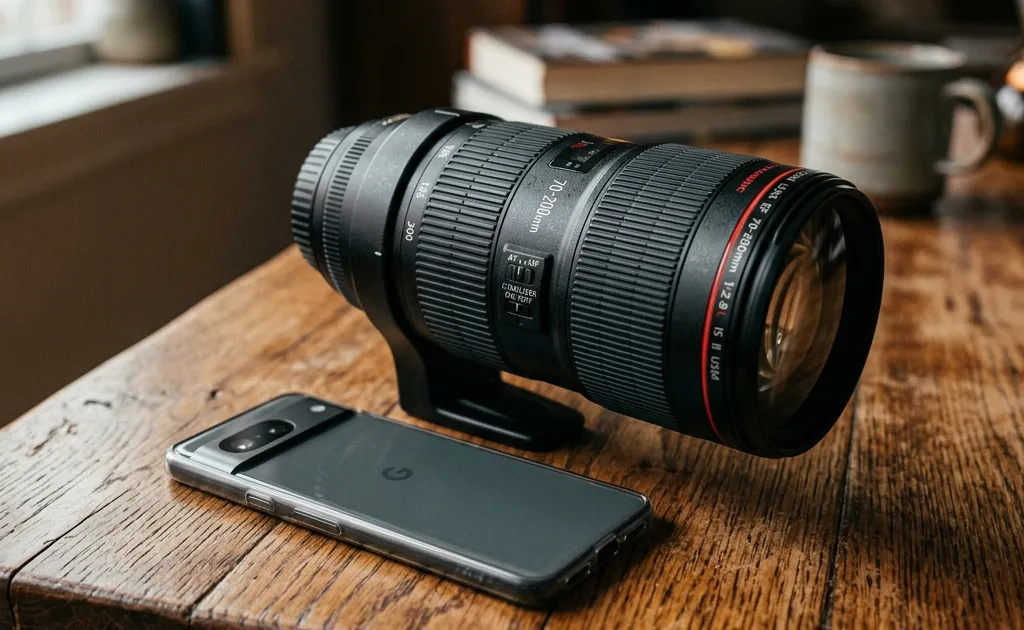
The Physics of Light vs. The Power of Silicon
For over a century, photography was governed by strict, unbreakable laws of physics. To capture more light, you needed a physically larger lens aperture. To freeze fast motion without noise, you needed a massive sensor capable of absorbing photons instantly. To achieve a shallow depth of field, that creamy, beautiful blur behind a subject known as ‘bokeh’, you needed heavy, expensive, meticulously ground glass.
Looking for the bigger picture? Check out our complete Photography Guide for Beginners for gear recommendations, camera fundamentals, and editing workflows.
This paradigm birthed the modern DSLR (Digital Single-Lens Reflex) and its successor, the Mirrorless camera. These machines are magnificent feats of optical engineering. They are also incredibly heavy, notoriously expensive, and require a steep learning curve to operate manually.
Then came the smartphone.
Phone manufacturers faced an impossible physical dilemma. They could not fit a massive, 35mm full-frame sensor into a device that slides into a pocket. They could not attach a thick, heavy lens to a phone that is 8 millimeters thin. According to the traditional laws of optics, smartphone cameras should be terrible. They should be noisy, dark, and blurry.
And for the first decade of the smartphone, they were.
But then, Silicon Valley stopped trying to solve an optical problem with glass, and started solving it with math. Thus began the era of Computational Photography. Today, a flagship smartphone does not just take a picture; it calculates it.
This comprehensive deep-dive will tear down the invisible battle between silicon and glass. We will compare the heavy hitters of the smartphone world, the Apple iPhone, the Google Pixel, and the Samsung Galaxy, against the traditional optical camera, evaluating exactly where math wins, and where physics remains undefeated.
The Magic Trick: How Computational Photography Actually Works
When you press the physical shutter button on a traditional DSLR, an actual mechanical curtain drops, exposing the sensor to light for a precise fraction of a second, and then closes. It captures a single frame in time. If you exposed it for too long, the image is blurry. If you exposed it for too short, the image is dark and grainy.
When you tap the digital shutter button on a modern smartphone, you are not actually initiating a capture; you are terminating a continuous stream of captures.
The moment you open your phone’s camera app, the sensor begins continuously capturing a buffer of high-resolution images, usually running at 30 to 60 frames per second. When you tap the button, the phone’s ISP (Image Signal Processor) grabs the last 9 to 15 frames from the buffer.
The HDR+ Pipeline
This is where the magic happens. The phone analyzes these 15 frames simultaneously.
- Alignment: Handshake means each frame is slightly offset. The processor micro-aligns every single pixel across all 15 frames perfectly.
- Noise Reduction: If a pixel in the shadows is filled with random digital noise in frame 1, but is clean in frame 7 and 12, the algorithm averages them out, effectively erasing the noise.
- Dynamic Range Merging: Some of the frames in the buffer were intentionally underexposed (to capture the details in the bright sky), and some were intentionally overexposed (to capture the details in the dark shadows). The phone merges them, creating a High Dynamic Range (HDR) image that perfectly exposes the entire scene.
- AI Enhancements: Finally, neural networks analyze the scene. They identify faces and ensure skin tones are accurate. They identify grass and boost the green saturation. They identify the sky and deepen the blue.
All of this complex computation happens in a fraction of a second. The resulting image violates the physical limitations of the tiny sensor. It is a mathematical composite of reality, synthesized to perfection.
The Smartphone Heavyweights: Pixel vs. iPhone vs. Galaxy
While the fundamental concept of computational photography is shared across all major manufacturers, their specific algorithms, their “color science” and AI priorities, differ wildly.
Google Pixel: The Computational Pioneer
Google was the first company to truly realize that software, not hardware, was the future of mobile photography. The Pixel series effectively invented the modern HDR+ pipeline.
The Pixel Look: The Pixel is famous for its incredibly high-contrast, dramatic, and emotionally evocative photos. It prefers cooler, slightly blue shadows and highly textured details.
- Super Res Zoom: Because the Pixel lacks the massive optical zoom hardware of Samsung, it uses the natural handshake of the user to shift the sensor by a single pixel between frames. It then uses complex math to reconstruct the missing details, effectively creating optical zoom quality out of a standard lens.
- Night Sight: Google revolutionized low-light photography. Instead of holding the shutter open for one blurry second, Night Sight takes 15 rapid, slightly dark, sharp images and merges them, extracting light out of apparent pitch blackness.
Apple iPhone: The King of Consistency and Video
Apple’s approach to computational photography is deeply integrated into its custom silicon (the A-series Bionic chips). Apple refers to its current pipeline as the “Photonic Engine.”
The iPhone Look: iPhones generally prioritize a warmer, highly realistic, and physically accurate representation of the scene. They are less aggressive with contrast than the Pixel, aiming for a highly polished, instantly shareable aesthetic.
- Deep Fusion: Apple’s proprietary algorithm analyzes images pixel-by-pixel, optimizing for texture, details, and noise in medium-to-low light. It is exceptional at rendering the texture of sweaters, skin, and fur.
- Computational Video: This is where Apple holds an absolute, undisputed monopoly. Applying computational photography (merging multiple frames, tracking subjects, reducing noise) to 4K video at 60 frames per second requires an astronomical amount of processing power. The iPhone’s silicon crushes this, providing video stabilization and dynamic range that rivals expensive cinema rigs.
Samsung Galaxy: The Hardware and Software Hybrid
Samsung refuses to rely entirely on software. They aggressively push the absolute limits of smartphone hardware, pairing massive megapixel counts (up to 200MP) with aggressive, highly saturated computational algorithms.
The Galaxy Look: Samsung photos are notoriously punchy. They crank the saturation of the sky and the grass, creating images that pop aggressively on a high-resolution OLED screen. It is an aesthetic designed specifically for maximum impact on Instagram.
- Space Zoom: Samsung combines actual periscope optical lenses (bouncing light sideways inside the phone) with extreme AI upscaling to achieve 100x zoom. At 100x, you are not actually seeing a pure photograph; you are seeing an AI’s best, highly educated guess of what the blurry pixels should look like. It can literally identify that you are photographing the moon and artificially map moon craters onto the white blur.
The True Camera: Where Glass Remains Undefeated
If smartphones are utilizing artificial intelligence and trillion-operation-per-second processors to literally bend the rules of light, why do professional photographers still carry around five-pound DSLR and Mirrorless cameras? Why does a $3,000 Sony A7R VI or a Canon EOS R5 II still exist?
Because eventually, you cannot cheat physics. Computational photography hits a wall in several critical edge cases where pure optical superiority is the only answer.
1. Genuine Depth of Field (The Bokeh Fallacy)
Smartphones offer “Portrait Mode.” This uses multiple lenses and AI to create a depth map of the scene, identifying the subject in the foreground and artificially blurring the background to simulate a professional lens.
The Reality: It is a simulation, and it frequently fails. Portrait mode algorithms struggle immensely with complex edges: wispy human hair, the edges of eyeglasses, or a chain-link fence. The AI will often blur parts of the subject’s ear or leave a patch of sharp background between their arm and their torso.
A real camera with an f/1.4 lens creates bokeh through pure optical physics. The light naturally bends through the glass. The transition from sharp to out-of-focus is incredibly gradual, organic, and physically perfect. It cannot be perfectly simulated by an algorithm, because true optical blur contains complex micro-reflections and geometric shapes that AI cannot perfectly guess.
2. High-Speed Action in Less-Than-Perfect Light
Imagine you are photographing an indoor basketball game, or a bird in flight at dawn. You need a shutter speed of 1/1000th of a second to freeze the fast-moving subject without motion blur.
Because the smartphone sensor is incredibly tiny, a shutter speed of 1/1000th of a second lets in almost zero light. The image will be pitch black. To compensate, the smartphone will dramatically boost the ISO (digital gain), resulting in a horrific, unusable mess of digital noise. The multi-frame HDR trick fails here, because if the subject is moving rapidly, the phone cannot align the 15 frames, the bird is in a different position in every single frame, resulting in ghosting.
A professional camera with a full-frame sensor is physically massive. It can absorb hundreds of times more photons in that same 1/1000th of a second. It freezes the action while maintaining a perfectly clean, bright, noise-free image. For sports and wildlife, the smartphone is entirely useless.
3. The Power of the RAW File
Smartphones produce JPEGs or HEIC files. These are “baked” images. The phone’s AI has already made all the permanent decisions about color, contrast, sharpening, and noise reduction. If the phone’s AI miscalculated the white balance and made the entire image too yellow, you cannot undo it without severely degrading the image quality.
Professional cameras shoot in uncompressed RAW format. A RAW file is not an image; it is purely mathematical data captured by the sensor before any processing is applied. It is a massive digital negative. A professional photographer brings that RAW file into Lightroom and has absolute, infinite control over recovering shadows, pulling back blown-out highlights, and manipulating colors. The latitude of a full-frame RAW file is staggering, allowing for artistic manipulation that a smartphone’s heavily compressed file simply cannot withstand.
Conclusion: The Convergence of Two Realities
The debate between the smartphone and the traditional camera is largely missing the point. We are not watching a battle for replacement; we are watching a bifurcation of purpose.
The smartphone has completely annihilated the entry-level point-and-shoot camera market. For 95% of the human population, taking photos of their dinner, their vacations, and their pets, computational photography provides a vastly superior, infinitely more convenient result. The algorithms running on the iPhone, Pixel, and Galaxy are modern miracles of software engineering. They guarantee a perfectly exposed, sharp, colorful image in almost any casual scenario.
However, the dedicated Mirrorless or DSLR camera is no longer a consumer device; it has retreated entirely to the realm of the professional tool. It is the scalpel to the smartphone’s Swiss Army Knife. When intentionality, absolute control, extreme physical conditions, and pure optical perfection are required, heavy glass and massive silicon sensors remain entirely undefeated by lines of code.
We live in the golden age of imagery. Whether you are letting a trillion-operation neural network calculate your sunset, or you are manually dialing in your aperture to paint with light through a pound of optical glass, the power to freeze time has never been more accessible or more powerful.
Top Ranked Frontier AI Models
Empirical rankings sourced from Artificial Analysis, Arena.ai, LLM Stats & BenchLM.
Related Articles

Offline Travel Tech: Essential Apps & Devices for No-Data Regions
Prepare your smartphone, Kindle, and gear for zero-connectivity travel. Discover offline maps, offline translation packs, travel guides, and power tips.
Sensor Sizes: Full Frame vs. APS-C vs. Micro Four Thirds
Choosing the right camera sensor size is the most important decision for your photography workflow. Compare Full Frame, APS-C, and MFT to find your perfect fit.

Is AI the Death of Photoshop? The Future of Editing
As generative AI and automated tools revolutionize the creative industry, we explore whether traditional Photoshop skills are becoming obsolete in 2026.