
Standing Desk vs Sitting Desk: What Science Says
Is a standing desk actually worth it? We dig into the real studies behind the hype, debunk overhyped claims, and help you decide what works for your body.

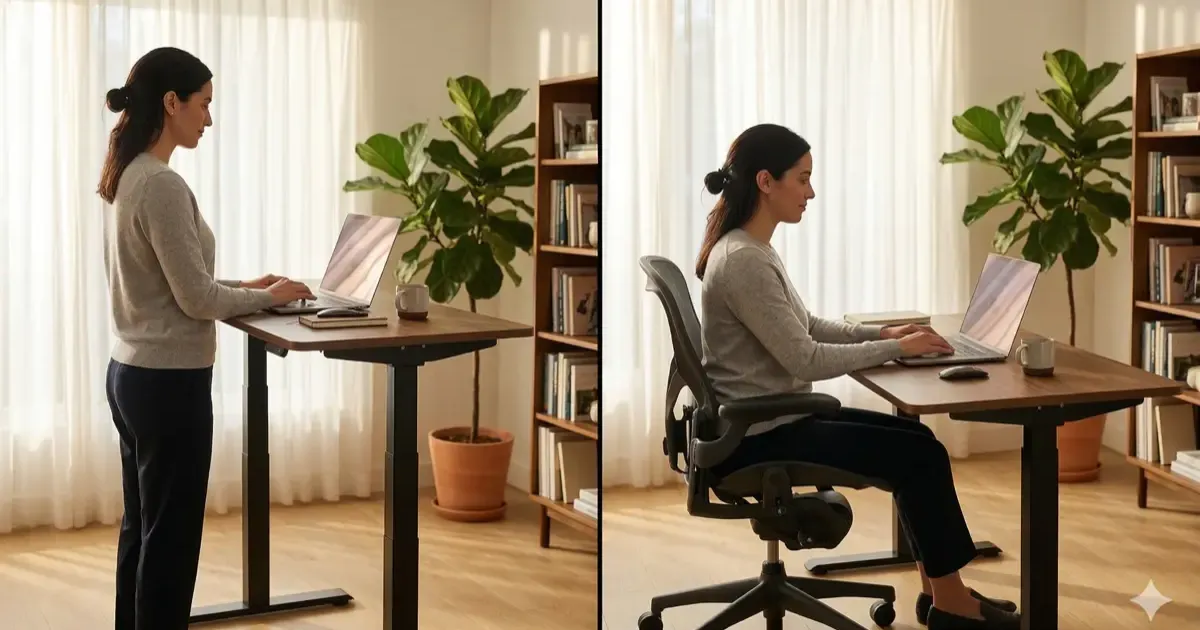
“Sitting is the new smoking.”
You’ve heard it from your health-obsessed coworker. You’ve seen it in LinkedIn posts from people selling standing desks. It’s been repeated so often that it feels like established medical fact.
It’s not. And the science on standing desks is a lot more complicated than the marketing would have you believe.
A 2018 paper in the American Journal of Public Health compared the actual risk data and found that smoking increases the risk of dying from any cause by approximately 180%, while excessive sitting raises it by about 25%. Smoking causes over 2,000 excess deaths per 100,000 people per year among the heaviest smokers. Sitting? About 190 excess deaths per 100,000 when comparing the highest and lowest sit times. That’s nearly a 10x difference in absolute risk.
Harvard evolutionary biologist Daniel Lieberman put it more bluntly in his book Exercised: “It’s unhelpful to equate sitting with smoking. Unlike smoking, it’s perfectly normal to sit.” His research with indigenous hunter-gatherers found that they sit as much as we do, nearly 10 hours a day. Sitting itself isn’t the enemy. What you do (or don’t do) around the sitting is what matters.
So where does that leave standing desks? Let’s look at what the research actually shows, the good, the bad, and the overhyped.
What the Science Actually Says
The largest study on this topic dropped in October 2024, published in the International Journal of Epidemiology. Researchers analyzed accelerometer data from 83,013 adults in the UK Biobank and tracked health outcomes over 6.9 years. During that period, 6,829 cardiovascular disease events and 2,042 orthostatic circulatory disease events occurred.
The findings challenged standing desk evangelists: standing more did not reduce cardiovascular disease risk. Worse, prolonged standing increased the risk of orthostatic circulatory diseases (think varicose veins and deep vein thrombosis) by 11% for every additional 30 minutes of standing beyond 2 hours per day.
Meanwhile, sitting more than 10 hours per day was associated with heightened risks of both cardiovascular and circulatory diseases. So excessive sitting is still bad, nobody disputes that. But simply replacing sitting with standing doesn’t fix the problem.
The takeaway from this study is clear: your body doesn’t care whether you’re static in a chair or static on your feet. It cares about movement.
The Real Benefits of Standing Desks (Backed by Evidence)
Standing desks aren’t useless. They do have genuine benefits, just not always the ones people think.
Reduced Sedentary Time (The Actual Win)
The biggest benefit isn’t standing itself, it’s that a sit-stand desk nudges you to change positions more often. A systematic review found that sit-stand desks reduced workplace sitting by an average of 38 minutes per workday. That position-switching is the real value.
When you have the option to stand, you’re also more likely to take short walks, stretch, and shift your weight. That incidental movement adds up.
Blood Sugar and Metabolic Benefits
A 2021 study published in BMC Public Health found that alternating between sitting and standing led to significant improvements in fasting triglycerides and insulin resistance over 24 weeks. For office workers at risk of metabolic syndrome, this is meaningful.
The mechanism makes sense: standing activates more muscle groups than sitting, which helps your body process glucose. This doesn’t mean standing cures diabetes, but it can be one piece of a healthier work routine.
Mood and Energy
Seven studies in a 2025 scoping review found that standing desk interventions improved mental health outcomes including anxiety, mood, stress, and general feelings of well-being among university students. If you’ve ever noticed feeling more alert after getting up from your desk, there’s data backing that up.
Some Evidence for Back Pain Relief
This one’s complicated. A 2017 systematic review and meta-analysis found that sit-stand workstations may reduce low back discomfort. But a separate meta-analysis found that “objectively measured prolonged standing postures during desk work did not induce significantly less perceived low back pain compared to seated postures.”
Translation: alternating between sitting and standing can help with back discomfort. Just standing all day won’t. If you have chronic back pain, a sit-stand desk might help, but it’s not a guaranteed fix. A good ergonomic chair matters just as much, if not more.
The Overhyped Claims
Here’s where the standing desk industry’s marketing outpaces the science.
“Standing Desks Help You Lose Weight”
This is technically true in the same way that breathing faster burns more calories, the difference is negligible. Standing burns roughly 8-15 extra calories per hour compared to sitting. Over a full workday, that’s 80-120 extra calories. That’s one banana. One.
A 2015 University of Iowa study found that standing desk users burned only 87 extra calories per day, and a good chunk of that came from walking an average of 6 extra minutes (not from standing itself). If weight loss is your goal, a 15-minute walk after lunch will do more than standing all afternoon.
“Standing Desks Fix Your Posture”
Standing doesn’t automatically mean good posture. Plenty of people stand with rounded shoulders, a forward head position, and locked knees. A 2024 study on postural changes found that standing desk use can improve craniovertebral angle, but only when combined with awareness of posture.
Bad posture while standing may actually be worse than bad posture while sitting, because standing puts more load on your spine and joints. Without a conscious effort to stand properly, you’re just trading one form of slouching for another.
“Standing Desks Boost Productivity”
The evidence here is all over the place. Four studies found no effect on productivity, three reported improvements, and one found mixed results. A frequently cited call center study claimed standing desk users were 45% more productive, but that study was funded by a standing desk manufacturer and involved call center work, which isn’t representative of most office jobs.
A more balanced reading of the literature: standing desks don’t hurt productivity, and they may help with simpler tasks. For deep focus work, most people still prefer sitting. One study even found that using a standing workstation “degraded attention and executive function,” though the majority of studies show no significant difference either way.
Don’t buy a standing desk expecting it to make you more productive. Buy it for the health benefits and consider any productivity gains a bonus.
“Standing Desks Reduce Heart Disease Risk”
This was the big one, and it took a hit in 2024. The UK Biobank study of 83,013 adults found that standing more compared with sitting did not reduce cardiovascular disease risk. The researchers were blunt: simply swapping sitting for standing is not a solution for heart health.
What does reduce cardiovascular risk? Regular moderate exercise. Even 20-30 minutes of walking per day dramatically outperforms any amount of standing.
Who Should Get a Standing Desk
A standing desk makes sense if you:
- Sit more than 8 hours a day and struggle to take regular breaks. The desk itself becomes a break trigger.
- Have mild lower back discomfort from prolonged sitting. Alternating positions can relieve pressure on your lumbar spine.
- Already exercise regularly and want to add more low-level activity to your day. A standing desk complements an active lifestyle, it doesn’t replace one.
- Work from home and have full control over your setup. In an office, you might be stuck with whatever desk IT provides.
- Do a mix of tasks, calls, emails, quick reviews, where you can stand for lighter work and sit for deep focus.
If you’re in the market, check out our roundup of the best standing desks under $600 for specific recommendations. Popular options include desks from Uplift Desk, Flexispot, and Autonomous.
Who Should NOT Get a Standing Desk
Standing desks aren’t for everyone. Skip it if you:
- Have existing joint problems in your knees, hips, or ankles. Standing loads these joints more than sitting, and prolonged standing can aggravate conditions like plantar fasciitis.
- Are pregnant (third trimester especially). Prolonged standing during pregnancy is associated with increased risk of preterm birth and low birth weight, according to multiple occupational health studies.
- Think it will replace exercise. If you buy a standing desk and then skip the gym because you “stood all day,” you’ve made your health worse, not better.
- Have varicose veins or circulatory issues. The 2024 UK Biobank study found a direct link between prolonged standing and increased orthostatic circulatory disease risk. Standing more is the last thing you want.
- Can’t afford one right now. A $400 standing desk is not going to transform your health if you’re not also walking, stretching, and exercising. Spend that money on a good pair of running shoes and a quality office chair instead.
How to Transition: The 30/30 Rule
If you do get a standing desk, don’t start by standing all day. You’ll end up with sore feet, aching knees, and a desk you never raise again.
The best approach is the 30/30 rule: stand for 30 minutes, sit for 30 minutes, repeat. Here’s a practical 4-week transition:
Week 1: Stand for 15-20 minutes, twice a day. That’s it. Get used to the position.
Week 2: Stand for 30 minutes, twice a day. Start noticing which tasks feel natural while standing (calls, emails) versus sitting (writing, coding).
Week 3: Aim for 30 minutes standing, 30 minutes sitting, alternating throughout the day. Total standing time: about 3-4 hours.
Week 4: Find your rhythm. Most people settle on 2-4 hours of standing per day, broken into 30-45 minute chunks.
A few things that make the transition easier:
- Anti-fatigue mat. Standing on a hard floor for 30+ minutes gets uncomfortable fast. A good mat ($30-60) makes a noticeable difference.
- Supportive footwear. Standing barefoot or in flat shoes puts extra strain on your feet and lower back. Wear shoes with arch support, or invest in insoles.
- A footrest for sitting periods. When you’re in the chair, a quality footrest takes pressure off your lower back and improves circulation in your legs.
- Set a timer. You’ll forget to switch positions. Use your phone or a desktop app to remind you every 30 minutes.
Cost Comparison: What Are You Actually Paying For?
Here’s a realistic breakdown of what each setup costs:
| Setup | Cost Range | Lifespan | Annual Cost |
|---|---|---|---|
| Budget office chair | $100-200 | 2-3 years | $50-80/yr |
| Quality ergonomic chair | $400-700 | 7-12 years | $40-80/yr |
| Manual standing desk converter | $150-300 | 3-5 years | $40-80/yr |
| Electric sit-stand desk | $400-600 | 10+ years | $40-60/yr |
| Premium sit-stand desk | $700-1,500 | 10-15 years | $60-100/yr |
The math actually favors a sit-stand desk long-term. A $500 electric standing desk that lasts 10 years costs you $50 per year. Pair it with a solid chair and you’re set for a decade. Our desk upgrade guide breaks down the full cost of building a proper home office setup.
If budget is tight, a desk converter ($150-300) on top of your existing desk works. It’s not ideal ergonomically, the monitor and keyboard are at fixed distances, but it gets you the sit-stand functionality for less.
The Honest Take
After digging through dozens of studies, here’s what I’ve landed on: standing desks are a solid investment for most office workers, but they’re not the health revolution the marketing claims.
The real benefit isn’t standing. It’s that a sit-stand desk forces you to change positions throughout the day. That position-switching, combined with regular walks and actual exercise, is what moves the needle on your health.
If someone tells you “sitting is the new smoking,” feel free to point out that the actual mortality data disagrees by a factor of ten. If someone tells you their standing desk fixed their back pain, changed their life, and cured their existential dread, they probably also started exercising and sleeping better around the same time.
Buy a standing desk because it gives you options. Don’t buy it expecting miracles. And whatever you do, don’t stand in one position for 8 hours thinking you’ve outsmarted cardiovascular disease. You haven’t. You’ve just traded one form of being sedentary for another, with the added bonus of sore feet.
Get up. Sit down. Walk around. Repeat. That’s the entire secret.
Related Articles
Desk Upgrade Guide: Build Your Perfect Home Office
The complete home office desk upgrade guide, standing desks, ergonomic chairs, monitor arms, and cable management for a productive workspace.

Secretlab Titan Evo vs Herman Miller Aeron (2026)
Secretlab Titan Evo vs Herman Miller Aeron compared head-to-head for WFH. Build quality, ergonomics, 8-hour comfort, warranty, and value tested in both.
7 Best Under-Desk Footrests for Posture & Ergonomics
Struggling with leg fatigue or posture? We compared 7 top under-desk footrests from $18 to $143. Find the best rocking, tilting, and memory foam picks for 2026.