
Alcohol, Drugs, and the Corporate Ladder: The Hidden Costs
Explore the relationship between substance use and corporate ambition. Learn to recognize unhealthy coping mechanisms and protect your mental health.

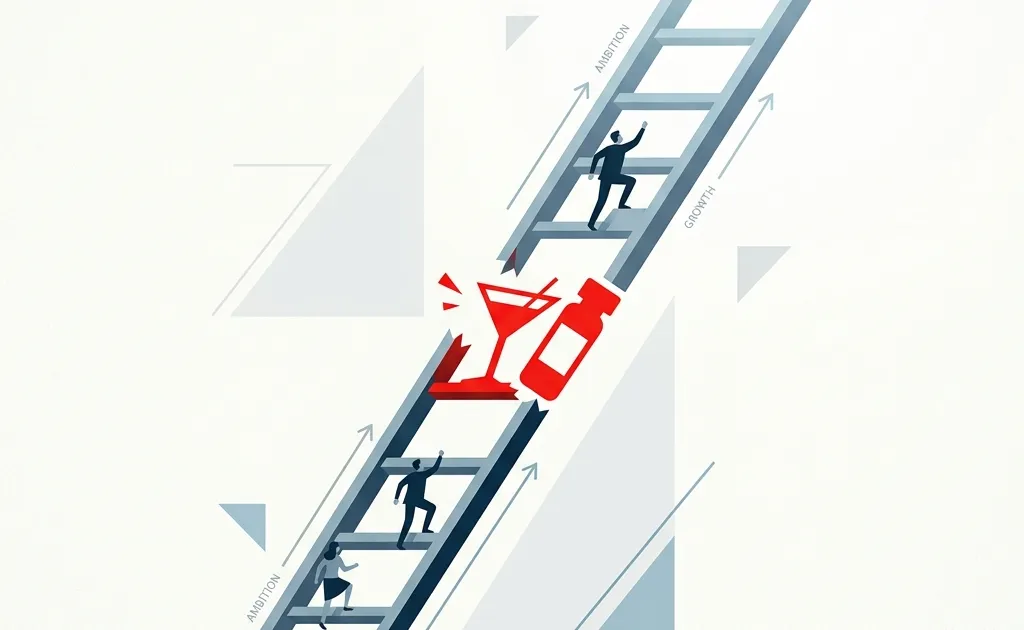
It is Thursday evening, and the weekly team happy hour is in full swing. The fluorescent lights of the office have been traded for the dim, sophisticated ambiance of a nearby upscale bar. Drinks are flowing, laughter is echoing, and the unspoken rule of corporate life is playing out exactly as expected: if you want to be seen as a team player, if you want to be considered for that next promotion, you need to be here, and you need to keep up.
This scenario is so deeply ingrained in modern professional life that we rarely pause to question it. The “work hard, play hard” mantra has become a foundational pillar of corporate culture, particularly in high-stress industries like finance, law, tech, and consulting. But beneath the veneer of camaraderie and networking lies a complex, often perilous relationship between ambition, substance use, and the climb up the corporate ladder.
Want a structured roadmap? Check out our comprehensive Guide to Learning AI in 2026 with step-by-step milestones, free courses, and career advice.
In our relentless pursuit of success, we have inadvertently normalized a culture where alcohol and, increasingly, other drugs are not just recreational indulgences, but strategic tools for survival, networking, and performance. This extensive exploration will pull back the curtain on this hidden aspect of corporate life. We will examine how substances are used to lubricate the gears of ambition, the insidious toll this takes on mental and physical health, and the ultimate, often invisible, impact it has on the very career trajectory it was supposed to enhance.
The Lubricant of Success: The Normalization of Alcohol
Alcohol is the undisputed king of corporate social currency. From the moment you enter the professional world, the message is clear: deals are closed over martinis, promotions are celebrated with champagne, and team solidarity is forged through Friday night beers.
The Networking Imperative
Networking is crucial for career advancement, and networking is almost entirely synonymous with drinking. Whether it is an industry conference, a client dinner, or a department off-site, alcohol is the central pivot around which social interactions revolve. It is positioned as the great equalizer, a social lubricant that dissolves professional boundaries and allows colleagues and clients to bond on a “personal” level.
However, this creates a subtle but profound pressure. If you do not drink, or if you choose to leave early, you are often perceived as aloof, uncommitted, or simply “not a culture fit.” The fear of missing out (FOMO) is not just a social anxiety; it is a professional liability. Employees force themselves to attend these events, matching rounds with their superiors, driven by the anxiety that absence equates to invisibility when promotion cycles roll around.
The “Work Hard, Play Hard” Trap
The “work hard, play hard” ethos is deeply problematic because it frames heavy drinking not as a vice, but as a reward for extreme dedication. It romanticizes burnout. The narrative suggests that if you are grinding through 80-hour workweeks, you have earned the right to completely disconnect on the weekends, often through binge drinking.
This cycle creates a volatile pendulum swing. During the week, professionals operate in a state of high anxiety, hyper-focus, and immense pressure. When the weekend arrives, alcohol becomes the blunt instrument used to forcibly shut down the stress response. This is not genuine relaxation; it is chemical sedation. And when Monday morning arrives, the resulting physical and emotional hangover only exacerbates the stress of the new workweek, creating a self-perpetuating cycle of exhaustion and self-medication.
The Productivity Paradox: Stimulants and the Quest for the Edge
While alcohol is the accepted drug for winding down and networking, the corporate ladder has a dark, parallel track dedicated to winding up. In hyper-competitive environments, where the volume of work consistently outpaces the hours in a day, employees increasingly turn to chemical assistance to maintain superhuman levels of productivity.
The Caffeine Baseline
It starts innocuously enough with caffeine. Coffee culture is fetishized in the corporate world. We brag about our triple-shot espressos and our inability to function before our morning brew. But for many professionals, caffeine consumption crosses the line from a morning ritual into a constant, desperate IV drip required to battle chronic sleep deprivation.
When you are routinely working past midnight and expected back at your desk by 8:00 AM, the natural human circadian rhythm breaks down. Caffeine masks the exhaustion, allowing employees to push past their physical limits. But this borrowed energy comes with a high interest rate, leading to adrenal fatigue, chronic anxiety, and inevitable crashes.
The Rise of Prescription Stimulants
More concerning is the rising misuse of prescription stimulants like Adderall, Ritalin, and Modafinil among professionals without a legitimate medical diagnosis. Originally prescribed for ADHD or narcolepsy, these drugs have become the performance-enhancing substances of the corporate world.
In environments where output is the only metric that matters, the allure of a pill that guarantees twelve hours of unbroken, laser-sharp focus is immense. Young professionals, often recent graduates who normalized “study drugs” during university, bring these habits into the workplace. They use stimulants to power through massive data models, write complex code on zero sleep, or prepare exhaustively for high-stakes presentations.
The use of these drugs creates an artificial baseline for productivity. When an employee is consistently producing superhuman output fueled by amphetamines, it raises the bar for everyone else. This creates an unspoken arms race of productivity, where those who choose not to chemically enhance their performance feel chronically behind, pushing even more people toward substance use to simply survive the expectations.
The Coping Mechanism: Self-Medicating the Stress Epidemic
Beyond networking and performance, the most pervasive use of substances in the corporate world is fundamentally an attempt at self-medication. The modern job ladder is steep, slippery, and built on a foundation of chronic stress.
The Burden of Responsibility
As you climb the ladder, the responsibilities compound. You are no longer just managing your own output; you are managing teams, budgets, and the expectations of demanding stakeholders. The psychological weight of this responsibility can be crushing. Imposter syndrome, fear of failure, and constant anxiety become daily companions.
For many, a glass of wine (or three) at the end of the day becomes the primary coping mechanism for this stress. It is a quick, accessible, and socially acceptable way to numb the anxiety and transition from “work mode” to “home mode.” However, relying on a central nervous system depressant to manage stress is fundamentally flawed. Alcohol actively disrupts REM sleep, ensuring that you wake up the next morning feeling less rested and more anxious, requiring more energy (and perhaps more caffeine or stimulants) to face the day.
The Isolation of Leadership
The higher you climb, the lonelier it gets. Leadership positions require a certain level of emotional distance from your team. You cannot vent your anxieties to the people you manage, and admitting vulnerability to your superiors is often viewed as weakness. This profound isolation can drive executives toward covert substance use to manage the pressure that they feel unable to articulate or share with anyone else.
The Hidden Costs: How Substances Erode Career Trajectories
The tragic irony of relying on alcohol and drugs to survive the corporate ladder is that they almost invariably end up sabotaging the very career they were meant to support. The erosion is rarely sudden; it is slow, insidious, and devastating.
The Degradation of Cognitive Function
Substance abuse, even at “functional” levels, fundamentally degrades cognitive performance over time. Chronic lack of quality sleep (exacerbated by alcohol and stimulants) impairs memory, reduces emotional regulation, and destroys creative problem-solving abilities.
You might still be able to grind out spreadsheets, but you lose the capacity for the deep, strategic thinking that is required for senior leadership roles. You become reactive rather than proactive. You start making careless errors, your decision-making becomes clouded, and your overall efficiency plummets.
The Damage to Professional Reputation
The corporate world is surprisingly small, and reputations are fragile. While heavy drinking might be normalized in certain settings, losing control is absolutely not. The colleague who becomes consistently aggressive, sloppy, or inappropriate at company events quickly becomes a liability.
Furthermore, the behavioral changes associated with substance use (mood swings, unreliability, missed deadlines, and chronic absenteeism) are impossible to hide indefinitely. Once your reliability is questioned, your upward mobility is effectively halted. Managers will not promote someone they cannot trust to represent the company or manage a team effectively.
The Physical and Mental Health Toll
Ultimately, the most significant cost is paid by the individual. The chronic cycle of stress, self-medication, sleep deprivation, and artificial stimulation destroys physical and mental health. Severe anxiety, clinical depression, cardiovascular issues, and liver disease are the grim realities waiting at the end of this path. A prestigious title and a massive salary are utterly meaningless if you do not have the physical or mental capacity to enjoy your life.
Breaking the Cycle: A New Blueprint for Professional Success
Recognizing the pervasive nature of substance use in corporate culture is the first step toward reclaiming your health and your career trajectory. If you feel that your relationship with alcohol or other substances has become intertwined with your professional survival, it is imperative to take action.
1. Audit Your Habits
Start by conducting a brutally honest audit of your consumption. Track every drink, every pill, and every excessive cup of coffee for a month. More importantly, track the why. Are you drinking because you genuinely want a cocktail, or because you feel anxious around your boss? Are you taking a stimulant because you are medically required to, or because you procrastinated and need to pull an all-nighter? Identifying the triggers is essential for finding healthier alternatives.
2. Decouple Networking from Drinking
You do not need to drink to build a strong professional network. It is entirely possible to navigate corporate social events sober. Order a club soda with lime; most people will assume it is a gin and tonic and will not ask questions. If you are questioned, a simple “I have an early start tomorrow” or “I am cutting back for my health” is a complete and respectable answer.
Better yet, take the initiative to organize networking events that do not revolve around alcohol. Suggest breakfast meetings, coffee catch-ups, or activity-based team building exercises. You will likely find that many of your colleagues are quietly relieved to have an alternative to the bar scene.
3. Redefine Productivity
We need to reject the narrative that extreme, chemical-fueled hours equate to valuable work. True productivity is sustainable. Focus on ruthless prioritization, deep work techniques, and protecting your energy. If you are consistently unable to complete your workload within reasonable hours without chemical assistance, the problem is not your focus; the problem is the workload or the system itself. You must learn to set boundaries, improve your work life balance, and push back against unreasonable demands, rather than medicating yourself to meet them.
4. Develop Healthy Coping Mechanisms
Stress is inevitable in any ambitious career, but how you manage it is entirely up to you. Replace the evening glass of wine with sustainable stress-reduction techniques. This might include rigorous exercise, meditation, journaling, or simply dedicating time to a hobby completely unrelated to your industry. You need a reliable mechanism to process the stress of the day that does not involve altering your brain chemistry.
5. Seek Professional Support
If you realize that you are unable to control your substance use, or if it is significantly impacting your life and career, it is critical to seek professional help. This is not a sign of weakness; it is a profound act of self-preservation. Many companies offer Employee Assistance Programs (EAPs) that provide confidential counseling and resources. Therapists and specialized counselors, or free resources like the SAMHSA National Helpline, can help you develop the tools to manage stress, address underlying anxieties, and navigate the corporate world without relying on substances.
The Ultimate Metric of Success
The corporate ladder is an intoxicating structure. It promises power, prestige, and financial security. But it is vital to remember that a career is a marathon, not a sprint. Using alcohol and drugs to artificially accelerate your pace or numb the pain of the climb is a strategy that inevitably leads to a crash.
True professional success should not require the sacrifice of your physical and mental well-being. It is entirely possible to be highly ambitious, incredibly successful, and completely sober. In fact, clarity of mind, emotional resilience, and physical vitality are the true, sustainable competitive advantages in the modern business world. By consciously rejecting the normalization of substance use in corporate culture, you protect not only your career trajectory but, more importantly, the quality of the life you are working so hard to build.
For ethical technology discussions, read our analysis on AI in the adult industry ethics and impact.
Related Articles

Feeling Stuck in Corporate Life? How to Break Free
Are you feeling trapped in a mundane corporate job? Discover actionable steps to reignite your passion, pivot your career, and find fulfillment outside work.

The Ultimate Guide to Achieving Real Work Life Balance
Struggling to disconnect after hours? Learn actionable strategies to achieve work life balance, set boundaries, and reclaim your personal time.

Is It Ever Too Late to Learn Something New?
Wondering if you are too old to learn coding, a new language, or an instrument? We explore the science of neuroplasticity and why age is not a barrier.