
Camera Lens Types Explained: A Beginner Guide (2026)
Confused by focal lengths, primes, zooms, and apertures? Learn how camera lens types work and choose the best lens for your photography style in 2026.

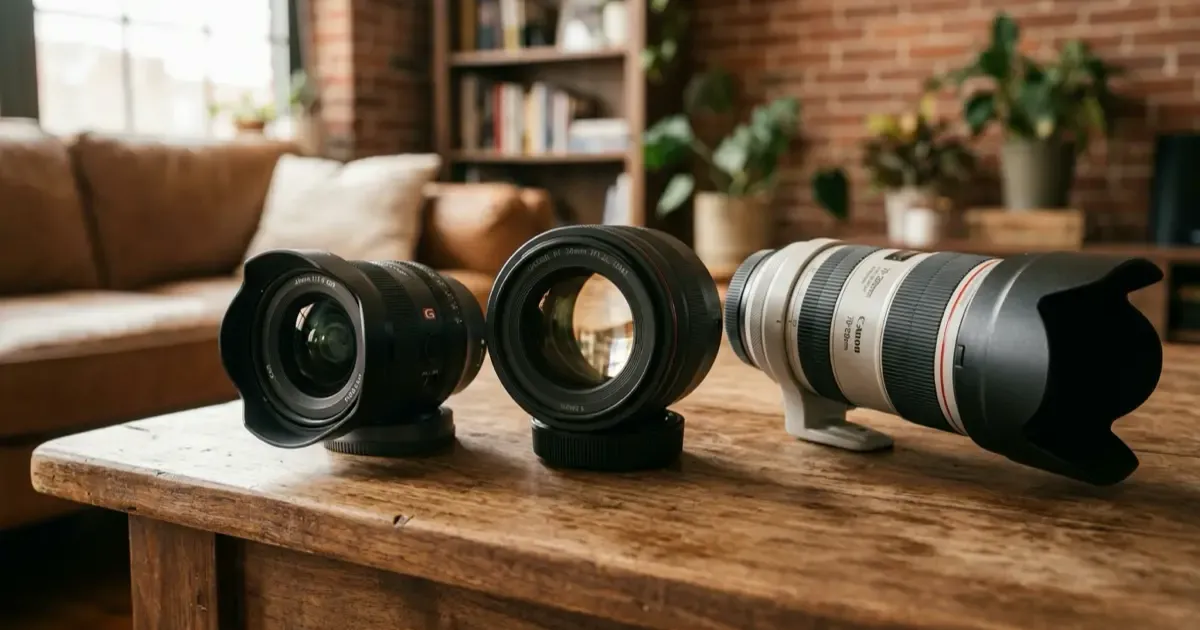
Buying your first dedicated mirrorless or DSLR camera is an exciting milestone, but it usually comes with a rude awakening: the basic 18-55mm or 16-50mm kit lens included in the box often produces images that look surprisingly similar to a high-end smartphone.
The secret to unlocking the cinematic depth of field, razor-sharp detail, and stunning low-light capabilities you bought a camera for is not upgrading the camera body. It is choosing the right glass.
As we explored in our breakdown of why a great lens beats a camera body, optical glass determines over 70% of your final image quality. Yet, walking into a camera shop or browsing online stores presents a bewildering alphabet soup of numbers, acronyms, and focal lengths.
Mastering photography basics? Check out our Beginner Photography Mistakes Guide and our complete Photography Gear & Buying Guide to build a versatile kit without overspending.
Quick Picks: Best Lens Types for Every Photography Style
In a hurry? Here is the rapid guide to which lens category suits your creative goals:
- Best First Upgrade for Beginners: 50mm f/1.8 Prime (“Nifty Fifty”) (~$120-$220) – Delivers rich background blur (bokeh), stellar sharpness, and effortless low-light shooting.
- Best All-in-One Everyday & Street Lens: 35mm f/1.8 Prime or 24-70mm f/2.8 Zoom – Matches natural human vision and captures versatile environmental perspectives.
- Best for Landscapes & Architecture: 16-35mm Ultra-Wide Zoom – Expands the field of view to capture grand vistas, interiors, and towering skylines.
- Best for Portraits & Isolating Subjects: 85mm f/1.8 Prime – Flattering facial compression with dreamy, distraction-free background separation.
- Best for Wildlife & Sports: 70-200mm or 100-400mm Telephoto Zoom – Reaches distant action and pulls faraway subjects close with tight perspective compression.
Camera Lens Categories: Comparison Matrix
| Lens Type | Typical Focal Length | Ideal Aperture | Primary Genre | Standout Advantage |
|---|---|---|---|---|
| Ultra-Wide Angle | 12mm – 24mm | f/2.8 – f/4.0 | Landscapes, Architecture, Real Estate | Expansive dramatic perspective |
| Wide Angle | 24mm – 35mm | f/1.4 – f/2.8 | Street, Travel, Environmental Portraits | Natural context with minimal distortion |
| Standard Prime (“Normal”) | 45mm – 55mm | f/1.4 – f/1.8 | Everyday, Street, Casual Portraits | Mimics human eye, razor-sharp |
| Portrait Telephoto | 85mm – 135mm | f/1.4 – f/2.0 | Studio Portraits, Weddings, Events | Flattering facial geometry & creamy bokeh |
| Telephoto Zoom | 70mm – 200mm | f/2.8 – f/4.0 | Sports, Action, Distant Portraits | Powerful reach & background compression |
| Super-Telephoto | 300mm – 600mm | f/4.0 – f/6.3 | Wildlife, Birds, Stadium Sports | Extreme magnification for faraway subjects |
| Macro Lens | 60mm – 105mm | f/2.8 | Close-Up Details, Insects, Products | 1:1 true life-size magnification |
1. Prime Lenses vs. Zoom Lenses: The Core Dilemma
Before examining focal lengths, every photographer must understand the fundamental trade-off between prime lenses and zoom lenses.
Prime vs. Zoom at a Glance:
- Prime Lenses (Fixed Focal Length, e.g., 50mm): Wider maximum aperture (f/1.4–f/1.8), superior optical sharpness, lighter build, and creamy background blur (bokeh). You zoom with your feet.
- Zoom Lenses (Variable Focal Length, e.g., 24-70mm): Instant framing versatility from wide to telephoto without swapping glass, but heavier, more expensive for fast apertures, and slightly narrower maximum light intake (f/2.8–f/5.6).
Prime Lenses (Fixed Focal Length)
A prime lens has a fixed focal length. A 50mm prime stays at 50mm; you cannot twist a barrel to zoom in. If you want to get closer to your subject, you must physically walk forward.
- Why photographers love primes: Because prime lenses do not need dozens of moving glass elements to shift focal lengths, optical engineers can optimize them for pure image quality. They are sharper, lighter, and feature much wider maximum apertures (f/1.4, f/1.8, or f/2.0).
- The Creative Advantage: Shooting with a prime lens teaches composition faster than a zoom. Instead of standing in one spot zooming in and out, a prime forces you to explore angles, heights, and physical proximity to your subject. If you are on a tight budget, explore cheap manual prime lenses for beginners from brands like TTArtisan and 7Artisans for sub-$100 creative glass.
Zoom Lenses (Variable Focal Length)
A zoom lens covers a designated focal range, such as 24-70mm or 70-200mm. By rotating the zoom ring, you change the angle of view on the fly.
- Why zooms dominate professional events: During a wedding, press conference, or fast-moving family event, you rarely have time to swap lenses or walk 15 feet closer. A quality zoom lens lets you capture an environmental wide shot and a tight emotional portrait within two seconds.
- The Trade-off: High-end zooms that maintain a constant fast aperture (such as 24-70mm f/2.8) are heavy, physically large, and cost upwards of $1,000 to $2,200. Budget kit zooms (f/3.5-5.6) compromise on low-light capability and sharpness at the telephoto end.
2. Understanding Focal Lengths: What the Millimetres Mean
The focal length number (measured in millimetres) tells you two crucial things: how wide your field of view is and how much perspective compression you receive.
Here is how the standard focal length spectrum breaks down across real-world shooting scenarios:
Ultra-Wide (12mm – 24mm): Dramatic Space & Scale
Ultra-wide lenses capture an immense field of view (often exceeding 90 to 110 degrees). They exaggerate the distance between foreground objects and the background, making rooms feel enormous and landscape horizons feel infinite.
- Best Suited For: Milky Way astrophotography, architectural interiors, and sweeping mountain ranges.
- Watch Out For: Edge stretching and distortion. Placing people near the outer edges of a 16mm frame will unpleasantly warp their facial features and limbs.
Standard Wide (28mm – 35mm): The Documentary Storyteller
A 35mm lens is widely regarded by photojournalists and street photographers as the holy grail of documentary focal lengths. It provides enough width to establish environmental context (showing the room, street, or cafe) without warping human proportions.
- Best Suited For: Travel storytelling, street photography, lifestyle blogging, and casual group shots.
- Why It Works: It feels intimate. The viewer feels as if they are standing right next to the subject rather than watching from across the street.
The “Normal” Standard (45mm – 55mm): True Human Perspective
A 50mm lens on a full-frame sensor closely replicates how human central vision perceives scale and spatial relationships. Objects do not appear exaggeratedly stretched or compressed; what you see with your naked eye is precisely how the camera renders the frame.
- The Iconic “Nifty Fifty”: Every major camera manufacturer (Sony, Canon, Nikon, Fujifilm, Panasonic) offers an affordable 50mm f/1.8 prime lens. It is universally the most cost-effective upgrade in all of digital photography, offering breathtaking subject isolation for roughly $150.
- Best Suited For: Everyday walkaround photography, food photography, pet portraits, and general creative work.
The Portrait Telephoto (85mm – 135mm): Flattering Subject Isolation
When you shoot a portrait at 85mm, optical compression subtly flattens facial features, making noses and foreheads appear naturally proportioned. Combined with a wide f/1.4 or f/1.8 aperture, an 85mm lens dissolves busy background clutter into smooth, painterly blur.
- Best Suited For: Headshots, editorial portraits, graduation photos, and weddings.
- Why It Works: You can stand 8 to 12 feet away from your subject, giving them comfortable personal space while filling the entire frame with their expression.
Telephoto & Super-Telephoto (200mm – 600mm): Distant Power
Telephoto lenses pull distant action directly into your viewfinder while intensely compressing background layers, making far-off mountains or city skylines appear huge directly behind your subject.
- Best Suited For: Birding, wildlife safaris, trackside motorsport, and field sports where physical access to the subject is impossible.
- Key Consideration: Telephoto lenses require fast shutter speeds or robust optical image stabilization (OIS) to avoid camera shake blur caused by their high magnification.
3. Sensor Size and the “Crop Factor” Multiplier
When choosing a lens, you must account for your camera sensor size. A 50mm lens behaves differently on a full-frame camera than on an APS-C or Micro Four Thirds camera.
As detailed in our Sensor Size Guide: MFT vs. APS-C vs. Full-Frame, smaller sensors crop into the center of the image circle projected by the lens:
| Lens Focal Length | Full-Frame Equivalent (1.0x) | APS-C Field of View (1.5x) | Micro Four Thirds Field of View (2.0x) |
|---|---|---|---|
| 24mm Wide | 24mm (Wide Angle) | ~36mm (Moderate Wide) | ~48mm (Standard Normal) |
| 35mm Moderate | 35mm (Moderate Wide) | ~52.5mm (Standard Normal) | ~70mm (Short Telephoto) |
| 50mm Standard | 50mm (Standard Normal) | ~75mm (Portrait Telephoto) | ~100mm (Medium Telephoto) |
| 85mm Portrait | 85mm (Portrait Telephoto) | ~127.5mm (Tight Telephoto) | ~170mm (Long Telephoto) |
- If you shoot APS-C (Sony a6700, Fujifilm X-T5, Nikon Z50 II): Multiply the focal length by 1.5x. If you want a classic 50mm normal field of view, you need a 33mm or 35mm lens.
- If you shoot Micro Four Thirds (OM System, Lumix G9 II): Multiply by 2.0x. A compact 25mm lens provides the exact field of view of a standard 50mm full-frame optic.
4. Specialized Lenses: Macro, Tilt-Shift, and Fisheye
Beyond standard primes and zooms, several specialized lens types serve unique commercial and artistic purposes:
1. Macro Lenses (True 1:1 Reproduction)
Standard lenses can rarely focus closer than 12 to 18 inches from an object. A dedicated macro lens features internal floating optical elements that focus mere inches from the front glass, reproducing miniature subjects at full life-size (1:1 magnification ratio) on the camera sensor.
- Best For: Jewelry, watch details, insect eyes, botanical textures, and miniature product photography.
- Bonus Utility: Most 90mm or 105mm f/2.8 macro lenses double as exceptionally sharp, distortion-free portrait lenses.
2. Tilt-Shift Lenses (Perspective Control)
Tilt-shift lenses allow photographers to physically tilt the optical axis and shift the front lens elements up, down, or sideways relative to the sensor.
- Shift Function: Eliminates keystoning when photographing tall skyscrapers from street level, keeping vertical building lines perfectly parallel without software perspective warping.
- Tilt Function: Controls the plane of focus using the Scheimpflug principle, allowing entire landscapes from 2 feet to infinity to stay sharp at f/2.8, or creating the iconic “miniature toy town” selective focus effect.
3. Fisheye Lenses (Curvilinear Ultra-Wide)
Fisheye lenses embrace extreme 180-degree hemispherical distortion rather than correcting straight lines.
- Best For: Extreme sports action (skateboarding, BMX), hemispherical astrophotography, and stylized music videos.
5. The Ideal 2-Lens Beginner Kit (Under $500 Total)
Instead of collecting five mediocre lenses that gather dust, most photographers achieve superior creative results by pairing two versatile optics:
The Ultimate 2-Lens Starter Setup:
- Lens 1: The Fast Prime (35mm or 50mm f/1.8): Low light, indoor gatherings, creamy portraits, and evening street scenes. Delivers outstanding optical sharpness and background blur for under $200.
- Lens 2: The Versatile Standard Zoom (18-50mm or 24-70mm): Travel, landscapes, hiking, and dynamic events where you cannot step closer or change lenses quickly.
- Lens 1: An Affordable Fast Prime (35mm f/1.8 or 50mm f/1.8): This is your creative powerhouse. It lives on your camera for indoor gatherings, moody evening street scenes, coffee shop dates, and dramatic portraits.
- Lens 2: A Versatile Standard Zoom (18-50mm f/2.8 or 24-70mm f/4): This is your utilitarian travel and day-trip workhorse. Use it when hiking, visiting historic cities, or covering events where framing speed matters more than extreme background blur.
Summary & Buying Checklist
When evaluating your next lens purchase, ask yourself three guiding questions:
- What is my biggest limitation right now? If your photos are grainy in low light, buy a f/1.8 fast prime. If you cannot get close enough to distant subjects, buy a 70-200mm telephoto zoom. If you cannot fit grand architecture into the frame, buy a wide-angle zoom.
- What sensor size am I shooting on? Always calculate the 1.5x or 2.0x crop factor before committing to a focal length.
- Will I actually carry it? A massive $2,000 f/2.8 zoom that stays at home in a closet captures zero photos. A compact $200 prime lens in your coat pocket captures memories every single day.
Invest in quality glass, master one focal length thoroughly before buying the next, and watch your photography transform.
Related Articles
- Why a Great Lens Beats a Pro Camera Body in 2026
- Cheap Manual Lenses for Beginners: 7Artisans & TTArtisan
- Sensor Size Guide: Micro Four Thirds vs. APS-C vs. Full-Frame
- Photography Gear & Buying Guide
- Beginner Photography Mistakes and How to Fix Them
- AI in Photography: The Complete 2026 Workflow Guide
Related Articles
Why a Great Lens Beats a Pro Camera Body in 2026
Is your camera holding you back, or is it your lens? Learn how a high-quality lens can save a mediocre camera body and why glass is the best investment.
Photography for Beginners: The Complete Guide (2026)
Your complete guide to photography, from choosing your first camera to taking better photos. Everything beginners need to start their photography journey.
Photography Buying Guide: Everything You Need to Start in 2026
The complete guide to buying your first camera in 2026. From budget options to the DSLR vs mirrorless debate, we cover everything without the gear-head jargon.