
Sensor Sizes: Full Frame vs. APS-C vs. Micro Four Thirds
Choosing the right camera sensor size is the most important decision for your photography workflow. Compare Full Frame, APS-C, and MFT to find your perfect fit.
In the world of modern photography, the most debated topic isn’t megapixels or brand loyalty, it’s sensor size. Whether you are a professional covering high-stakes events or a hobbyist looking to maximize your “stealth learning” time during a lunch break, the physical size of your camera’s sensor will dictate almost every aspect of your creative output.
Understanding the difference between Full Frame, APS-C, and Micro Four Thirds (MFT) is essential because it influences the “look” of your images, the weight of your bag, and the depth of your bank account. In this comprehensive guide, we will break down the technical realities of each format and help you decide which one aligns with your specific workflow.
Looking for the bigger picture? Check out our complete Photography Guide for Beginners for gear recommendations, camera fundamentals, and editing workflows.
What is Sensor Size and Why Does It Matter?
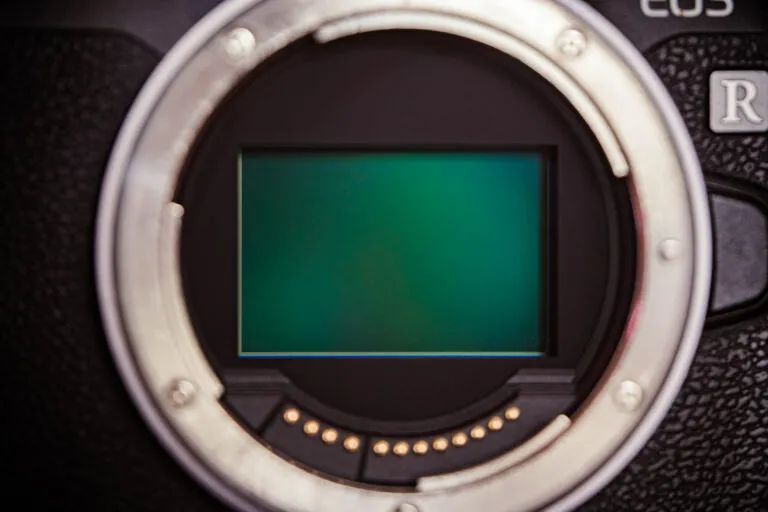
The sensor is the “digital film” of your camera. It is the silicon chip that captures light coming through the lens and converts it into electrical signals. While we often obsess over megapixels (the resolution), the physical dimensions of the sensor are arguably more important for image quality.
Think of a sensor as a bucket collecting rain (light). A larger bucket (Full Frame) can catch more rain in a shorter amount of time than a smaller bucket (MFT). This fundamental physical reality leads to several key differences:
- Low Light Performance: Larger sensors have larger individual pixels (photosites), which are more efficient at capturing light without generating digital noise.
- Depth of Field: Larger sensors make it easier to achieve that “blurry background” (bokeh) effect at any given focal length.
- Dynamic Range: Bigger sensors can usually capture more detail in the highlights and shadows of a high-contrast scene.
- System Size: The sensor size dictates the size of the lens. Lenses designed for larger sensors must project a larger circle of light, making them significantly heavier and more complex.
1. Full Frame: The Professional Standard
Dimensions: ~36mm x 24mm (Based on traditional 35mm film).
Full Frame is the benchmark against which all other sensors are measured. For decades, this was the exclusive domain of high-end DSLRs used by photojournalists and studio pros. Today, mirrorless technology has made Full Frame cameras more accessible, but the “pro” designation still sticks.
The Strengths
- Unrivaled Image Quality: When it comes to raw data, Full Frame is king. It offers the cleanest images at high ISO settings, making it the only choice for astro-photography, indoor events, and professional wedding photography.
- The “35mm Look”: Lenses behave exactly as they were traditionally intended. A 35mm lens is a wide-angle; an 85mm lens is a portrait lens. There is no mental math required for crop factors.
- Lens Selection: Most manufacturers (Sony, Canon, Nikon) prioritize their best engineering for their Full Frame lens lineups (the “G-Master” or “L-Series” glass).
The Trade-offs
- Weight and Bulk: While bodies like the Sony A7 series or Canon R6 are small, the lenses are not. A high-quality f/2.8 zoom lens for Full Frame is a heavy, metal-and-glass cylinder that will strain your neck after an hour.
- Cost: Not only are the bodies more expensive, but the total “cost of ownership” is higher. Filters are larger, tripods need to be sturdier, and lenses can easily cost $2,000 each.
2. APS-C: The Golden Middle
Dimensions: ~24mm x 16mm (Crop factor of 1.5x or 1.6x).
APS-C (Advanced Photo System type-C) is the most popular sensor size for enthusiasts and advanced beginners. It strikes a nearly perfect balance between image quality and portability. Most “entry-level” DSLRs and mid-range mirrorless cameras (like the Fujifilm X-series or Sony A6000 series) use this format.
The Strengths
- Versatility: APS-C cameras are small enough for “stealth” street photography but powerful enough for professional work. Many professionals use APS-C bodies as a “B-cam” or for lightweight travel.
- Reach (The Crop Factor Advantage): Because the sensor is smaller, it “crops” into the center of the lens’s image circle. A 200mm lens on APS-C behaves like a 300mm lens on Full Frame. This makes APS-C a favorite for wildlife and sports photographers who need extra reach without the massive cost of giant telephoto lenses.
- Fujifilm’s Ecosystem: Unlike other brands that treat APS-C as a “stepping stone” to Full Frame, Fujifilm has built an entire professional ecosystem around this sensor size, proving that you don’t need Full Frame to get world-class results.
The Trade-offs
- Low Light Gap: You will start to see noise at ISO 3200 or 6400 much sooner than you would on a Full Frame sensor.
- Depth of Field: It is harder to get that ultra-creamy background blur. An f/1.4 lens on APS-C looks more like an f/2.1 lens on Full Frame in terms of background separation.
3. Micro Four Thirds (MFT): The King of Portability
Dimensions: ~17mm x 13mm (Crop factor of 2.0x).
Developed by Olympus (now OM System) and Panasonic, MFT is a truly open standard. The sensor is roughly half the size of Full Frame. While some critics dismiss MFT as a “toy” format, it remains a powerhouse for specific professional niches.
The Strengths
- Size and Weight: This is where MFT wins. You can carry a camera and three professional-grade lenses in a small waist pack. For long-distance hikers, travel vloggers, and street photographers, this portability is life-changing.
- Deep Depth of Field: While this sounds like a negative, it’s a massive plus for landscape and macro photography. You can get more of your subject in focus at wider apertures, which allows you to keep your ISO lower.
- Computational Features: Because the sensor is small and light, MFT manufacturers have pioneered incredible tech like 100-megapixel high-res shot modes, Live ND filters, and the world’s best In-Body Image Stabilization (IBIS). You can often hand-hold a 2-second exposure on an MFT camera, something impossible on Full Frame.
The Trade-offs
- Low Light Limitations: This is the primary weakness. MFT sensors struggle in dark environments. If you primarily shoot night scenes or dimly lit receptions, MFT will be a struggle.
- Background Blur: If you want that “subject floating in a sea of blur” look, you have to work much harder and buy specialized, expensive f/1.2 lenses to achieve it.
Technical Comparison Table
| Feature | Full Frame | APS-C | Micro Four Thirds |
|---|---|---|---|
| Sensor Area | 864 $mm^2$ | ~370 $mm^2$ | 225 $mm^2$ |
| Crop Factor | 1.0x | 1.5x / 1.6x | 2.0x |
| Low Light | Excellent | Good | Moderate |
| DOF Control | Shallowest | Moderate | Deep |
| System Weight | Heavy | Moderate | Lightest |
| Best For | Studio, Wedding, Astro | Enthusiasts, Wildlife | Travel, Vlogging, Macro |
Which Sensor is Right for Your Workflow?
Choosing a sensor size shouldn’t be about what is “the best,” but rather what is the best for your specific lifestyle and creative goals.
The Professional / Event Photographer
If your paycheck depends on delivering clean images regardless of the lighting conditions, Full Frame is non-negotiable. The reliability and low-light headroom provided by a larger sensor are worth the extra weight and cost.
The Stealth Learner / Hobbyist
If you are trying to improve your skills while traveling or during your daily commute, APS-C is the sweet spot. It provides enough image quality to feel “professional,” but the system remains small enough that you’ll actually want to carry it with you every day. A Fujifilm X100VI or a Sony A6700 is the perfect tool for this workflow.
The Content Creator / World Traveler
If you are vlogging, hiking, or obsessed with macro photography (flowers, insects, tech parts), Micro Four Thirds is the champion. The incredible stabilization means you can leave the tripod at home, and the deep depth of field makes focusing much easier when you are filming yourself on the move.
The Future of Sensor Tech: Stacked and BSI
It is worth noting that sensor size isn’t the only factor anymore. Modern Back-Illuminated (BSI) and Stacked sensors are narrowing the gap. A modern APS-C sensor with BSI tech can often outperform a 5-year-old Full Frame sensor.
As we move further into 2026, the software (AI denosing, computational RAW processing) is becoming just as important as the hardware. We are reaching a point where the sensor size dictates your ergonomics more than your final image quality.
Conclusion: The Best Camera is the One You Have (and Can Carry)
The “Full Frame is better” argument is a technical truth that often leads to a practical failure. If you buy a heavy Full Frame kit but leave it in the closet because it’s too cumbersome to carry to work, it is a bad camera.
- Choose Full Frame if you need the absolute maximum technical quality and don’t mind the weight.
- Choose APS-C if you want a balanced, high-performance system that fits in a small messenger bag.
- Choose Micro Four Thirds if you value portability, stabilization, and vlogging features above all else.
Photography is about the moment, the light, and the composition. Your sensor size is simply the tool you use to capture that vision. Pick the one that fits your hand, fits your bag, and, most importantly, gets you excited to go out and shoot.
Related Articles
Camera Lens Types Explained: A Beginner Guide (2026)
Confused by focal lengths, primes, zooms, and apertures? Learn how camera lens types work and choose the best lens for your photography style in 2026.
OM SYSTEM PEN First Look: Retro Charm Meets Modern Power
First look at the OM SYSTEM PEN, announced September 2026: 20.4MP sensor, built-in OLED EVF, IPX1 weather sealing, creative dial, $999, ships October.

Gen Z Retro Tech Trend: Vintage Cameras & Wired Earphones
Explore the growing trend of Gen Z embracing vintage digital cameras and wired earphones. Understand the cultural shift away from algorithmic perfection.