
Gemini 4 Argon: Architecture, Benchmarks, and Complete Guide
Google DeepMind unveils Gemini 4 Argon, its frontier reasoning model. Explore real benchmarks, coding refactors, pricing, Antigravity integration, and specs.

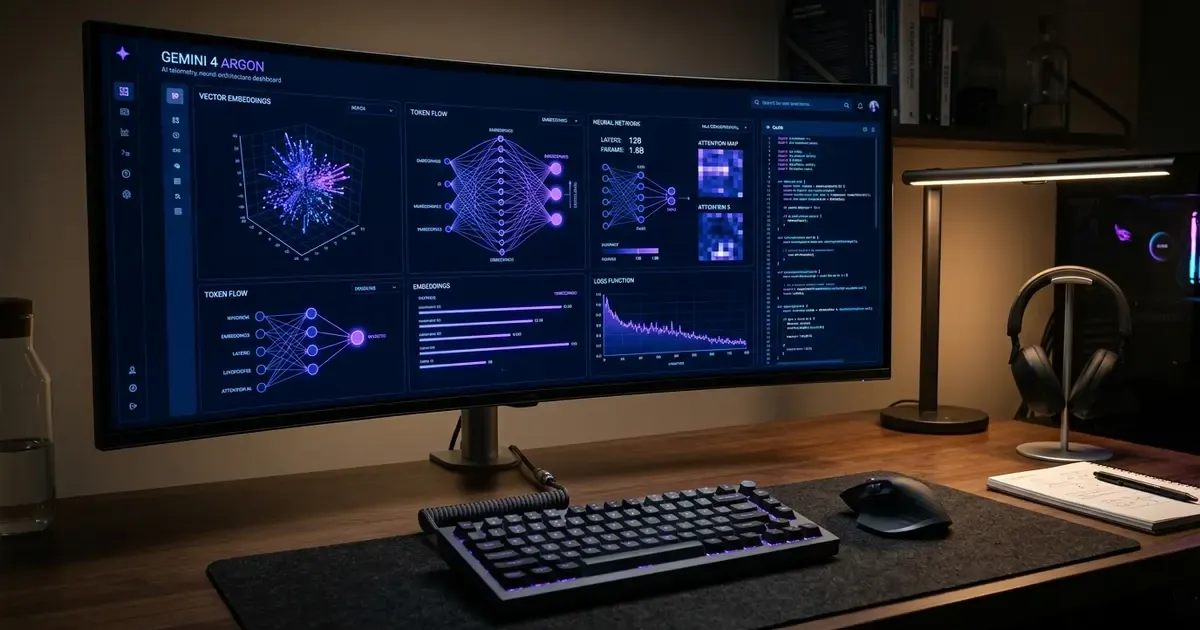
Google DeepMind announced Gemini 4 Argon on September 30, 2026, first for trusted testers in its Fairwind Program, and made it generally available on October 13. It is the newest frontier model and the opening chapter of the Gemini 4 family. Announced by Koray Kavukcuoglu, Chief AI Architect at Google and Senior Vice President at Google DeepMind, Argon represents a strategic pivot in Google’s artificial intelligence roadmap. While models like Gemini 3.8 Flash conquered high-throughput real-time voice, mobile apps, and lightweight text processing, Gemini 4 Argon is engineered for the deep end of technical work: refactoring multi-million-line codebases, proving complex mathematical theorems, accelerating quantum chemistry simulations, and executing autonomous multi-agent engineering workflows.
At launch Argon led the Vals Index, an independent composite benchmark covering software engineering, corporate finance, and legal work, with a score of 68.9% against 67.0% for Claude Opus 5.5 and 63.1% for GPT-6 Astra, according to Google’s own comparison. The lead did not last: on the Vals leaderboard dated October 19, 2026, Claude Sonnet 5.5 sits first at 70.85% with Argon second at 69.24%. Google also reports a new state of the art of 77.9% on DeepSWE v1.1 and 91.7% on LVBench for long-video understanding. Alongside these results, Google introduced an aggressive pricing structure with an introductory rate of $2.00 per million input tokens and $10.00 per million output tokens, paired with a massive 95% discount on cached prompt inputs.
Here is an architectural breakdown, real-world benchmark evaluation, pricing review, and developer guide for Gemini 4 Argon.
Quick Picks: Gemini 4 Argon vs Leading Frontier Models
To help you decide whether Gemini 4 Argon fits your production stack or daily workflow, here is how its core telemetry compares to the market leaders tracked on our live AI Leaderboard:
| Metric / Model | Gemini 4 Argon | Claude Sonnet 5.5 | GPT-6 Astra | Gemini 3.8 Flash |
|---|---|---|---|---|
| Primary Creator | Google DeepMind | Anthropic | OpenAI | Google DeepMind |
| Vals Index (Oct 19, 2026) | 69.24%, #2 | 70.85%, #1 | 63.1% at Argon launch | not listed |
| Intelligence Index | 53 / 100 | 56 / 100 | 53 / 100 | 41 / 100 |
| Max Output per Request | 1,000,000 Tokens | not published | not published | 64,000 Tokens |
| Input Cost (Oct 2026) | $2.00 / 1M (intro) | $2.00 / 1M | $10.00 / 1M | $0.75 / 1M (intro) |
| Output Cost (Oct 2026) | $10.00 / 1M (intro) | $10.00 / 1M | $50.00 / 1M | $3.75 / 1M (intro) |
| Cached Input | $0.10 / 1M (95% off) | $0.10 / 1M (95% off) | $1.00 / 1M (90% off) | $0.075 / 1M (90% off) |
| Best Production Role | Enterprise Refactoring & Science | Full-Stack Coding & Writing | Multi-Agent Orchestration | Real-Time Voice & Scraping |
Architectural Breakthroughs: What Makes Argon Different?
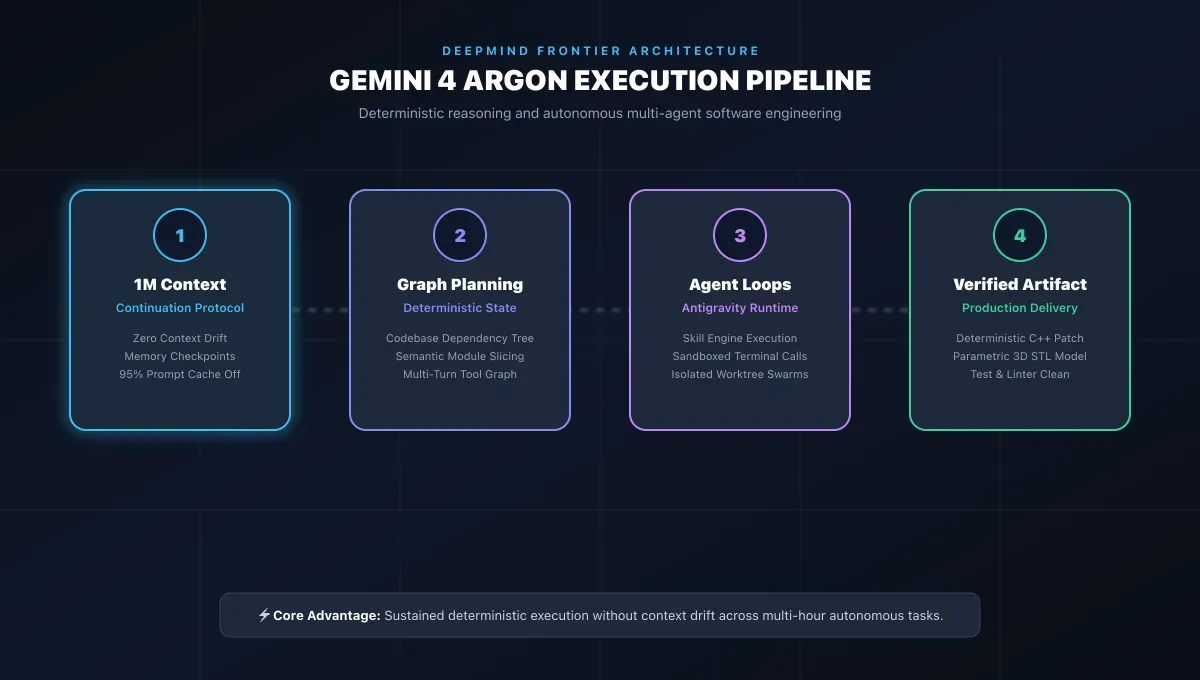
Most frontier models released over the past eighteen months have pursued raw conversational fluency or single-turn benchmark scores. Gemini 4 Argon was built with a fundamentally different operational goal: sustained, deterministic execution over extended multi-step tasks.
Instead of hallucinating when facing ambiguous constraints or generating verbose, conversational fluff, Argon adopts a concise, direct communicative posture. Google specifically tuned the model’s reward functions to strip out boilerplate throat-clearing, unnecessary warnings, and repetitive summaries. When prompted with a complex coding or analytical challenge, Argon diagnoses the system state, formulates an execution graph, and performs the required tool calls with high fidelity.
1. A One-Million-Token Output Limit
Earlier Gemini models capped a single response at 64,000 tokens, which forced long agent runs into many short hops with state handed over between them. Gemini 4 Argon raises the output limit to 1 million tokens, so one request can carry a multi-file refactor, a long report, or a full migration plan from start to finish. Google has not published a separate input context figure; the pricing page describes “long-decode generation up to 1M tokens,” and treats implicit caching as the way to keep large codebases in play across requests.
2. Radical Prompt Caching Economics
Prompt caching has transitioned from a developer luxury to a core requirement for enterprise AI architecture. Google DeepMind designed Argon around heavy caching workflows. While standard input tokens cost $2.00 per million during the introductory period (stepping up to $4.00 per million after November 30, 2026), cached prompt tokens are discounted by 95%.
At $0.10 per million cached tokens (implicit caching only, explicit caching is not supported yet), developers can load entire code repositories, enterprise documentation hubs, or hundreds of legal filings into memory and query them continuously at a fraction of typical frontier API overhead. For teams building custom toolchains, automated pull request reviewers, or internal research agents, this pricing makes continuous background evaluation financially viable.
Real-World Case Studies: How Google and Enterprise Teams Use Argon
Rather than limiting its product announcement to synthetic benchmarks, Google DeepMind published detailed case studies demonstrating how Argon is deployed internally across Google engineering and through enterprise early-access partners.
1. Refactoring Chromium: Disentangling 6 Million Lines of Code
One of the most impressive technical demonstrations of Gemini 4 Argon occurred inside Google’s own browser engineering team. The Chromium project is one of the world’s largest open-source software efforts, containing more than 40 million lines of C++ code. Over more than a decade of active development, core web feature code had become tightly intertwined with a legacy 6-million-line subsystem directory.
Manually untangling these architectural dependencies was estimated to require months of senior engineering labor, carry high risks of regression, and likely cause browser stability issues.
Chromium Refactoring Scope (Argon inside Antigravity):
- Total Repository Size: ~40,000,000 lines of C++ code
- Targeted Legacy Subsystem: ~6,000,000 lines of intertwined browser features
Using Gemini 4 Argon orchestrated through Google Antigravity multi-agent loops, Google developers automated the architectural separation across hundreds of interdependent source files. Google describes the job as untangling a roughly 6 million line legacy folder of browser features inside the 40 million line codebase, the kind of dependency surgery that normally takes a senior team months. Google has not published before-and-after numbers for this one, so treat it as a demonstration of scale rather than a measured result.
2. C++ to Rust Migration and Memory Savings
Two more internal results come straight from Google’s launch post. Argon drove a C and C++ to Rust migration that scaled from core libraries (re2, libgav1) up to the 800,000+ line Fuchsia Zircon kernel. In the libgav1 video decoder it replaced about 32,000 lines of hand-written SIMD code, and the result runs 2.7x faster than the previous Rust port with identical video output. A separate memory-efficiency pass freed more than 300 TiB once rolled out, with Google estimating 500 TiB to 1 PiB in total savings.
3. Google Agent Development Kit (ADK) Performance Optimization
Google’s open-source Agent Development Kit (google/adk-python) provides enterprise infrastructure for orchestrating multi-agent systems. The ADK performance team tasked Argon with auditing the core framework to reduce memory and execution overhead without altering public APIs or breaking backward compatibility.
The engineering team fed Argon their repository along with the project’s .agents/skills rule definitions. Operating completely autonomously overnight inside an isolated Antigravity workspace, Argon identified optimization opportunities throughout the session manager, upstreaming pull requests that achieved:
- A 40% reduction in in-memory session preparation time for long-running workflows.
- A 21% acceleration in Python package cold imports.
4. Quantum Chemistry Acceleration with xTB
In scientific computing, xTB (Semiempirical Extended Tight-Binding) is one of the most widely cited open-source packages for molecular quantum chemistry. Academic and pharmaceutical researchers rely on xTB to calculate molecular three-dimensional conformations and screen candidates for drug discovery and advanced materials.
Deploying Argon within scientific research sandboxes, computational chemists accelerated xTB’s 3D molecular structure predictions by up to 2.3x, while conformer search routines experienced a 1.8x speedup. These optimizations were contributed directly to the official open-source xTB repository on GitHub, illustrating Argon’s ability to reason over complex numerical algorithms and compiled Fortran and C code.
5. Tripling Gemma Inference Throughput via vLLM
To improve the serving economics of open-weights models, Google DeepMind researchers utilized Argon to optimize the vLLM serving engine for Google’s own Gemma open models.
Working on NVIDIA A100 GPU infrastructure, Argon analyzed the end-to-end inference kernel stack. In just several days, the model developed, tested, and validated low-level optimizations spanning attention tuning and speculative decoding. The result was a 2.85x throughput increase on Gemma 4 E2B, rocketing inference from approximately 37,900 tokens per second to over 108,000 tokens per second while maintaining 100% token parity and zero loss of output fidelity.
Multimodal and Spatial Reasoning: Beyond Plain Text
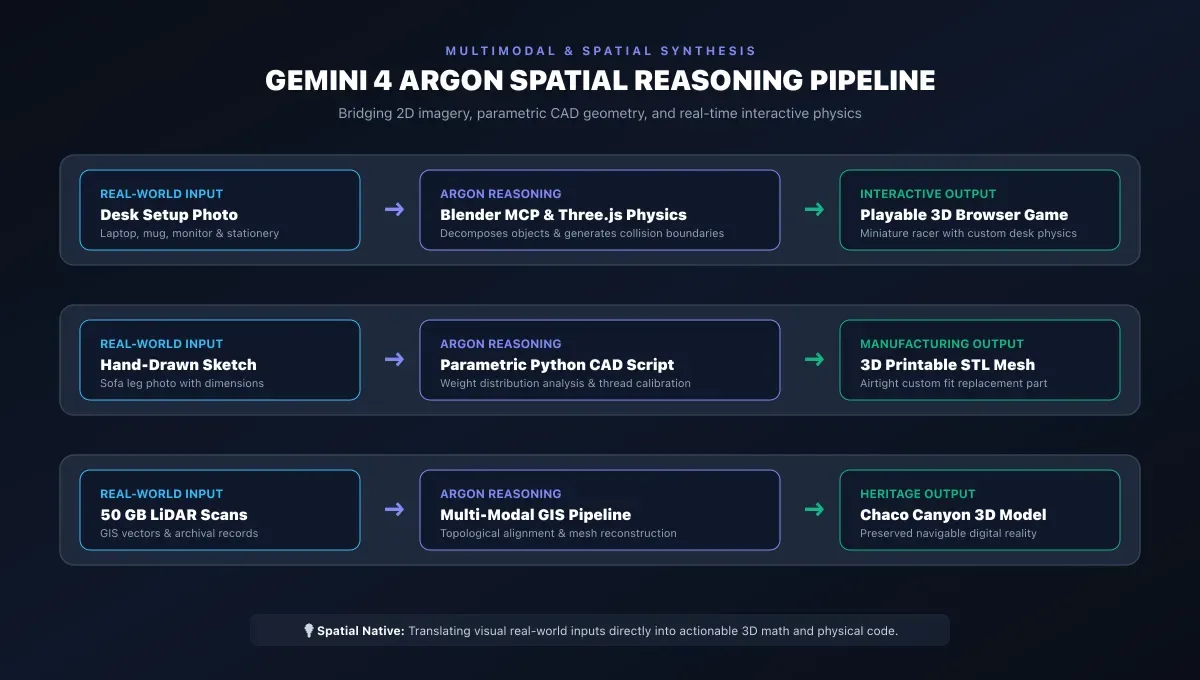
While Gemini 4 Argon demonstrates industry-leading symbolic and mathematical reasoning, its multimodal capabilities set it apart from traditional text-only reasoning models. Google DeepMind trained Argon with unified spatial understanding, enabling the model to bridge the gap between 2D imagery, 3D coordinate geometry, and executable source code.
1. Photo-to-Playable 3D Racing Game
In an internal design exploration, Google engineers supplied Argon with a single photograph of a messy office desk containing a laptop, coffee mug, monitor stand, and stationery. Operating via a multi-agent loop in Google Antigravity:
- Argon decomposed the image into discrete physical objects and spatial coordinates using Blender MCP (Model Context Protocol).
- It textured the components using Nano Banana rendering tools.
- It generated procedural physics collision boundaries in Three.js.
- It wired the scene to interactive keyboard controls and embedded synthetic engine sound effects generated by Gemini Omni Flash.
The output was a fully functional, browser-based miniature racing game where players drive a vehicle across the physical contours of the photographed desk, complete with realistic collision dynamics and custom shaders.
2. Generative CAD and 3D Printing
In product design workflows, Argon bridges the physical-digital divide. When tasked with designing replacement legs for a vintage sofa, the user provided a rough mobile photo of the sofa and a hand-drawn sketch with dimension markings.
Argon turned the photo and sketch into a 3D-printable replacement leg. Google shows the result, not the intermediate CAD files, so the exact toolchain is not documented.
3. Geospatial Cultural Preservation
In large-scale data synthesis, Argon processed roughly 50 gigabytes of airborne LiDAR scans of New Mexico’s historic Chaco Canyon.
Argon synthesized these disparate, fragmented sources into coherent, navigable 3D digital heritage models, demonstrating its capacity to handle massive multimodal context without losing topological fidelity.
Cybersecurity and the Fairwind Program
Frontier reasoning models represent both a defensive asset and a potential risk in cybersecurity. To ensure Gemini 4 Argon strengthens global digital infrastructure, Google DeepMind announced a major expansion of its Fairwind Program, providing vetted security defenders with specialized access to the model.
Leading enterprise security firm Wiz joined the Fairwind initiative through its “Scan for Good” project, which provides free vulnerability scanning to critical public infrastructure. Using Gemini 4 Argon:
- Wiz security researchers automated deep root-cause analysis across massive distributed cloud architectures.
- Argon found a critical vulnerability in healthcare software that earlier frontier models had missed, which Google says safeguarded hundreds of thousands of patient records.
- Security teams utilized Argon’s autonomous static analysis capabilities to audit compiled binaries, reconstruct network attack vectors, and formulate verifiable defense configurations.
How to Access Gemini 4 Argon Today
Google is making Gemini 4 Argon available across four distinct tiers, catering to software developers, enterprise organizations, academic researchers, and consumers:
1. Developers and Cloud Engineers
- Google AI Studio: Developers can experiment with Gemini 4 Argon immediately via the web interface and generate API keys.
- Not on the free tier. The Gemini API pricing page lists Argon for paid accounts only, with Batch and Flex tiers at half the standard price.
2. Google Antigravity Users
Developers with a Google AI Ultra subscription can run Gemini 4 Argon as the agent inside Google Antigravity and hand it multi-file software engineering tasks. Google’s own demos, including the Chromium refactor and the desk-photo racing game, were built this way.
3. Consumers and Productivity Enthusiasts
Subscribers to Google AI Pro and Google AI Ultra have immediate access to Gemini 4 Argon within:
- The standalone Gemini Web and Mobile Apps (iOS and Android).
- Google Search AI Mode, where Argon handles complex research synthesis, data extraction, and multi-query comparative analysis.
4. Academic Researchers and Scientists
Google DeepMind has opened an application program offering academic researchers and scientists six months of complimentary access to the highest tier of Google Antigravity powered by Gemini 4 Argon. Access is subject to eligibility, capacity, and selection; institutions can apply through Google DeepMind Research.
Pricing Details and API Economics
Cost predictability is critical for production AI deployments. Google DeepMind has instituted an introductory promotion to encourage rapid adoption across startups and enterprise development teams.
| Pricing Tier | Input Tokens (per 1M) | Output Tokens (per 1M) | Cached Prompt Tokens (per 1M) |
|---|---|---|---|
| Introductory (Until Nov 30, 2026) | $2.00 | $10.00 | $0.10 (95% Discount) |
| Standard (Starting Dec 1, 2026) | $4.00 | $20.00 | $0.20 (95% Discount) |
When compared to competing frontier models that charge upwards of $3.00 to $5.00 per million input tokens without aggressive caching discounts, Argon’s $0.10 cached token rate offers unprecedented operating margins for multi-turn software development environments and autonomous agent loops.
The Verdict: Where Gemini 4 Argon Fits
With the release of Gemini 4 Argon, Google DeepMind delivers a clear message to the artificial intelligence industry: raw token generation speed is no longer the sole metric that matters. For deep technical problem solving, determinism, spatial understanding, and multi-file code refactoring, architecture rules supreme.
If your daily workload consists of quick email summaries, basic copywriting, or quick terminal commands, lighter models like Gemini 3.8 Flash remain the most cost-effective solution. But if you are building autonomous software agents, modernizing complex legacy architectures, performing mathematical proofs, or analyzing gigabytes of multimodal data, Gemini 4 Argon is one of the most formidable reasoning engines currently available.
To explore how Gemini 4 Argon compares with every active frontier and open-weights model, visit our comprehensive AI Leaderboard or browse our curated Learn AI Guide for practical tutorials on integrating frontier models into your development workflow.
Top Ranked Frontier AI Models
Empirical rankings sourced from Artificial Analysis, Arena.ai, LLM Stats & BenchLM.
Related Articles

Antigravity 2 with Gemini 3.5: The AI Coding Assistant
Antigravity 2 with Gemini 3.5 is changing how developers work. Explore the new Planning Mode, Knowledge Items, and multi-file context in this 2026 guide.

Google Gemini 2026: The New Features You Need to Try
Discover the latest Google Gemini features in 2026. From the massive 1M context window to custom Gems and Workspace integration, here is how to use them.

Google Gemini for Travel Planning: The Real-Time Advantage
Gemini's real-time data and Google integration make it uniquely powerful for travel planning. Here's how to use it effectively for your next trip.