
iPhone Duo: What to Expect from Apple's First Foldable
Apple has unveiled the iPhone Duo, its first foldable phone. Explore the 7.6-inch dual display, A20 Pro chip, camera specs, pricing, and launch dates.

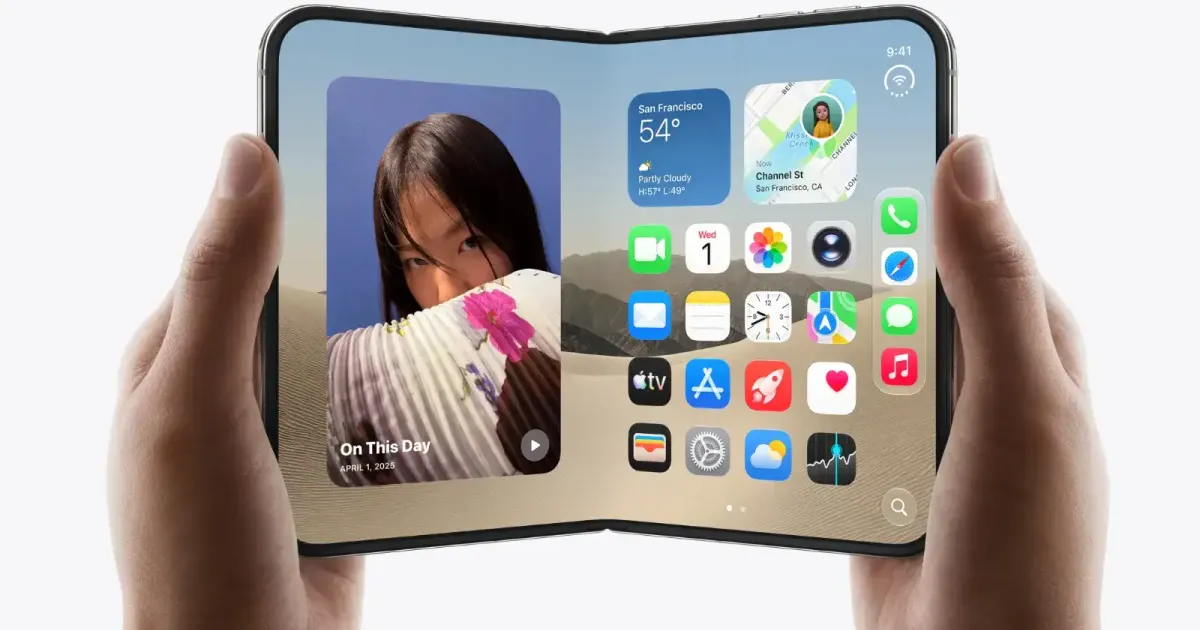
After years of industry speculation, patents, and engineering refinements in Cupertino, Apple has finally unveiled its inaugural foldable device: the iPhone Duo. Rather than chasing thinness records at the expense of structural integrity, Apple took a measured approach to the book-style foldable category. The result is a device built with precision aerospace materials, an innovative optical adhesive stack designed to minimize display creasing, and an operating system overhaul tailored specifically to dual-screen workflows.
For power users who carry both an iPhone and an iPad mini in their daily carry, the iPhone Duo consolidates that workflow into a single pocketable package. With official pre-orders kicking off on October 16, 2026, and in-store availability arriving on October 23, 2026, tech enthusiasts and creative professionals are assessing whether Apple’s first foldable justifies its flagship price tag.
Here is everything you need to know about what to expect from the iPhone Duo, from its bespoke titanium hinge to its A20 Pro silicon and custom iOS 27 features.
Quick Summary: iPhone Duo Specs at a Glance
For readers comparing flagship flagships on mobile, here is the official specification breakdown for Apple’s first foldable smartphone:
| Feature | iPhone Duo Specification | Key Advantage |
|---|---|---|
| Inner Display | 7.6-inch Super Retina XDR OLED, 120Hz ProMotion, Nano-Texture | 50% larger canvas than iPhone 18 Pro Max with zero glare |
| Outer Display | 5.4-inch Super Retina XDR OLED, 120Hz ProMotion, 3,000 nits | Full-featured, ergonomic one-handed cover screen |
| Processor | Apple A20 Pro (2nm generation) | Unthrottled sustained performance across dual displays |
| Neural Engine | Dual 16-core Neural Engine stack | Real-time local AI processing for multimodal assistant tasks |
| Biometrics | Touch ID integrated into Side Power Button | Fast unlock whether folded, unfolded, or resting on a desk |
| Cameras | 48MP Dual Fusion (Wide + Ultra Wide), 2x Optical Quality Zoom | Smart Take, Duo Preview, and Kid Cue outer display modes |
| Battery Life | Dual-cell battery architecture (up to 31 hours video playback) | Longest battery endurance in any foldable smartphone to date |
| Charging | Fast wired (50% in ~20 min), MagSafe, Qi2 25W wireless | Universal wireless alignment across both chassis halves |
| Build & Durability | Grade 5 Titanium frame, Ceramic Shield 2, IP68 rated | Exceptional drops, scuffs, and water immersion protection |
| Stylus Input | Apple Pencil (USB-C) support | Sketching, note-taking, and PDF annotation on inner canvas |
| Base Price | $1,999 USD (€2,299 EUR) for 256GB storage | Premium halo pricing positioned directly above Pro Max |
1. Industrial Design: Grade 5 Titanium and Ceramic Shield 2
The most immediate challenge facing foldable smartphones has always been durability. Early generations of folding devices from competitor brands suffered from hinge ingress, micro-scratches on delicate plastic films, and noticeable aesthetic creasing. With the iPhone Duo, Apple engineered an enclosure that prioritizes long-term resilience over paper-thin marketing stunts.
The chassis utilizes a precision-milled Grade 5 titanium outer frame coupled with a specialized brushed titanium hinge cover. Grade 5 titanium offers an unmatched strength-to-weight ratio, allowing Apple to reinforce the mechanical hinge gears without turning the handset into an unwieldy brick.
On the exterior, the 5.4-inch cover screen is shielded by Ceramic Shield 2, an updated glass-ceramic formulation that Apple says offers 3x better scratch resistance than the previous generation. The back plate features textured matte Ceramic Shield glass, available in two launch finishes: Night Sky (a deep, graphite-infused slate) and Star White (a pearl-like satin finish with silver titanium accents).
Critically, Apple engineered the hinge with custom silicone seals and micro-bristle sweeps, earning the iPhone Duo a full IP68 water and dust resistance rating. This means you do not need to baby the handset around sudden rainstorms, poolside environments, or dusty coffee shop tables.
iPhone Duo Hardware Highlights:
- Outer Cover Display (5.4”): Ceramic Shield 2, 3,000 nits peak brightness, integrated Touch ID side button, eSIM-only design.
- Unfolded Inner Canvas (7.6”): Anti-reflective nano-texture glass, optically clear elastic adhesive crease reduction, multi-stop titanium hinge, native Split View in iOS 27.
2. Display Innovation: The 7.6-Inch Inner Canvas and Nano-Texture Glass
The centerpiece of the iPhone Duo experience is its internal folding panel. When unfolded along its central axis, the device reveals an expansive 7.6-inch Super Retina XDR OLED display.
This active display area is roughly 50% larger than an iPhone 18 Pro Max, putting it directly on par with the usable real estate of an iPad mini. Both the internal panel and the external 5.4-inch cover screen share the exact same aspect ratio, ensuring that applications do not stretch awkwardly or encounter letterboxing when users transition from the closed cover screen to the unfolded canvas.
Tackling the Hinge Crease
To address the infamous folding crease that plagues competing flexible displays, Apple introduced a proprietary multi-layer stack featuring optically clear adhesives with dynamic elasticity. Underneath the flexible ultra-thin glass substrate, a micro-machined support plate automatically tensions when opened to 180 degrees. While a slight tactile seam remains perceptible if you run your fingertip directly over the center line, it virtually disappears under direct viewing angles.
Anti-Glare Nano-Texture Finish
In an industry first for foldable mobile hardware, Apple brought its renowned nano-texture finish to the interior display of the iPhone Duo. By etching the surface glass at the nanometer level, ambient room lighting and outdoor reflections are scattered rather than mirrored back at the viewer. Whether you are editing spreadsheets under fluorescent office bulbs or reviewing raw photos under bright sunlight, the 3,000-nit peak outdoor brightness and nano-texture coating ensure clear legibility without washed-out contrast.
If you enjoy keeping your workspace clean and reflection-free, you can pair the Duo with ergonomic desktop stands highlighted in our Desk Upgrade Guide.
3. Performance Core: A20 Pro Chip and Dual 16-Core Neural Engine
Powering two 120Hz ProMotion displays simultaneously demands immense processing bandwidth. At the heart of the iPhone Duo sits Apple’s next-generation A20 Pro silicon, fabricated on advanced 2-nanometer architecture.
The A20 Pro features a 6-core CPU design (2 high-performance cores and 4 high-efficiency cores) paired with a 6-core GPU featuring hardware-accelerated ray tracing and dynamic caching. However, the true architectural highlight is the Dual 16-Core Neural Engine stack.
| A20 Pro Architectural Component | Specification | Primary Task |
|---|---|---|
| CPU Complex | 6-Core (2 Performance + 4 Efficiency) | High-throughput dual-screen app multitasking |
| GPU Subsystem | 6-Core with Dynamic Caching | Hardware-accelerated ray tracing and 120Hz ProMotion driving |
| Dual Neural Engine | 32 Cores Total (Dual 16-Core Stack) | Real-time on-device multimodal Apple Intelligence operations |
By dedicating 32 neural cores to machine learning operations, the iPhone Duo runs Apple Intelligence language and vision models entirely on-device without offloading sensitive context to remote cloud servers. Siri responds with zero network latency, indexing local files, generating image summaries, and maintaining conversational context across split applications in real time.
For creators who track AI development benchmarks, check out our AI Leaderboard and our deep dive into modern multimodal workflows in the Learn AI Guide.
4. The Biometric Pivot: Touch ID Returns on the Power Button
One of the most surprising design decisions on the iPhone Duo is the absence of Face ID sensors. Instead, Apple integrated an ultra-responsive Touch ID capacitive sensor directly into the side power button.
While Face ID remains a staple on traditional monoblock iPhones, its inclusion on a folding device presents major user experience hurdles:
- A TrueDepth sensor array placed on the outer screen cannot scan your face when the device is unfolded on a tabletop.
- A notch or cutout on the inner display would interrupt full-screen video playback and document reading.
- Placing separate TrueDepth sensors on both screens would add thickness, complexity, and internal component mass.
By embedding Touch ID into the top-mounted power button, authentication is completely unified. As your finger naturally presses the power button to wake the screen, the iPhone Duo unlocks instantly. This holds true whether the phone is closed in your palm, unfolded in tablet orientation, or resting on a nightstand in desk clock mode.
The sensor also integrates with Apple Pay, 1Password, and passkey authentication with a simple tap, delivering tactile reassurance that long-time iPhone users will welcome back.
5. Camera System: 48MP Dual Fusion and Foldable-Exclusive Features
Rather than shoehorning an enormous telephoto periscope module that would make the folding halves lopsided, Apple engineered the 48MP Dual Fusion camera system specifically for the Duo form factor.
The system combines:
- 48MP Fusion Main Camera: 24mm equivalent focal length with f/1.6 aperture, second-generation sensor-shift optical image stabilization, and 100% Focus Pixels. By using the center 12 megapixels of the high-resolution sensor, it delivers lossless 2x optical-quality zoom.
- 48MP Fusion Ultra Wide Camera: 13mm equivalent focal length with f/2.2 aperture, 120-degree field of view, and macro photography capabilities down to 2 centimeters.
- 12MP Center Stage Front Camera & Under-Display FaceTime Lens: A 12MP ultra-wide sensor on the outer screen with Center Stage subject tracking, paired with an under-display 1080p camera tucked cleanly beneath the inner 7.6-inch panel for unobtrusive video conferencing.
To master focal lengths and understand how sensor crops compare to physical glass, read our detailed Camera Lens Types Guide.
Exclusive Foldable Camera Capabilities:
- Smart Take: Hands-free group capture with automated framing and shutter trigger on flat surfaces.
- Duo Preview: Live viewfinder mirror on the 5.4-inch outer cover screen for subjects.
- Kid Cue: Animated visuals and sound cues on the outer screen to capture toddlers’ attention.
- Duo FaceTime: Dual-camera conference streaming engaging both participants and room environments.
Innovative Shooting Modes
The dual-screen physical format unlocks shooting features impossible on standard phones:
- Duo Preview: When taking photos of friends or family, the 5.4-inch outer display mirrors the viewfinder in real time. The person being photographed can check their posture, smile, and framing before you press the shutter.
- Kid Cue: Photographing restless children or pets has always been tricky. In Kid Cue mode, the outer screen plays playful, animated graphics and sounds to grab their attention while the photographer captures candid portraits from the inner display.
- Smart Take: By bending the titanium hinge to a 90-degree angle and placing the iPhone Duo on a table or ledge, the camera stabilizes itself without needing a bulky tripod. The A20 Pro Neural Engine automatically tracks group movement and triggers the shutter when everyone is in frame.
6. Battery Architecture and the eSIM-Only Transition
Foldable phones are notorious for poor battery endurance because they must illuminate two separate high-refresh screens while cramming delicate hinge mechanisms into the chassis. Apple tackled this engineering dilemma with a dual-battery split architecture.
By distributing high-density lithium-cobalt cells across both halves of the titanium chassis, weight remains evenly balanced when held in one hand. Apple rates the iPhone Duo for up to 31 hours of continuous video playback on the inner 7.6-inch screen, representing the highest endurance of any book-style foldable on the market.
| Chassis Section | Internal Components Housed | Mass Distribution |
|---|---|---|
| Left Half | 45% Battery Cell, Ultra Wide Camera Optics, eSIM Logic, Speaker Chamber | Balanced for single-hand hold |
| Center Hinge | Grade 5 Titanium Multi-Gear Mechanism, Flexible Micro-Ribbon Bus | Dynamic tension resistance |
| Right Half | 55% Battery Cell, A20 Pro Motherboard, MagSafe Coil, Touch ID Power Button | Center of gravity stabilization |
Worldwide eSIM Adoption
To make room for these enlarged battery cells, Apple made the strategic decision to make the iPhone Duo 100% eSIM-only worldwide.
While North American iPhone models transitioned away from physical SIM trays years ago, international variants often retained a nano-SIM slot. On the iPhone Duo, eliminating the physical tray, tray gasket, and internal contact pins freed up critical cubic millimeters of space, allowing Apple to expand battery capacity and ensure uniform IP68 water sealing globally.
Travelers who switch carriers abroad can easily store up to eight digital eSIM profiles and keep two active simultaneously, a feature we frequently recommend in our AI Travel Planning Guide.
Fast Wired and Wireless Power
Charging the dual-battery setup is swift. Using a 45W USB-C power adapter, the iPhone Duo charges from 0% to 50% in approximately 20 minutes. For wireless power, the rear chassis features MagSafe and Qi2 certification supporting up to 25W, with magnetic alignment that works seamlessly whether the phone is closed or laid out flat. If you are comparing mobile audio accessories to pair with your setup, check out our analysis of AirPods vs Galaxy Buds vs Sony.
7. Software Experience: iOS 27 Postures and Apple Pencil Support
Hardware is only half the foldable equation; software execution determines whether a foldable is an indispensable tool or an awkward novelty. With iOS 27, Apple introduces specialized postures and interface adaptations built specifically for dual-screen productivity.
Adaptive Postures
The iPhone Duo recognizes three distinct hardware postures:
- Closed Mode: Functions identically to a compact 5.4-inch iPhone. Every standard iOS app, widget, and gesture behaves exactly as expected.
- Open Mode: The full 7.6-inch canvas enables true side-by-side Split View. You can drag images directly from Safari into an email draft, compare two spreadsheets simultaneously, or run a Slack conversation alongside a PDF document.
- Seated Posture (L-Shape): When rested partially folded on a flat desk, the upper half displays content (such as a FaceTime call or video stream) while the bottom half automatically converts into an interactive trackpad, keyboard, or media playback control deck.
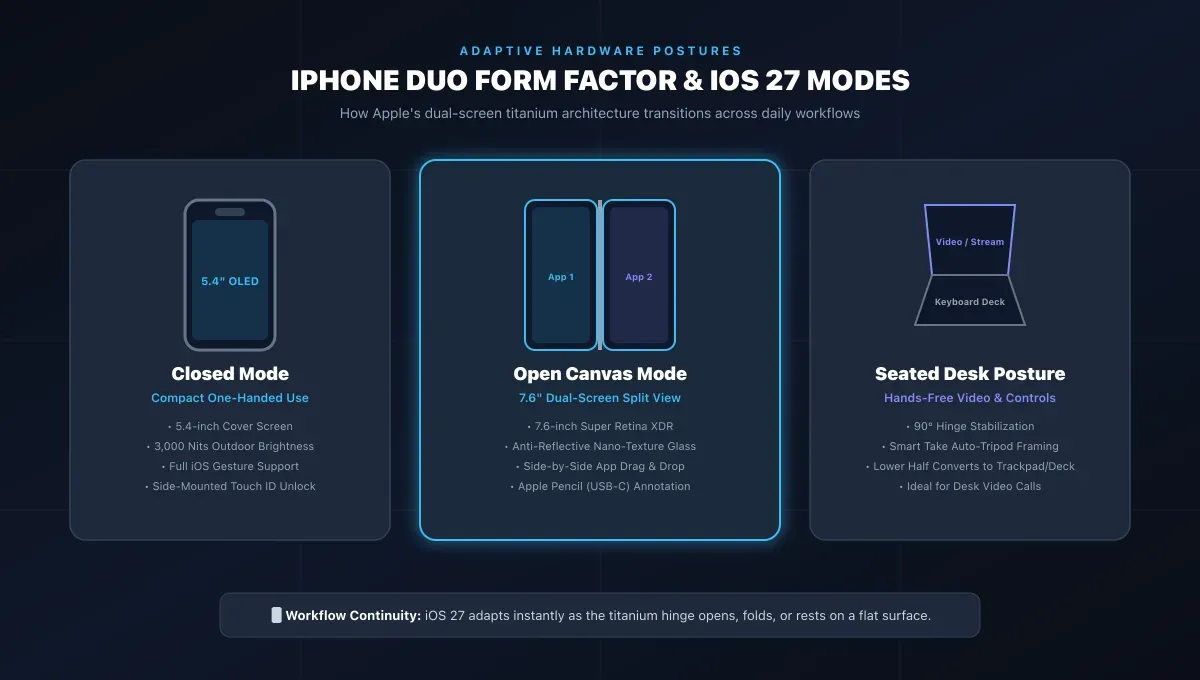
Hardware Posture Configurations in iOS 27:
- Closed Mode (5.4”): Ultra-compact one-handed smartphone experience with full iOS capabilities.
- Seated L-Shape Mode: Upper half displays video playback or document preview at 90 degrees while the lower half transforms into a dedicated typing keyboard and media control deck.
- Open Canvas Mode (7.6”): Expansive uninterrupted workspace for side-by-side multitasking and Apple Pencil sketching.
StandBy Anywhere
Unlike previous iPhone models that required a connected MagSafe charging stand to trigger StandBy mode, the iPhone Duo supports StandBy Anywhere. You can fold the device into a tent shape and rest it on a bedside table or office credenza at any time, transforming it into an ambient clock, calendar, and music visualizer without plugging into power.
Apple Pencil Integration
In a move that creative professionals have requested for years, Apple announced that the iPhone Duo supports the Apple Pencil (USB-C).
Users can sketch concepts in Freeform, mark up contracts in Apple Books, or take handwritten meeting notes in Apple Notes directly on the inner 7.6-inch display. While the initial release focuses on the USB-C version of Apple Pencil, full pressure-sensitive latency optimizations will arrive via an over-the-air iOS update later this year.
8. Pricing, Storage Tiers, and Availability
As a halo product pioneering a brand-new form factor for Apple, the iPhone Duo commands flagship pricing. It does not replace the traditional iPhone Pro lineup, but rather sits directly above it.
Here are the official retail storage configurations and launch pricing:
| Storage Capacity | US Retail Price | European Retail Price | Recommended Use Case |
|---|---|---|---|
| 256GB | $1,999 USD | €2,299 EUR | General productivity, cloud-first users |
| 512GB | $2,199 USD | €2,549 EUR | Heavy multitasking, 48MP photography |
| 1TB | $2,599 USD | €3,049 EUR | Local 4K ProRes video workflows |
| 2TB | $3,199 USD | €3,799 EUR | Enterprise creatives, massive offline media |
Important Dates
- Official Pre-Orders: Friday, October 16, 2026 (beginning at 5:00 a.m. PDT on Apple.com and the Apple Store app).
- Retail Store and Carrier Launch: Friday, October 23, 2026.
Every iPhone Duo includes a color-matched braided USB-C charge cable (1m) and documentation in an ultra-slim, 100% fiber-based recyclable package. Due to Apple’s environmental commitments, power adapters and the Apple Pencil are sold separately.
9. Who Should Buy the iPhone Duo?
Investing two thousand dollars in a smartphone requires clear justification. Is the iPhone Duo the right upgrade for your workflow?
You Should Buy the iPhone Duo If:
- You want one device instead of two: If you frequently juggle both an iPhone and an iPad mini while traveling or commuting, the Duo replaces both without compromise.
- You live in multi-window productivity apps: Having dual full-sized phone applications running side by side changes how you process email, manage finances, and communicate on the go.
- You love mobile photography with friends: Features like Duo Preview and hands-free Smart Take make group travel photography effortless.
- You want Apple’s most durable mobile build: With Grade 5 titanium, IP68 water resistance, and nano-texture anti-glare glass, Apple has built what is arguably the most structurally sound foldable on the market.
You Should Wait If:
- You rely on extreme telephoto zoom: If 5x or 10x periscope telephoto lenses are central to your photography, traditional iPhone Pro Max models remain superior.
- You have a strict tech budget: At $1,999 base, the Duo is a luxury halo device with a steep early-adopter tax.
- You prefer ultra-thin featherweight handsets: While remarkably balanced, folding two screens together inevitably results in a thicker folded profile than a standard iPhone.
Frequently Asked Questions
When does the iPhone Duo come out?
Pre-orders for the iPhone Duo open on Friday, October 16, 2026, with official retail and carrier deliveries commencing on Friday, October 23, 2026.
How much does the iPhone Duo cost?
The iPhone Duo starts at $1,999 in the United States and €2,299 in European markets for the 256GB storage tier. Upgraded tiers are priced at €2,549 (512GB), €3,049 (1TB), and €3,799 (2TB).
Does the iPhone Duo use Face ID or Touch ID?
The iPhone Duo relies on Touch ID built directly into the side power button rather than Face ID. This provides swift, frictionless biometric authentication across every device posture, whether folded closed, opened into a 7.6-inch canvas, or resting on a table.
Does the iPhone Duo support Apple Pencil?
Yes, Apple confirmed that the iPhone Duo inner screen supports the Apple Pencil (USB-C), with expanded software optimizations arriving later this year via an iOS 27 update.
Is the iPhone Duo waterproof?
Yes. Despite its folding titanium mechanical hinge, the iPhone Duo achieved a full IP68 water and dust resistance certification, protecting against spills, rain, and fresh water immersion up to 6 meters for 30 minutes.
Does the iPhone Duo have a physical SIM card tray?
No. The iPhone Duo is an eSIM-only smartphone in all regions worldwide. Removing the physical SIM tray allowed Apple to maximize internal battery space and maintain uniform structural waterproofing.
Related Articles

Apple HomeView: Specs, Siri AI, Pricing & Release Date
Apple has announced HomeView, a $299 smart display powered by Siri AI and A18 silicon. Discover the 7-inch screen, multi-user privacy, audio, and specs.
Rumored iPhone Fold: Specs, Release Date & Price
Everything about Apple's rumored iPhone Fold: supply chain leaks, crease-free display patents, expected launch windows, pricing, and custom iOS features.

iPad vs. Android Tablet: Which Should You Buy in 2026?
A comprehensive 2026 comparison between iPads and Android tablets to help you decide which platform best suits your creative and professional needs.