
Perplexity AI for Travel Research: Better Than Google?
Perplexity combines AI conversation with real-time search, making it perfect for travel research. Here's how to use it to plan smarter trips.

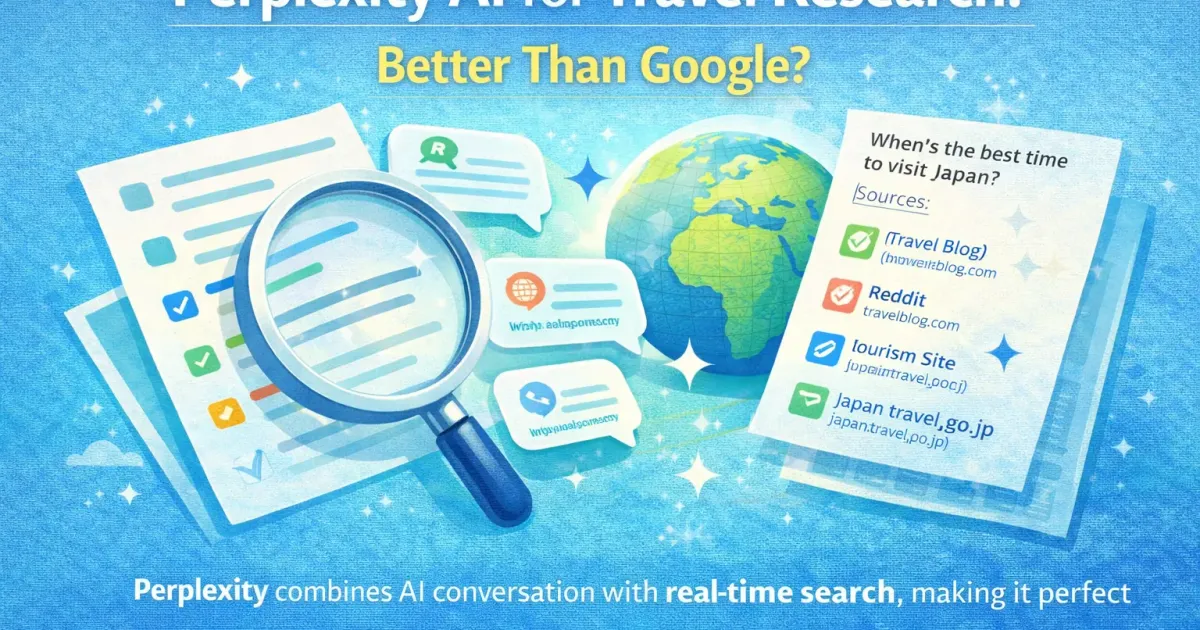
Google gives you links. ChatGPT gives you answers (sometimes outdated). Perplexity gives you answers with sources, and that’s a game-changer for travel research.
If you’ve ever spent hours comparing blog posts trying to figure out “is Bali worth visiting in rainy season?” or “what’s the best way to get from Rome to Amalfi Coast?”, Perplexity is about to become your new favorite tool.
What Makes Perplexity Different?
Answers, Not Links
Traditional search:
- Search “best time to visit Japan”
- Open 5 different blog posts
- Compare conflicting information
- Try to figure out who’s right
Perplexity:
- Ask “when’s the best time to visit Japan?”
- Get a synthesized answer with sources
- Click sources if you want to dive deeper
- Done
Sources You Can Verify
Unlike ChatGPT, Perplexity shows its work. Every answer includes citations so you can:
- Verify the information
- Read more if interested
- Evaluate source credibility
For travel planning, this matters. You want to know if advice comes from a travel blog, official tourism site, or Reddit thread.
Real-Time Information
Perplexity searches the web in real-time. It can find:
- Current visa requirements
- Recent travel advisories
- Up-to-date prices and hours
- Fresh traveler reviews and experiences
Best Perplexity Prompts for Travel Research
1. Destination Deep Dive
Is [destination] worth visiting in [month]?I want to know about weather, crowds, prices, and any events.Focus on recent traveler experiences from the past year.What you get: A comprehensive answer synthesizing multiple sources, with citations to recent blog posts, Reddit threads, and official tourism info.
2. Comparing Destinations
Compare [destination A] vs [destination B] for a [duration] trip in [month].Consider: cost, weather, things to do, safety, ease of travel.Which is better for someone who loves [interests]?What you get: Side-by-side comparison with pros and cons, backed by sources.
3. “Should I…” Questions
Should I rent a car in [destination] or use public transport?Consider: cost, convenience, safety, parking, and whether I need a car to see the main attractions.What you get: Practical advice based on multiple sources, including Reddit discussions where real travelers share experiences.
4. Logistics Research
What's the best way to get from [point A] to [point B]?Compare all options: cost, time, comfort, and practicality.Include any tips for booking or things to watch out for.What you get: Comprehensive transportation comparison with current information.
5. Hidden Gems Discovery
What are underrated things to do in [destination] that most tourists miss?Focus on recent recommendations from locals and experienced travelers.Avoid the obvious tourist attractions.What you get: Lesser-known suggestions sourced from travel forums, local blogs, and recent articles.
6. Safety & Practical Research
Is [destination] safe for [solo travelers/women/families/LGBTQ+ travelers]?What should I know about scams, areas to avoid, and practical safety tips?Include recent traveler experiences.What you get: Nuanced safety information from multiple perspectives, with sources you can evaluate.
7. Budget Research
What's a realistic daily budget for [destination]?Break down: accommodation, food, transport, activities.Compare budget, mid-range, and comfortable travel styles.Base this on recent traveler reports, not outdated guides.What you get: Current budget information with source citations, not generic estimates.
8. Dietary Restrictions Deep Dive
I have [celiac disease/severe nut allergy/etc.] and am traveling to [destination].Research:- How aware is the local food culture about this condition?- Which specific ingredients contain hidden [gluten/allergen]?- Recent experiences from travelers with this same condition- Restaurants recommended by people with [condition]- Local phrases and how to communicate my needs effectively
Focus on recent Reddit threads, travel blogs, and celiac/allergy community posts.
What you get: Real experiences from people who’ve navigated the same challenges, with sources you can follow up on.
Why Perplexity excels here: Can search specifically for dietary restriction communities and recent traveler reports, synthesizing advice from people who actually have the same condition.
9. Travel Insurance Research
I need travel insurance for a [X-week] trip to [destination].Research:- What coverage do travelers recommend for this region?- Average medical costs if hospitalized in [destination]- Which insurance companies have good claim experiences?- Recent complaints or issues with specific providers- Do I need special coverage for [planned activities]?
Focus on recent reviews and traveler experiences, not just marketing claims.
What you get: Real experiences from travelers who’ve actually used their insurance, with sources from Reddit, travel forums, and review sites.
Why Perplexity excels here: Can find recent claim experiences and compare what providers actually deliver versus what they promise.
Perplexity vs Other AI Tools for Travel
| Task | Best Tool | Why |
|---|---|---|
| Complex research questions | Perplexity | Sources + synthesis |
| Building itineraries | ChatGPT | Better at structure |
| Real-time prices | Gemini | Google integration |
| Creative suggestions | Claude | More thoughtful |
| Quick fact-checking | Perplexity | Instant sources |
| Comparing options | Perplexity | Synthesizes multiple views |
| Conversational planning | ChatGPT | Better dialogue |
When to Use Perplexity
✅ Researching a destination you know nothing about ✅ Comparing multiple options (destinations, routes, accommodations) ✅ Answering “should I…” questions ✅ Finding current, practical information ✅ Verifying advice from other sources ✅ Discovering hidden gems and local tips
When to Use Something Else
❌ Building day-by-day itineraries (use ChatGPT) ❌ Checking live flight prices (use Google Flights or Gemini) ❌ Organizing your trip (use Wanderlog or Mindtrip) ❌ Quick, simple questions (use Google)
The Research-First Workflow
Here’s how to integrate Perplexity into your travel planning:
Phase 1: Initial Research (Perplexity)
Before you commit to anything, use Perplexity to answer:
- “Is [destination] a good choice for [my situation]?”
- “What’s the best time to visit?”
- “How many days do I need?”
- “What’s a realistic budget?”
- “Any safety concerns or practical issues?”
Phase 2: Deep Dives (Perplexity)
For specific questions:
- “Best neighborhoods to stay in [destination]?”
- “How to get from airport to city center?”
- “Is [specific attraction] worth it?”
- “Best day trips from [destination]?”
Phase 3: Itinerary Building (ChatGPT)
Take your Perplexity research and feed it to ChatGPT:
Based on my research, I'm visiting [destination] for [X days].I've learned that:- [Key insight 1 from Perplexity]- [Key insight 2]- [Key insight 3]
Create a day-by-day itinerary incorporating this information.
Phase 4: Verification (Perplexity + Gemini)
Before booking, verify:
- Current visa requirements
- Any recent changes or closures
- Updated prices and hours
Perplexity Pro Tips
Use Follow-Up Questions
Perplexity remembers context. After your initial question, follow up:
- “What about for families with kids?”
- “How does this change in winter?”
- “Any recent changes I should know about?”
Check the Sources
Not all sources are equal. Prioritize:
- Official tourism websites
- Recent travel blogs (past 6 months)
- Reddit/forum threads (real experiences)
- Older guidebook content (may be outdated)
Be Specific About Recency
Add phrases like:
- “based on 2025-2026 information”
- “recent traveler experiences”
- “current prices and conditions”
This helps Perplexity prioritize fresh sources.
Use Focus Modes
Perplexity offers different focus modes:
- All - General web search
- Academic - Research papers (less useful for travel)
- Social - Reddit, forums, social media (great for real experiences)
For travel research, try Social focus for authentic traveler perspectives.
Real Example: Researching Portugal
Here’s how I’d use Perplexity to research a Portugal trip:
Question 1:
Is Portugal a good destination for a 10-day trip in October?Consider weather, crowds, prices, and things to do.Perplexity synthesizes info from tourism sites, travel blogs, and weather data, with sources.
Question 2:
What's the best itinerary split between Lisbon, Porto, and the Algarve?I have 10 days and prefer a relaxed pace.Perplexity compares different approaches travelers have taken, citing specific blog posts and forum discussions.
Question 3:
Is renting a car necessary in Portugal, or can I rely on trains and buses?I want to see more than just the big cities.Perplexity gives nuanced advice based on what real travelers experienced.
Question 4:
What are the most overrated tourist attractions in Portugal that I should skip?And what should I do instead?Perplexity finds contrarian opinions from experienced travelers, with sources.
After this research, I have a solid foundation to build my itinerary in ChatGPT.
The Verdict
Perplexity isn’t a complete travel planning solution, it’s a research superpower. Use it to:
- Get informed before making decisions
- Compare options with balanced perspectives
- Verify information from other AI tools
- Discover insights you’d miss with regular Google searches
Pair it with ChatGPT for itinerary building and Gemini for real-time prices, and you have a complete AI travel planning stack.
Related Articles
- Perplexity AI Guide, Complete Perplexity guide
- AI Tools Guide, All AI tools compared
- AI Travel Planning Hub, Complete travel guide
- Best AI Trip Planners, Compare all tools
- ChatGPT Mastery Guide, Alternative for planning
Related Articles

Japan vs Vietnam vs Cambodia: Which Should You Visit?
Can't decide between Japan, Vietnam, or Cambodia? Use AI to compare these destinations based on budget, weather, food, and your travel style.

AI Trip Planning: Cambodia - The Complete Guide for 2026
Plan your Cambodia adventure with AI. From Angkor Wat to tropical beaches, use ChatGPT and flight agents to discover the Kingdom of Wonder.

AI Trip Planning: Vietnam - The Complete Guide for 2026
Plan your Vietnam adventure with AI. From Hanoi to Ho Chi Minh, use ChatGPT and flight agents to create the perfect Vietnamese itinerary.