
What is AI Slop? Why the Internet Is Revolting Against It
AI slop is a tidal wave of low-effort synthetic content flooding the web. Discover what it is, why the internet hates it, and how to survive.

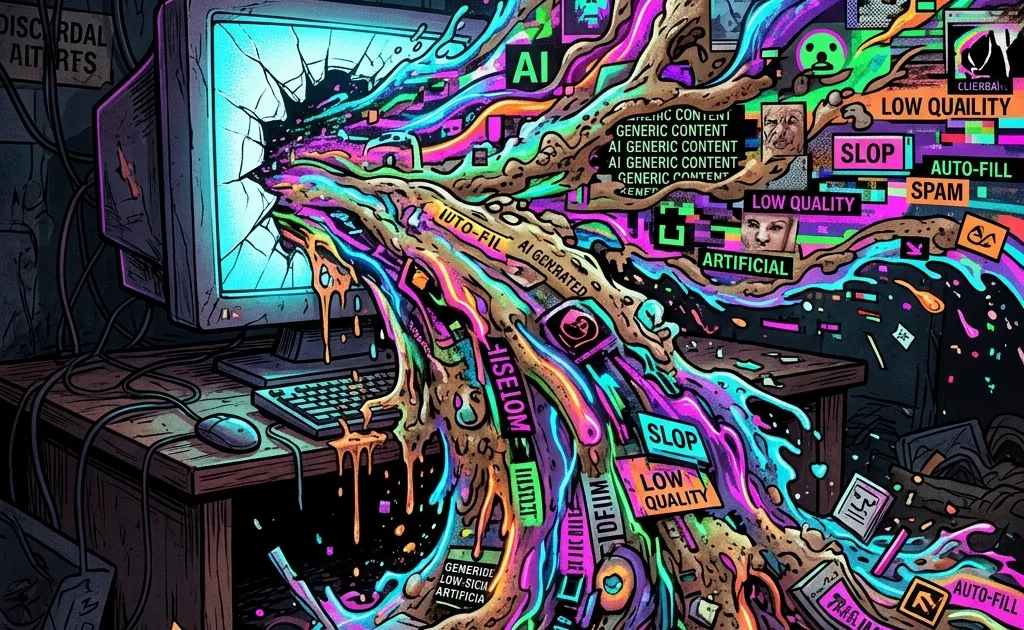
If you have spent any significant amount of time on the internet in the past two years, you have likely encountered it. Perhaps you were searching for a simple recipe, only to be met with a 2,000-word, oddly repetitive essay about the history of the potato. Maybe you scrolled past a bizarre, overly smooth image of a six-fingered celebrity on social media. Or perhaps you tried to find troubleshooting advice for your software, only to read a perfectly punctuated paragraph that confidently provided instructions that made absolutely no sense.
Welcome to the era of AI slop.
As generative AI tools like ChatGPT, Midjourney, and their countless derivatives became cheap and widely accessible, they didn’t just democratize creativity; they democratized spam. The resulting tidal wave of synthetic, low-effort content has fundamentally altered the texture of the web. This phenomenon, dubbed “slop” by frustrated netizens, is causing a massive backlash. Let’s explore exactly what AI slop is, why the internet is revolting against it, and what it means for the future of digital culture.
Defining the Digital Pollution: What is AI Slop?
The term “slop” is evocative, bringing to mind the image of cheap, unappetizing food shoveled into a trough. In the digital realm, AI slop is exactly that: a slurry of cheap, unappetizing content shoveled into the internet’s algorithmic troughs.
At its core, AI slop is defined by intent. It is not art, it is not journalism, and it is not genuine communication. It is synthetic media (text, images, audio, or video) generated in bulk by artificial intelligence, with the sole purpose of gaming algorithms to harvest clicks, engagement, and ad revenue.
The Characteristics of Slop
You know slop when you see it, but it generally shares several distinct characteristics:
- The “Uncanny Valley” of Tone: Slop text often adopts an overly enthusiastic, sterile, or formal tone. It uses phrases like “In today’s fast-paced digital landscape,” or “It is crucial to remember that…” It lacks the distinct voice, humor, or idiosyncratic flaws of human writing.
- Infinite Padding: Because search engines historically rewarded long-form content, AI slop is famous for taking a one-sentence answer and expanding it into a multi-page essay filled with redundant transitions and filler words.
- Confident Hallucinations: Slop prioritizes sounding authoritative over being factually correct. It will confidently tell you that the capital of Australia is Sydney, or provide a recipe that calls for toxic ingredients, because it is merely predicting the next most likely word, not verifying facts.
- Visual Homogeneity: AI slop images often have a distinct, glossy, hyper-real aesthetic. The lighting is too perfect, the textures are plasticky, and upon closer inspection, the background details melt into incomprehensible mush.
- Zero Human Curation: True slop is published without human review. A spammer sets up an automated script to generate 500 articles a day based on trending keywords and immediately publishes them.
The Economics of Slop: Why Does It Exist?
To understand why the internet is drowning in slop, you have to understand the underlying economics of the web. For the last twenty years, the internet has operated on an attention economy funded by advertising.
If you can capture human attention, you can serve ads. If you serve ads, you make money. Historically, capturing attention was difficult and expensive. You had to hire writers, photographers, or videographers to create content that people actually wanted to see.
Generative AI drove the marginal cost of content creation down to absolute zero.
Today, a “publisher” doesn’t need to hire a writer. They can pay a few cents for an API call to an LLM, generating an infinite stream of articles optimized for whatever keywords people are searching for today. Even if 99% of those articles are ignored, the 1% that trickles through Google’s algorithms or goes viral on Facebook generates enough ad revenue to make the whole enterprise profitable.
It is a brute-force attack on the attention economy. It is digital strip-mining.
The Backlash: Why the Internet Hates Slop
The internet’s reaction to this flood of synthetic content has transitioned from mild amusement to intense, visceral hatred. The backlash is rooted in several profound disruptions to the user experience.
1. The Destruction of Search Utility
The most immediate casualty of AI slop has been the search engine. For decades, Google was a reliable oracle. Today, searching for product reviews, travel advice, or technical help often yields a first page dominated by AI-generated SEO bait. That has forced a rethink on the other side of the equation too: what it now takes to rank without producing slop yourself is the subject of SEO in 2026.
Users are incredibly frustrated by the “time tax” imposed by slop. You click a link hoping for a quick answer, only to realize you are reading an AI-generated labyrinth of useless text. This frustration has led to the viral trend of users appending “Reddit” to the end of every search query, a desperate attempt to bypass the slop and find a forum where actual humans are discussing the topic.
2. The Loss of Trust and Authenticity
The internet has always had a problem with fake news and scams, but slop introduces a new kind of ambient distrust. When you can no longer tell if a touching story, a breathtaking photograph, or a helpful piece of advice came from a human mind or a statistical model, paranoia sets in.
This phenomenon is known as the “Dead Internet Theory”, a once-fringe conspiracy theory which posits that the internet is mostly populated by bots talking to other bots. While not literally true, it feels increasingly true. The cost is not evenly distributed either: readers who grew up before this became normal are the least equipped to spot it, as we cover in AI, social media, and the danger to the older generation. When every comment section is filled with AI bots summarizing the article, and every article is an AI summarizing a press release, the internet feels lonely, sterile, and deeply unauthentic.
3. The Devaluation of Human Effort
For creators, writers, artists, musicians, the rise of slop is a direct threat to their livelihood and dignity. It is deeply demoralizing to spend days researching and writing an article, only to be outranked in search results by a script that generated a slightly worse version in two seconds.
Furthermore, the very AI models generating the slop were trained by scraping the original work of those human creators, usually without permission or compensation. The slop is, quite literally, a diluted, regurgitated version of human culture, sold back to us as original content.
4. The Pollution of Niche Communities
Niche communities, forums for hobbyists, specialized subreddits, localized Facebook groups, were once the safe havens of the internet. Today, they are constantly targeted by slop bots farming for karma or engagement. A bot will use AI to rewrite a popular post from five years ago and post it as new. This constant low-level spam exhausts volunteer moderators and degrades the communal trust that makes these spaces valuable.
The Counter-Offensive: How the Web is Fighting Back
The internet is not taking the slop invasion lying down. A massive immune response is currently underway across the digital ecosystem.
Algorithmic Punishments
Major platforms are locked in an arms race with slop peddlers. Google has rolled out massive “Helpful Content” core updates specifically designed to target and de-index mass-produced, unoriginal content. Social media platforms are experimenting with algorithmic penalties for accounts that post at superhuman frequencies or exhibit bot-like behavior. However, this is a game of whack-a-mole; as the platforms get smarter, the slop generators pivot their tactics.
The Rise of the “Human Web”
Perhaps the most significant cultural shift is the migration of users away from the “open web” (search engines and public social media feeds) and into closed, heavily moderated spaces.
We are seeing a resurgence of private Discord servers, paywalled newsletters (like Substack), and highly moderated boutique forums. In these spaces, entry often requires human verification, a subscription fee, or a personal invite. The open web is being ceded to the bots, while humans retreat to digital gated communities where authenticity is enforced.
Slop-Detecting Tools
A cottage industry of AI detection tools has sprung up. While text detection remains notoriously unreliable, platforms are implementing “nutrition labels” for content. Social networks are beginning to automatically tag images and videos generated by popular AI tools (using metadata standards like C2PA). This allows users to filter out synthetic media if they choose to only see human-created content.
The Difference Between Slop and Tooling
It is crucial to draw a line between “slop” and the legitimate use of AI. The backlash against slop should not be mistaken for a total rejection of artificial intelligence.
When a software engineer uses GitHub Copilot to write boilerplate code, that is tooling. When an author uses an LLM to brainstorm plot points or check for grammatical inconsistencies, that is tooling. When a graphic designer uses generative fill to quickly remove a distraction from a background, that is tooling.
The distinction lies in human intent and curation. AI becomes a tool when a human is driving the creative process, making editorial decisions, and taking responsibility for the final output. AI becomes slop when the human steps out of the loop, handing the keys over to a script designed solely to maximize volume and exploit algorithms.
Conclusion: Surviving the Slop Era
The internet is currently passing through an awkward, messy transition period. We have invented a machine that can generate infinite content at zero cost, but we have not yet updated our digital infrastructure, our search engines, our social networks, our economic incentives, to handle it.
The revolt against AI slop is a healthy, necessary reaction. It is the internet’s immune system demanding quality, authenticity, and human connection.
As we move deeper into the 2020s, the value of generic information will plummet to zero. But conversely, the value of distinct human voice, verified expertise, and genuine community will skyrocket. The future of the web belongs to those who refuse to serve slop, and those who build the spaces where humans can still find each other amidst the algorithmic noise.
Current Frontier AI Standings & Benchmarks
Empirical rankings sourced from Artificial Analysis, Arena.ai, LLM Stats & BenchLM.
Related Articles

AI, Social Media & the Danger to the Older Generation
As AI integrates into social media algorithms and content, the older generation faces an invisible threat of manipulation, deepfakes, and algorithmic isolation.

Offline Travel Tech: Essential Apps & Devices for No-Data Regions
Prepare your smartphone, Kindle, and gear for zero-connectivity travel. Discover offline maps, offline translation packs, travel guides, and power tips.

SEO in 2026: How to Rank in the Age of AI Search
Traditional keyword SEO is dead. Learn how to rank in 2026 with generative engine optimization: search intent, semantic content, and answers AI will cite.