
How Much Does 3D Printing Cost? Complete Breakdown (2026)
What does 3D printing actually cost? Full breakdown of printer prices, filament, electricity, and hidden costs with real examples and honest math.

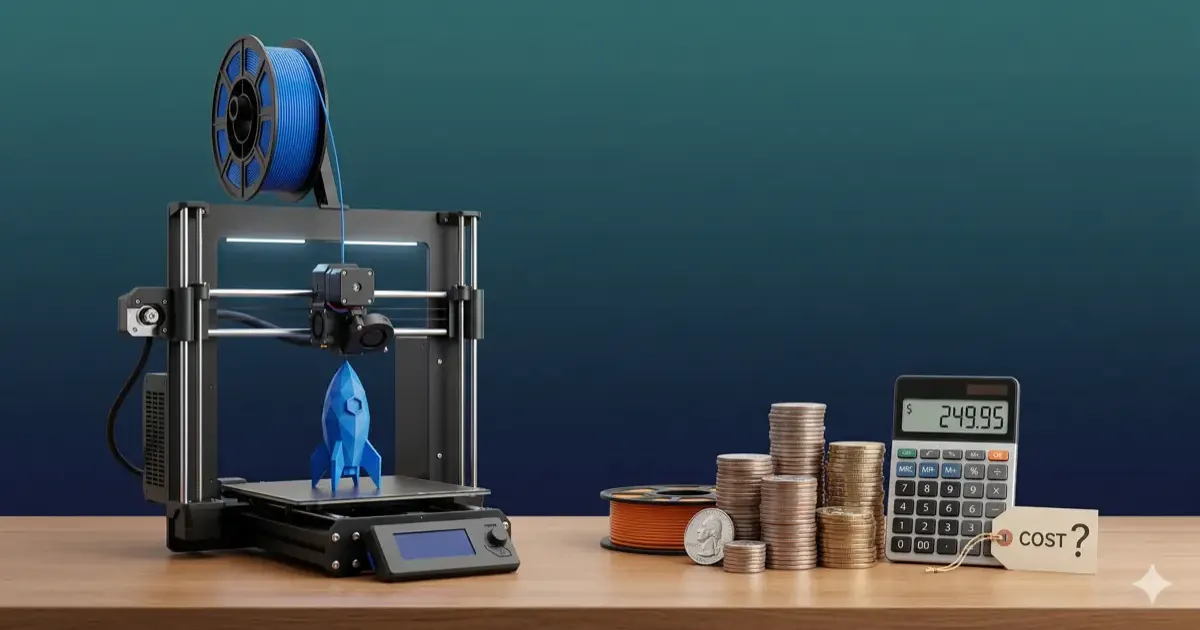
A typical small print costs between 50 cents and $2 in filament and power. The math: PLA runs $18 to $25 per kilogram (premium brands such as Prusament sit around €28), so a 50 g phone stand uses about $1 of material. Electricity barely registers: at the US average of 18.34 cents per kWh (EIA, June 2026), a printer drawing 100 W adds under 2 cents per hour. What actually moves the yearly total is the printer itself, failed prints, and upgrades, which is why the breakdown below starts there.
So you’re thinking about getting a 3D printer and want to know what it actually costs. Not the marketing fluff, the real numbers.
I’ve been printing for a while now, and I can tell you: the printer price is just the beginning. There’s filament, electricity, failed prints, replacement parts, and that irresistible urge to upgrade everything. Let me break it all down so you know exactly what you’re getting into.
Upgrading your workstation? See our all-in-one Desk Upgrade & Home Office Guide to build a comfortable, productive workspace.
If you’re still on the fence about whether to buy one at all, check out my honest analysis of whether 3D printing is worth it first.
Upfront Costs: The Printer Itself
Your biggest single expense is the printer. Here’s what the market looks like in 2026:
Budget FDM ($150-300)
This is where most beginners should start. You get surprisingly capable machines at this price point.
- Bambu Lab A1 Mini (~$200), Fast, reliable, nearly plug-and-play. My top pick for beginners.
- Creality Ender 3 V3 (~$200), Huge community, tons of upgrades available, solid workhorse.
Both are covered in detail in my best 3D printers under $300 roundup.
Mid-Range FDM ($300-600)
Bigger build volumes, better reliability, more material compatibility.
- Bambu Lab A1 (~$400), Larger build plate than the Mini, same great ecosystem.
- Prusa MK4S (~$709), Open-source legend. Premium price, but incredible build quality and community support.
Resin / MSLA ($150-400)
Resin printers like the Elegoo Mars or Anycubic Photon produce insanely detailed prints, perfect for miniatures and jewelry. But resin is messier, smellier, and the consumable costs are higher (more on that below).
Premium ($600+)
Machines like the Bambu Lab X1C (~$1,100) come with enclosures, multi-material systems, and can handle engineering-grade filaments. Overkill for most beginners, but tempting.
My recommendation: Start with a $200-300 printer. Seriously. A budget FDM printer will teach you everything you need to know, and you won’t cry if you decide the hobby isn’t for you. Our 3D printing beginners guide walks you through the whole setup process.
Ongoing Costs: Filament and Electricity
Filament Prices (Per Kilogram)
Filament is your main recurring expense. Here’s what each type costs:
| Material | Price per kg | Best For | Notes |
|---|---|---|---|
| PLA | $15-22 | General printing, beginners | Easiest to print, most popular |
| PETG | $18-28 | Functional parts, outdoor use | Stronger, heat-resistant |
| ABS | $16-25 | Heat-resistant parts | Requires enclosure, fumes |
| TPU | $25-35 | Flexible items (cases, gaskets) | Trickier to print |
PLA is where you’ll start and probably stay. It handles 90% of what office workers want to print, desk organizers, phone stands, cable clips, replacement parts. Not sure which material to pick? Here’s a deep comparison of PLA vs PETG vs ABS.
A single 1kg spool of PLA prints roughly 100-400 small items depending on size. Most casual users go through 1-2 spools per month ($15-44).
Resin costs more per gram, typically 2-4x the cost of PLA filament. But resin prints are often hollow, so you use less material per print. Still, factor in the cost of isopropyl alcohol for washing and UV curing equipment.
Electricity Costs
Good news: 3D printers barely move the needle on your electric bill.
- FDM printers: 50-250W during printing (the heated bed is the biggest draw)
- Resin printers: 30-150W
- Average US electricity rate: ~$0.17/kWh
A 10-hour FDM print costs roughly $0.10-0.50 in electricity. Even if you print every single day, you’re looking at maybe $5-15/month. This is the least of your worries.
Real-World Cost Examples
Let’s do the actual math. Here’s what common prints cost in materials and electricity:
| Filament Used | Print Time | Material Cost | Electricity | Total Cost | |
|---|---|---|---|---|---|
| Phone stand | 30g PLA | 2 hours | $0.45-0.66 | $0.03 | ~$0.50-0.70 |
| Desk organizer | 100g PLA | 6 hours | $1.50-2.20 | $0.10 | ~$1.60-2.30 |
| Cable management clips (10x) | 40g PLA | 3 hours | $0.60-0.88 | $0.05 | ~$0.65-0.93 |
| Headphone hook | 60g PLA | 4 hours | $0.90-1.32 | $0.07 | ~$1.00-1.40 |
| Cosplay helmet | 500g PLA | 20+ hours | $7.50-11.00 | $0.50 | ~$8.00-11.50 |
The average useful print costs somewhere between $0.50 and $5. Large decorative or cosplay pieces push into the $10-15 range. Need ideas for your first prints? Check out what to 3D print first.
Hidden Costs Most People Forget
Here’s the stuff that doesn’t make it into the marketing brochures:
Build Plate Adhesion
- Glue sticks, cheap, but you go through them
- PEI sheet replacement, $15-30 every 6-12 months depending on use
- Painter’s tape, a few dollars per roll
Nozzle Replacement
Nozzles wear out, especially with abrasive filaments. Budget $5-15 every few months. Hardened steel nozzles last longer but cost more upfront.
Failed Prints
This is the one nobody warns you about. As a beginner, expect 5-10% of your prints to fail, bad adhesion, spaghetti disasters, warping. That’s wasted filament and wasted time. You’ll get better fast, but those first few weeks can be humbling.
Upgrades (The Rabbit Hole)
Once you start printing, you’ll want:
- Enclosure ($50-150, or print one), for ABS and drafty rooms
- Dry box ($20-40), moisture ruins filament
- Better nozzles ($10-30), for specialty materials
- Multi-material upgrade, if your printer supports it
Time Investment
Your time has value. Factor in the learning curve: dialing in settings, learning slicer software like Cura or PrusaSlicer, troubleshooting failed prints. The first month is the steepest. After that, most prints are click-and-go.
Realistic annual hidden costs: $50-150 for a casual user, $200+ if you print heavily.
3D Printing vs. Buying: When Does It Make Sense?
Let’s be honest about when printing saves money and when it doesn’t.
Cheaper to Print
- Custom-fit items, an organizer designed exactly for your desk drawer? Can’t buy that.
- Replacement parts, a $0.50 print vs. a $25 manufacturer part (or a whole new appliance)
- Adapters and mounts, specific brackets for your exact setup
- Batch small items, 50 cable clips for $3 vs. $15 on Amazon
Cheaper to Buy
- Generic hooks and clips, a bag of 20 from the dollar store wins
- Anything you need right now, printing takes hours
- High-strength structural parts, injection-molded plastic is stronger
- Single-use items, not worth the setup time
The Real Value
Here’s what the pure cost comparison misses: you can print things that don’t exist as products. An exact-fit insert for your specific desk drawer. A replacement knob for a discontinued appliance. A custom mount for your weird monitor arm situation. That’s where 3D printing pays for itself, not in saving $2 on a phone stand, but in solving problems no store can solve.
For more on the practical side, our 3D printing guide covers everything from first print to advanced techniques.
The Verdict: What Will 3D Printing Actually Cost You?
Here’s the honest summary:
| Cost Category | Year 1 | Year 2+ |
|---|---|---|
| Printer | $200-400 | $0 (already own it) |
| Filament | $150-350 | $150-350 |
| Electricity | $20-60 | $20-60 |
| Replacement parts & maintenance | $30-80 | $30-80 |
| Upgrades | $50-150 | $0-100 |
| Total | $450-1,040 | $200-590 |
First year: $450-1,040 depending on how much you print and whether you catch the upgrade bug.
Each year after: $200-590, mostly filament.
Per print average: $0.50-5 for typical items.
Is that cheap? Compared to other hobbies, photography, woodworking, RC cars, it’s actually very affordable. And unlike most hobbies, 3D printing produces things you actually use every day. Those desk organizers, cable clips, and replacement parts add up.
Just don’t buy a printer expecting to save money on Amazon purchases. Buy it because you want to make things that don’t exist yet. The savings are a nice bonus.
Ready to get started? Our 3D printing beginners guide has everything you need to go from zero to first print.
Related Articles
Is a 3D Printer Worth It? Honest Cost Analysis 2026
Is 3D printing worth the money? An honest breakdown of purchase costs, running costs, time investment, and what you can actually make with it.
Buy vs 3D Print Tools: Pros, Cons and When to Do Which
Should you buy tools from the store or 3D print them yourself? We break down the pros, cons, costs, and durability to help you make the right decision.
Printing with TPU & Flexible Filaments: Beginner Guide
Everything you need to know about 3D printing with TPU and flexible filaments in 2026. From printer settings to drying methods and preventing jams.