
AI vs. Traditional Stock Screeners: Which Should You Use?
ChatGPT and Perplexity vs. Finviz and TradingView for stock screening. We compare features, accuracy, and pricing to help you pick the right approach.

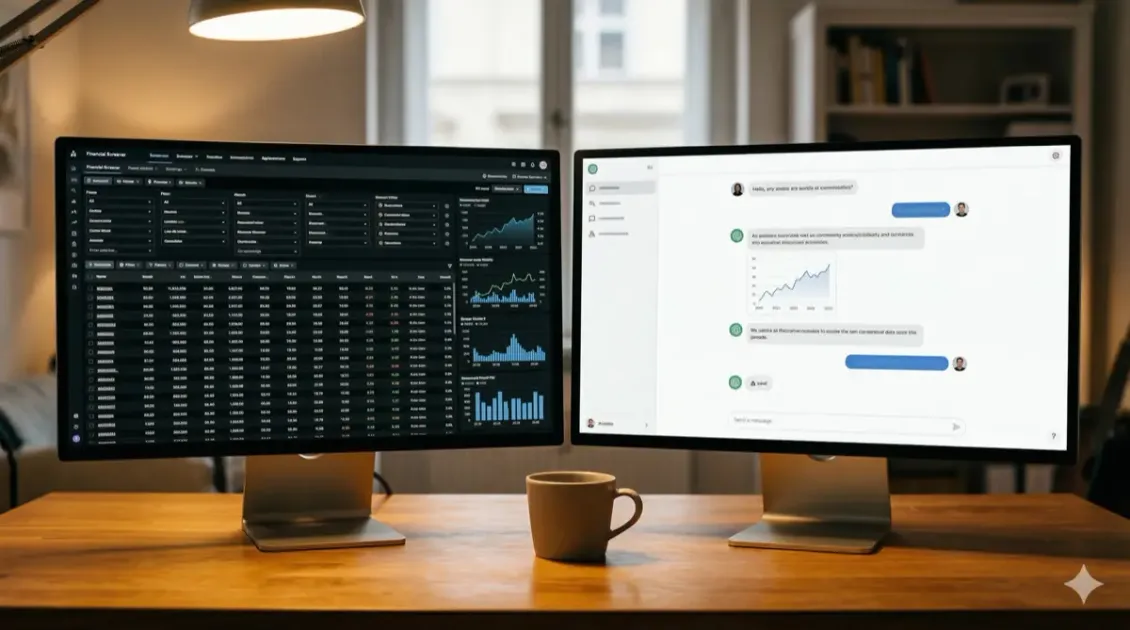
Stock screeners used to be simple: set your filters, get a list of tickers. Then AI showed up and people started asking ChatGPT to find stocks for them.
Both approaches work. But they’re good at very different things. Here’s when to use each one, and the stack that makes the most sense in 2026.
This article is for educational purposes only and does not constitute financial advice.
The Fundamental Difference
| Traditional Screeners | AI Chatbots | |
|---|---|---|
| Input | Filters and numbers | Natural language |
| Data | Real-time or 15-min delayed | Training data (not live) |
| Output | Exact, reproducible list | Contextual, conversational |
| Strength | Precision | Discovery and explanation |
| Weakness | Can’t handle qualitative criteria | Can hallucinate, no live data |
Traditional screeners answer: “Show me stocks where P/E < 15 AND dividend yield > 3%.”
AI answers: “What are some undervalued dividend stocks in the healthcare sector that might benefit from an aging population?”
Same goal, completely different approach.
Traditional Screeners: What They Do Well
Finviz
The industry standard for a reason. Clean, fast, visual.
| Feature | Free | Elite (~$25/month) |
|---|---|---|
| Screening filters | 67 | ~200 |
| Data | Delayed | Real-time |
| Heat maps | Yes | Yes |
| Backtesting | No | Yes |
| Export | No | CSV export |
| Technical patterns | Basic | Advanced candlestick |
Best for: Quick fundamental screens, market overview via heat maps, visual stock analysis.
Limitation: No pre-built screen templates. You need to know which filters to set.
TradingView
The strongest charting platform with a solid screener built in.
| Feature | Free | TradingView Plus (~$34/month) | TradingView Premium (~$60/month) |
|---|---|---|---|
| Screening metrics | ~150 | ~150 | ~150 |
| Technical indicators | 100+ | 100+ | 100+ |
| Community indicators | 100,000+ | 100,000+ | 100,000+ |
| Auto chart patterns | No | No | Yes |
| Alerts | 5 | 20 | 400 |
Best for: Technical traders who want screening + charting in one place.
Limitation: The screener alone doesn’t justify the price, you’re paying for the charting.
Seeking Alpha
More of a research platform than a pure screener, but its quant ratings are valuable.
| Feature | Free | Seeking Alpha Premium (~$20/month) |
|---|---|---|
| Quant ratings | Limited | Full access |
| Analyst ratings | Limited | Full access |
| Stock comparison | Basic | Advanced |
| Alpha Picks | No | Separate ($449/year) |
Best for: Fundamental investors who want crowd-sourced analysis alongside screening.
AI Chatbots for Screening: What They Do Well
ChatGPT
Strengths:
- Natural language queries: “Find me SaaS companies with growing revenue and positive free cash flow”
- Explains why a stock fits your criteria, not just that it does
- Can synthesize qualitative factors (competitive moats, management quality) that no screener can filter for
- Builds screening frameworks you can then apply in a traditional screener
Limitations:
- No real-time data, results are based on training data
- Can hallucinate specific numbers (always verify)
- Not reproducible, the same prompt may give different results
Best prompt for screening:
Act as a stock analyst. I’m looking for [criteria]. Suggest 10 stocks that fit, and for each one explain why it qualifies. Include current approximate market cap, P/E ratio, and revenue growth. Flag any numbers you’re less confident about.
That last sentence is key, it forces ChatGPT to self-assess.
Claude
Similar capabilities to ChatGPT for screening, with two advantages:
- 200K token context: Upload an entire earnings call transcript alongside your screening request
- More cautious: Claude tends to add more disclaimers and flag uncertainty, which is actually good for financial analysis
Limitation: CSV parsing isn’t as smooth as ChatGPT’s built-in Python sandbox.
Perplexity (The Best of Both Worlds)
This is the dark horse. Perplexity Finance has a built-in stock screener at perplexity.ai/finance with:
- Natural language screening with real-time data
- Sources from 40+ finance providers (FactSet, S&P Global, Coinbase, LSEG)
- Follow-up capability: “Which of these might see slowing growth and why?”
- Citation links so you can verify everything
Best for: Discovery-stage screening where you don’t know exactly what filters to set.
Limitation: Less granular than Finviz for precise multi-criteria filtering.
Head-to-Head: Real Examples
Example 1: “Find undervalued dividend stocks”
Finviz approach:
- Set filters: Dividend Yield > 3%, P/E < 20, Market Cap > $2B, Payout Ratio < 70%
- Get a list of 47 tickers
- Sort and analyze manually
ChatGPT approach:
- “Find me undervalued dividend stocks with sustainable payouts that are likely to maintain or increase their dividend”
- Get 10 stocks with explanations of why each one qualifies
- Follow up: “Which of these has the strongest balance sheet?”
Verdict: Finviz gives you a complete, accurate list faster. ChatGPT gives you context and reasoning but might miss stocks or hallucinate data.
Example 2: “Companies benefiting from AI adoption”
Finviz approach:
- Set sector to Technology… and then what? There’s no “AI beneficiary” filter
- You’re stuck manually searching
ChatGPT approach:
- “Which companies outside of the obvious big tech names are benefiting from AI adoption in their business operations?”
- Get a thematic, forward-looking list with reasoning
Verdict: AI wins here. Qualitative, thematic screening is something traditional tools simply can’t do.
Example 3: “Stocks near 52-week low with strong fundamentals”
Finviz approach:
- 52-Week Low filter + fundamental filters
- Real-time data, exact results
ChatGPT approach:
- Can describe the concept but doesn’t know current prices
- Would need to hallucinate or refuse
Verdict: Traditional screener wins. Anything requiring current market data needs a real screener.
The Optimal Stack for 2026
After testing various combinations, here’s what I’d recommend:
Beginner ($0/month)
| Tool | Use For |
|---|---|
| Finviz Free | Fundamental screening |
| Perplexity Free | AI-powered discovery |
| Yahoo Finance | Quick price checks |
Intermediate (~$20/month)
| Tool | Use For |
|---|---|
| Perplexity Pro | AI screening with live data |
| Finviz Free | Traditional screening |
| ChatGPT Free | Learning and frameworks |
Active Investor (~$45-60/month)
| Tool | Use For |
|---|---|
| Perplexity Pro ($20) | Daily discovery, AI screening |
| Finviz Elite (~$25) | Precise screening, real-time data |
| Claude/ChatGPT Pro ($20) | Deep analysis, earnings calls |
You don’t need all three AI subscriptions. Pick one based on whether you value real-time data (Perplexity), deep analysis (Claude), or versatility (ChatGPT).
When to Use What
| Task | Best Tool |
|---|---|
| Precise multi-filter screening | Finviz / TradingView |
| Thematic / qualitative screening | ChatGPT / Claude |
| Quick discovery with live data | Perplexity Finance |
| Technical pattern scanning | TradingView |
| “Explain why this stock is interesting” | ChatGPT / Claude |
| Earnings call + screening combo | Claude (200K context) |
| Reproducible, saveable screens | Finviz / TradingView |
| Learning what metrics mean | ChatGPT / Claude |
The Bottom Line
AI and traditional screeners aren’t competing, they’re complementary.
Traditional screeners are your filter. They give you precise, reproducible, real-time results based on hard numbers. Use them when you know what you’re looking for.
AI chatbots are your analyst. They explain, discover, and contextualize. Use them when you’re exploring, learning, or dealing with qualitative criteria.
The best investors in 2026 use both. Start with AI for discovery and thesis-building, then validate with a traditional screener’s real data.
Build Your Stack: Cost Calculator
Not sure which tools to pick? Use the calculator below to select the tools you’re considering and see your total monthly cost, feature coverage, and gaps. You can also compare against our recommended stacks.
Related: Learn how to use AI for portfolio analysis and earnings call analysis. For a broader overview of investing tools, check the investing tools guide. Looking for free screeners specifically? See our best free stock screeners roundup.
Disclaimer: This article is for informational and educational purposes only. Nothing here constitutes financial advice. Mentions of specific tools or stocks are not endorsements. Always do your own research before making investment decisions.
Stock Tool Cost Calculator
Select the tools you're considering. See your total monthly cost and which features each combo covers.
Select one or more tools:
AI Tools
Traditional Screeners
Research Platforms
Monthly Cost
$0
Annual Cost
$0
Feature Coverage
0%
Feature Coverage
| Feature | Your Stack |
|---|
Coverage by Category
Compare with Recommended Stacks
Top Frontier Models for Financial & Data Reasoning
Empirical rankings sourced from Artificial Analysis, Arena.ai, LLM Stats & BenchLM.
Related Articles

How to Use AI to Analyze Earnings Calls (Free Workflow)
Use ChatGPT, Claude, or Perplexity to summarize and analyze earnings call transcripts. Free sources, prompts, and a step-by-step workflow included.

How to Analyze Your Investment Portfolio With AI
Upload your brokerage CSV to ChatGPT or Claude and get instant portfolio analysis. Step-by-step guide with prompts for allocation, risk, and rebalancing.

10 Stock Research Prompts That Return Usable Answers
Ten prompts for researching a stock over a lunch break, what the answers are actually good for, and the points where the model quietly stops being reliable.