
Buy vs 3D Print Tools: Pros, Cons and When to Do Which
Should you buy tools from the store or 3D print them yourself? We break down the pros, cons, costs, and durability to help you make the right decision.

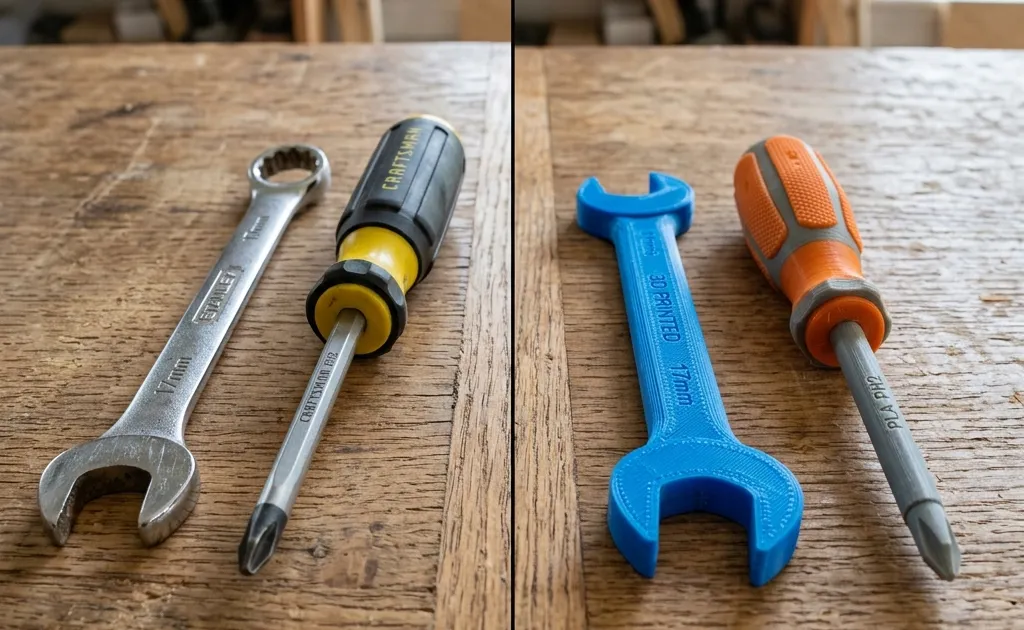
The desktop 3D printing revolution has completely changed how makers, hobbyists, and professionals approach problem-solving in their workshops. In 2026, the technology has reached a point where downloading a file and printing a physical, usable object is faster and more reliable than ever before. This incredible accessibility inevitably leads to a common question for anyone outfitting a workshop or tackling a DIY project: should you buy a tool, or should you 3D print it?
It is a deceptively simple question. On the surface, the idea of manufacturing your own tools on demand feels like a superpower. Why drive to the hardware store and spend $20 on a specialized wrench when you can print one for $0.50 in plastic? However, as anyone who has shattered a PLA wrench on a stubborn bolt will tell you, the reality is much more nuanced.
Master 3D printing from start to finish: Dive into our complete 3D Printing Guide for Beginners covering printers, troubleshooting, and project ideas.
In this comprehensive guide, we will break down the buy vs 3D print debate. We will explore the pros and cons of each approach, analyze the hidden costs, discuss material limitations, and provide a definitive list of which tools you should fabricate yourself and which ones you should absolutely purchase from a professional manufacturer.
The Case for 3D Printing Your Own Tools
The appeal of 3D printing tools is undeniable. If you already own a reliable 3D printer, the barrier to entry for creating custom hand tools, jigs, and fixtures is incredibly low. Here are the primary advantages of firing up your slicer instead of heading to the store.
1. Unmatched Customization
The single greatest advantage of 3D printing a tool is the ability to tailor it perfectly to your specific needs. Commercial tools are mass-produced to fit the average user and the most common use cases. If you have an unusually shaped workspace, a specific ergonomic requirement, or a proprietary fastener that standard tools cannot reach, 3D printing is often your only viable option. You can modify CAD files to make a handle thicker for better grip, angle a wrench head to reach around a blind corner, or design a specialized jig that holds two awkward pieces of wood at exactly 37.5 degrees.
2. Immediate Availability (For Some Items)
Have you ever been in the middle of a weekend project, only to realize you are missing a specific, inexpensive tool? If the hardware store is closed or does not stock the exact item you need, your project grinds to a halt. In these moments, searching a repository like MakerWorld or Printables, downloading a file, and printing it in an hour can be a massive timesaver. While the print time itself might take an hour or two, it saves you the trip to the store or the two-day wait for an online delivery.
3. Cost-Effectiveness for Specialized Tools
While standard tools are cheap to buy, specialized tools are often exorbitantly expensive. A basic metal caliper might cost $15, but a highly specific contour gauge or a router jig could easily cost $50 to $100. Because 3D printing costs are based entirely on the weight of the filament used (and a small amount of electricity), printing a complex, specialized tool often costs less than a dollar in plastic. This makes it incredibly economical to print tools you might only use once or twice.
4. Non-Marring Properties
Metal tools are strong, but that strength can be a liability when working with delicate materials. A metal wrench can easily scratch chrome plumbing fixtures, and metal pliers can crush soft wooden dowels. 3D printed tools, made from plastics like PLA, PETG, or TPU (flexible filament), are inherently softer than metal. This makes them excellent for “non-marring” applications where you need to apply force without damaging the surface of your workpiece.
The Drawbacks of 3D Printed Tools
While the benefits are significant, it is crucial to recognize the severe limitations of fused deposition modeling (FDM) 3D printing when it comes to tool creation.
1. Inferior Structural Strength
This is the elephant in the room. A wrench printed in standard PLA plastic will never, under any circumstances, match the tensile strength and shear resistance of forged chromium-vanadium steel. 3D prints are created layer by layer, which inherently introduces weak points along the layer lines (Z-axis). If you apply high torque to a 3D printed wrench, it is highly likely to snap along these layer lines. While stronger materials and specific print orientations can mitigate this, printed plastic simply cannot handle heavy mechanical loads.
2. Wear and Tear Over Time
Even if a 3D printed tool survives its first use, plastic degrades much faster than metal. The teeth on a printed gear or the jaws of a printed wrench will deform, round off, and lose their grip after repeated friction against metal fasteners. A quality steel tool can be passed down to your grandchildren; a 3D printed tool might barely survive the weekend.
3. Time Investment
We mentioned immediate availability as a pro, but this assumes the print goes perfectly and the tool is relatively small. If you need to print a massive drilling jig, it might take 15 hours. Furthermore, if the design needs iteration, or if the print fails halfway through, you could easily waste an entire day trying to manufacture a tool that would have taken 15 minutes to buy.
The Case for Buying Commercial Tools
For centuries, blacksmiths and engineers have perfected the art of tool making. There are very good reasons why the hardware industry relies on forged steel, aluminum, and injection-molded composites.
1. Ultimate Durability and Reliability
When you buy a high-quality hand tool from a reputable brand, you are paying for reliability. Forged metal tools can withstand immense torque, heavy impacts, and extreme temperatures without failing. When you are leaning your entire body weight onto a breaker bar to loosen a rusted lug nut, you need the absolute certainty that the tool will not shatter and send you to the hospital. Commercial tools provide this peace of mind.
2. Precision and Tolerances
While high-end 3D printers are very accurate, commercial manufacturing processes like CNC machining and die casting operate on a completely different level of precision. A store-bought metal square will be perfectly 90 degrees. A commercial caliper will measure down to the hundredth of a millimeter with repeatable accuracy. If your project demands absolute precision, rely on factory-calibrated commercial tools.
3. Ergonomics and Multi-Material Construction
Modern tool manufacturers spend millions on ergonomic research. A good store-bought screwdriver will feature a dual-density rubberized grip over a rigid core, perfectly molded to reduce hand fatigue. Replicating this level of multi-material comfort and grip security with a standard desktop 3D printer is incredibly difficult, if not impossible.
The Drawbacks of Buying Tools
Buying is not always the perfect solution, especially for budget-conscious makers.
1. High Upfront Costs
Quality tools are expensive. Outfitting a basic workshop with brand-name wrenches, saws, measuring devices, and clamps can easily cost thousands of dollars. For someone just starting a hobby, this financial barrier can be discouraging.
2. Storage and Clutter
When you buy a tool for a specific, one-off job, it goes into your toolbox and takes up space forever. Over the years, this leads to cluttered workspaces filled with highly specialized items you never use. In contrast, a 3D printed one-off tool can be recycled or thrown away without guilt once the job is done, saving physical storage space.
Material Matters: Choosing the Right Filament
If you decide that 3D printing a tool is the right path, your choice of filament is the difference between a successful project and a frustrating failure.
PLA (Polylactic Acid): This is the most common and easiest filament to print. It is very rigid and holds dimensional accuracy well. However, it is also incredibly brittle. A PLA tool will not bend; it will violently snap under pressure. It is also highly susceptible to heat and will deform if left in a hot car. Use PLA only for low-stress items like organizers or measurement templates.
PETG (Polyethylene Terephthalate Glycol): PETG is an excellent middle ground. It is stronger than PLA, has better layer adhesion, and crucially, it will flex slightly before it breaks. This flexibility makes it much safer for tools that might experience moderate stress, like clamps or light-duty wrenches. It also offers good chemical resistance against workshop oils.
ABS (Acrylonitrile Butadiene Styrene) and ASA: These materials offer excellent impact resistance and temperature stability. However, they are prone to warping during printing and require an enclosed 3D printer to process successfully. They are great for tools that might be dropped or exposed to high heat.
Polycarbonate (PC) and Carbon Fiber Blends: For the ultimate in 3D printed tool strength, advanced makers turn to Polycarbonate or filaments infused with chopped carbon fiber. These materials offer exceptional rigidity and strength that approach some soft metals. However, they are expensive, abrasive to printer nozzles, and require specialized high-temperature printers.
The Hybrid Approach: Best of Both Worlds
The most experienced makers rarely rely entirely on plastic for functional tools. Instead, they utilize a hybrid approach, combining the customization of 3D printing with the strength of commercial hardware.
A classic example is printing a large, ergonomic, custom-fit handle, but designing it to accept a standard, store-bought hex bit or metal socket. The 3D printer creates the geometry that interfaces perfectly with your hand, while the cheap, commercial metal insert handles the actual mechanical torque against the fastener.
Another hybrid technique involves using threaded brass inserts. Instead of relying on printed plastic threads (which strip out easily), you can use a soldering iron to melt metal threads into your 3D printed parts. This allows you to build complex, highly durable jigs and clamps that can be repeatedly assembled and disassembled with standard metal bolts.
Tools You SHOULD 3D Print
Based on material limits and cost analysis, here are the categories of tools where 3D printing truly shines.
1. Jigs and Fixtures: This is the killer application for 3D printed tools. Whether you need a drilling guide to ensure perfectly straight holes, a custom router template, or a fixture to hold a strangely shaped object while you solder it, 3D printing is unbeatable. These items require high customization but experience very low physical stress.
2. Organizers and Storage: Custom tool holders, battery dispensers, drawer dividers, and pegboard attachments are perfect for 3D printing. You can design them to fit your exact brand of tools, ensuring a perfectly organized workspace for pennies on the dollar.
3. Measurement and Marking Tools: Contour gauges, center finders, custom radius templates, and spacing blocks are incredibly useful and very easy to print accurately. Because they do not bear any load, even brittle PLA is perfectly acceptable for these applications.
4. Soft Jaws and Vise Pads: If you need to clamp a delicate, curved object in a metal vise without scratching it, you can design and print custom TPU (flexible) or PETG jaws that conform perfectly to the object’s shape.
5. Highly Specialized, One-Time Use Wrenches: If you have a proprietary plastic nut under your sink that requires a weird spanner, and you will only ever touch it once in your life, printing a custom wrench in PETG is much smarter than spending $30 on a specialty plumbing tool.
Tools You SHOULD NOT 3D Print
For your own safety and sanity, there are several categories of tools you should always buy commercially.
1. High-Torque Wrenches and Ratchets: Any tool required to break loose a rusted bolt, tighten automotive lug nuts, or apply heavy leverage should never be purely 3D printed. The risk of the plastic shattering and causing you to smash your knuckles against a sharp engine block is far too high.
2. Impact Tools: Hammers, mallets, center punches, and pry bars rely on massive kinetic energy and impact resistance. 3D printed layers will delaminate and shatter almost instantly under these conditions.
3. Cutting Tools: While you can print handles for blades, you cannot print a viable cutting edge using desktop FDM technology. The plastic will immediately dull or snap. Always buy commercial saw blades, utility knives, and drill bits.
4. Safety Equipment: Never, ever 3D print critical safety gear. Jack stands, heavy-duty lifting points, or safety guards for power tools must be engineered from high-strength metals and rigorously tested. Trusting your physical safety to a few layers of extruded plastic is a terrible idea.
Conclusion
The debate between buying and 3D printing tools is not about choosing one path exclusively; it is about understanding the strengths and weaknesses of your manufacturing methods.
Commercial metal tools will always reign supreme when it comes to raw strength, durability, and high-impact tasks. They are an investment in reliability and safety. If you are building a foundational workshop kit, spend your money on high-quality, store-bought essentials.
However, the 3D printer is arguably the most powerful accessory a workshop can have. It fills in the gaps that the commercial market ignores. When you need a custom jig, a highly specific organizer, or a non-marring tool for a delicate task, 3D printing offers a level of customization and cost-effectiveness that no hardware store can match.
By employing a hybrid mindset - buying for strength and printing for specialization - you can build a workshop that is perfectly tailored to your unique needs.
Looking to upgrade your technical skills? Check out our article on Is 3D Printing Worth It? or explore our detailed comparison of the Bambu A1 Mini vs Creality Ender 3 if you are looking to buy your first machine.
Related Articles
Gridfinity 101: Organize Every Drawer with 3D Printing
Master Gridfinity, the open-source modular drawer organization system. Learn grid dimensions, slicer settings, baseplate options, and bin designs.
The Golden Age of $500 3D Printers: Turn-key vs. DIY
Is $500 the sweet spot for 3D printing? We compare modern plug-and-play machines against legendary DIY kits, featuring the Bambu Lab P2S and Creality K2.
20 Best Functional 3D Prints That Are Actually Useful (2026)
Skip the toys, these 20 functional 3D prints solve real problems at your desk, home, and tech setup. Print times, difficulty, and STL sources included.