
Dumb Phones for Deep Work: Reclaiming Focus in 2026
Why high-performers are intentionally ditching their flagship smartphones for minimalist 'dumb phones' to reclaim their attention, focus, and productivity.

The Great Attention Heist
We are currently living through the greatest mass heist in human history, and we willingly opened the vault door. The commodity being stolen is not money, data, or natural resources; it is human attention.
The modern smartphone, the glowing rectangle that currently resides in your pocket, on your desk, or perhaps right in front of your eyes as you read this, is an engineering marvel. It is a supercomputer capable of instantaneous global communication, rendering photorealistic 3D graphics, and accessing the sum total of human knowledge. But it is also a perfectly designed behavioral modification engine.
Every major tech company in Silicon Valley employs armies of neuroscientists, behavioral psychologists, and UI/UX engineers whose sole, highly compensated directive is to design algorithms and interfaces that hijack your brain’s dopamine circuitry. They have weaponized the “variable ratio reinforcement schedule”, the exact same psychological mechanism that makes slot machines so violently addictive.
When you pull down to refresh a feed, you do not know if you will see a boring ad, a stressful email from your boss, or a highly validating notification that hundreds of people liked your photo. That precise unpredictability is what compels you to check your phone 150 times a day.
For a decade, we believed we could outsmart this hardware. We believed that with enough willpower, screen-time limits, grayscale filters, and app blockers, we could tame the beast. But by 2026, the verdict is in: willpower does not scale against a trillion-dollar algorithm.
To achieve true, uninterrupted “Deep Work,” a growing vanguard of professionals is realizing that software solutions to a hardware problem are fundamentally inadequate. The only way to win the game is to refuse to play it. Enter the radical, rising movement of the modern “Dumb Phone.”
The Psychological Incompatibility of the Smartphone and Deep Work
To understand why the dumb phone movement is accelerating, we must first deeply understand the concept of “Deep Work,” coined by computer science professor Cal Newport.
What is Deep Work?
Deep Work is the ability to focus without distraction on a cognitively demanding task. It is the state of mind required to write a novel, architect complex software code, formulate a massive legal brief, or synthesize complex data into a cohesive strategy. Deep Work pushes your cognitive capabilities to their absolute limit. It is rare, highly valuable, and incredibly fragile.
Conversely, “Shallow Work” encompasses non-cognitively demanding, logistical-style tasks, often performed while distracted. Replying to Slack messages, moving cards around a Trello board, answering rapid-fire emails, and attending status meetings are all Shallow Work.
The Cost of Context Switching
The human brain is physically incapable of true multitasking when it comes to complex cognitive loads. When you are writing a complex report and you pause for “just three seconds” to check an incoming iMessage, you have not just lost three seconds.
You have initiated a neurological phenomenon known as “attention residue.”
When you switch your focus from Task A (the report) to Task B (the message) and back to Task A, your attention does not immediately follow. A significant portion of your cognitive bandwidth remains “stuck” processing Task B. It can take up to 23 minutes for your brain to fully re-engage and reach the previous depth of focus on Task A.
If you check your smartphone every 15 minutes, you are existing in a perpetual state of cognitive shallowness. You are literally never entering a state of Deep Work. The modern smartphone is an engine of constant context switching. It is an artifact of the Shallow Work economy, fundamentally incompatible with deep cognitive exertion.
The Hardware Intervention: The Philosophy of the Dumb Phone
If software blockers and willpower are insufficient defenses against the slot machine in your pocket, the only viable solution is a physical, hardware-level intervention.
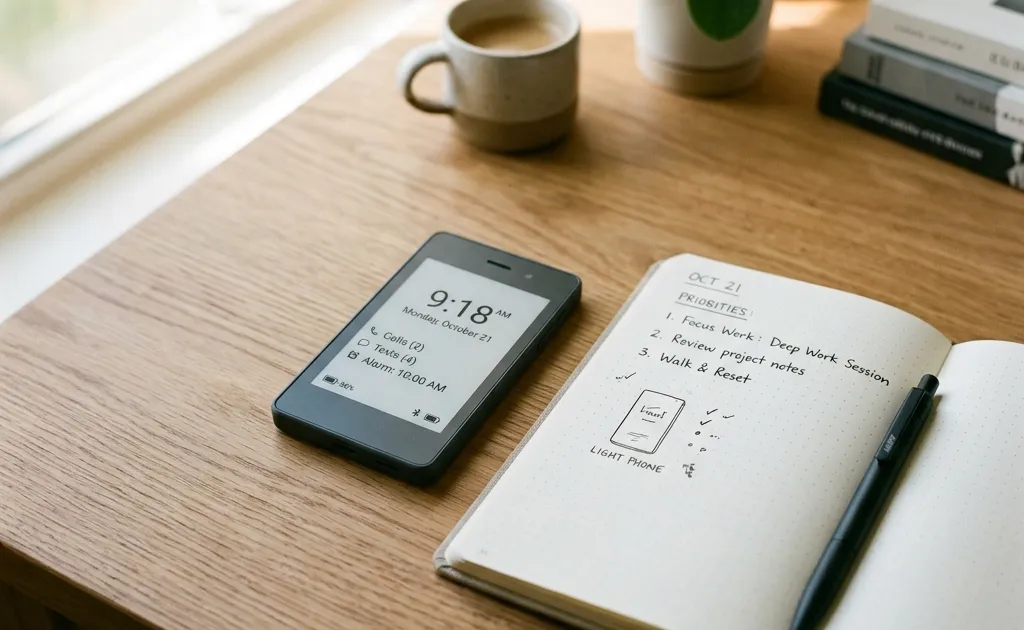
The modern “dumb phone” is not necessarily a nostalgic return to the Nokia 3310 of the early 2000s, though those still exist. Today’s minimalist phones are highly intentional, premium devices designed specifically for the modern professional who wants utility without distraction.
The Anatomy of Intentional Design
Devices like the Light Phone 2, the Punkt MP02, or the Mudita Pure share several core design philosophies:
- The E-Ink Display: Many minimalist phones utilize e-ink technology (similar to a Kindle). E-ink is functional, readable in direct sunlight, and critically, it is boring. It has a low refresh rate, making scrolling virtually impossible and visually unpleasant. It removes the glossy, high-definition dopamine hit of an OLED screen.
- Zero Algorithmic Feeds: These devices do not possess a web browser. There is no App Store. There is no Instagram, no TikTok, no X, no LinkedIn, and no Reddit. It is physically impossible to access an infinite scroll on the device.
- Utility over Engagement: A modern dumb phone is a tool, not a companion. It handles voice calls perfectly. It handles SMS text messaging (often with an intentionally cumbersome T9 keyboard to discourage long conversations). It may offer an alarm clock, a basic calculator, a minimalist podcast player, or a rudimentary maps tool for emergency navigation. It provides exactly what you need to survive in modern society, and absolutely nothing more.
- Form Factor: They are often small, lightweight, and unobtrusive. The goal is for the phone to disappear into your pocket and be entirely forgotten until you explicitly need to use it.
The Brutal Transition: The First 30 Days
Transitioning from a flagship smartphone to a minimalist device is not a gentle process. It is a jarring psychological withdrawal, frequently compared to quitting smoking or drastically cutting caffeine. If you attempt this transition, you must be prepared for the predictable phases of the detox.
Phase 1: The Phantom Vibrations and Intense Anxiety (Days 1-7)
During the first week, your brain will panic. You will reach for your pocket 50 times a day, only to remember your iPhone is sitting in a drawer at home. You will experience “phantom vibrations”, the distinct physical sensation of a notification buzzing against your leg, even when the dumb phone is entirely silent.
You will feel a profound, irrational anxiety that you are “missing out” on critical information. You will worry that your boss is trying to reach you on Slack, that your friends are making plans in the WhatsApp group, or that a major global event has occurred and you are entirely ignorant of it.
This anxiety is not real; it is the neurological manifestation of a sudden dopamine deficit. Your brain is starving for the unpredictable micro-hits of validation it has relied on for a decade.
Phase 2: The Confrontation with Boredom (Days 8-14)
As the acute anxiety subsides, you will face something even more terrifying: pure, unadulterated boredom.
For years, your smartphone has acted as an immediate pacifier against any moment of cognitive downtime. Waiting in line for coffee? Scroll. Riding the subway? Scroll. Sitting on the toilet? Scroll. When you strip away the pacifier, you are forced to sit alone with your own thoughts. If a hardware change feels too drastic, start with the software side: our account of deleting social media covers the same withdrawal curve without buying a second phone.
This is a profoundly uncomfortable experience for the modern human. However, it is also the crucial threshold. Boredom is the crucible of creativity. When your brain is deprived of external, high-intensity stimuli, it eventually begins to generate its own. This is when the fog begins to lift.
Phase 3: The Reclamation of Depth (Days 15-30)
By the third or fourth week, a profound shift occurs. The frantic, twitchy need to check a screen vanishes. You will sit down at your desk to write, code, or design, and you will suddenly realize two hours have passed seamlessly. You will have entered a state of Flow that you have not experienced since childhood.
You will notice that your baseline anxiety has plummeted. You will realize that the “urgent” emails were rarely actually urgent. You will find yourself engaging in deeper, more meaningful conversations with the people physically in front of you because you are no longer cognitively partitioned. You have successfully reclaimed your attention.
Practical Implementation: How to Make the Switch in 2026
A common objection to the dumb phone movement is the reality of modern logistical requirements. “I need my phone for two-factor authentication,” “I need Uber,” “I need to scan QR codes at restaurants,” or “My boss requires me to have Slack.”
These are valid concerns. The transition does not have to be an absolutist, all-or-nothing endeavor. Here are three practical models for implementation.
Model 1: The Weekend Purge (The Entry Level)
If you cannot abandon your smartphone during the workweek due to absolute corporate requirements, you can institute a strict hardware boundary on the weekends.
- The Protocol: On Friday at 6:00 PM, you power down your smartphone and place it in a locked drawer. You forward your calls to your minimalist phone. From Friday night until Monday morning, you only carry the dumb phone.
- The Benefit: This guarantees 48 hours of uninterrupted cognitive recovery, forcing you to be entirely present with your family, friends, and offline hobbies.
Model 2: The Two-Device Tether (The Hybrid Approach)
This is the most common approach for high-level professionals who require deep work but still need occasional access to modern utility.
- The Protocol: You maintain your smartphone, but you strip it of its SIM card (or deactivate its cellular plan). It becomes a “dumb tablet.” It lives exclusively on Wi-Fi. You carry the minimalist phone as your primary cellular device for calls and texts. If you need to hail an Uber or use mobile banking, you tether the smartphone to the minimalist phone’s mobile hotspot.
- The Benefit: The friction of having to turn on a hotspot and wait for a connection is usually enough to deter mindless scrolling, while still preserving access to mandatory modern apps when explicitly necessary.
Model 3: The Absolute Burn (The Purist)
This is the radical, uncompromising approach.
- The Protocol: You sell your smartphone. You purchase a dedicated physical GPS for your car. You buy a dedicated digital camera. You carry a physical notebook. You handle all email and social media exclusively from a desktop computer during predetermined, batched hours. The minimalist phone is your only communication device.
- The Benefit: Absolute, uncompromising liberation from the attention economy. Maximum cognitive bandwidth.
Conclusion: The Ultimate Luxury
In the 20th century, physical goods were the ultimate marker of luxury and status. In 2026, as physical goods become increasingly commoditized and cheap, the new ultimate luxury is an undivided attention span.
The ability to sit in a quiet room, stare at a complex problem, and focus on it for four uninterrupted hours is a superpower in an economy defined by distraction. It is the defining characteristic that will separate the elite knowledge workers from the easily automated, chronically distracted masses.
The smartphone is a brilliant invention, but it is a terrible master. By taking the radical step of adopting a minimalist “dumb phone,” you are not rejecting technology; you are asserting dominance over it. You are drawing a hard, physical boundary around your consciousness. You are choosing the profound, quiet power of Deep Work over the loud, exhausting chaos of the infinite scroll. The transition is brutal, but the clarity on the other side is worth every moment of withdrawal.
Related Articles
The Top 10 Must-Have Gadgets to Upgrade Your Commute in 2026
From intelligent noise-canceling headphones to smart travel mugs, these 10 gadgets will make your daily commute more productive, comfortable, and enjoyable.
TRMNL: The E-Ink Dashboard That Reclaims Your Desk and Focus
Is your desk setup missing something? Discover TRMNL, the minimalist E-ink display that gives you glanceable data without the distraction of a standard monitor.

Best Desk Upgrades Under $100 That Are Actually Worth It
The best desk upgrades under $100 in 2026, ranked by real impact on comfort and focus. Small, high-ROI changes that make working at your desk noticeably better.