
How to Leverage Time at Home to Grow: Skills & Routine
Turn quiet time at home into personal and professional growth. Discover high-leverage skill acquisition frameworks, reading habits, and evening routines.

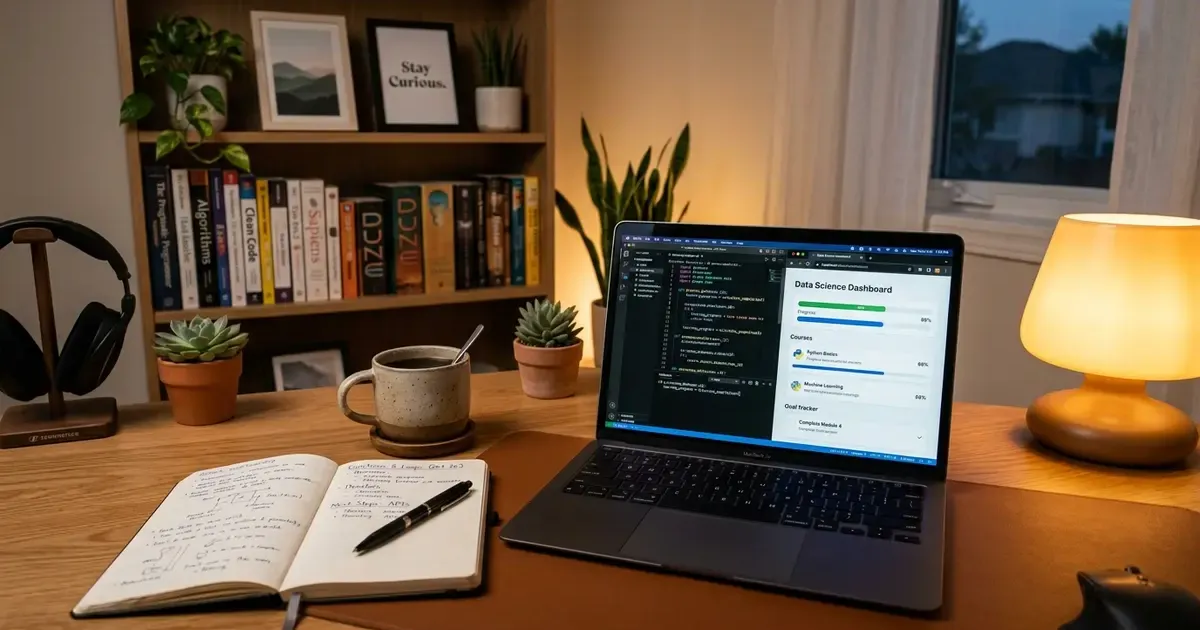
The modern shift toward remote and hybrid work has granted desk workers the most precious asset of the twenty-first century: unclaimed time. By eliminating daily office commutes, performative watercooler chatter, and rigid corporate schedules, the average knowledge worker reclaims between five and ten hours every single week.
Yet, this reclaimed time is remarkably fragile. Without intentional structure, quiet hours at home easily dissolve into doomscrolling social feeds, bingeing streaming video, or letting workplace emails seep into late-night hours.
When leveraged strategically, time at home becomes your personal incubator. The quiet evenings of autumn and winter offer an unmatched opportunity to acquire high-income technical skills, build compounding digital assets, read transformative books, and master modern tools that accelerate your career trajectory.
In this comprehensive guide, we examine how to transform your home into an engine for personal and professional growth through structured skill stacking, deliberate practice frameworks, and sustainable daily routines.
Quick Picks: High-Leverage Growth Systems at a Glance
| Growth Domain | High-Leverage Habit | Compounding Weekly Time | Expected 90-Day Outcome |
|---|---|---|---|
| Technical Fluency | AI Orchestration & Python Scripting | 3.5 hours (30 min / day) | Build automated personal workflow bots and scrapers |
| Deep Reading | Non-Fiction Book Chunking (E-Ink) | 3 hours (25 pages / day) | Complete 6–8 foundational industry books per quarter |
| Tangible Fabrication | Parametric 3D CAD Modeling | 4 hours (weekend blocks) | Design and fabricate custom functional household parts |
| Financial Literacy | Portfolio Modeling & Metric Auditing | 2 hours (weekly review) | Automate personal cash flow and asset allocation models |
| Digital Writing | Public Proof-of-Work Documentation | 3 hours (1 essay / week) | Publish a public technical portfolio establishing authority |
Looking to build future-proof technical skills? Explore our comprehensive Learn AI Master Guide for complete beginner-to-advanced learning roadmaps.
1. The Reclaimed Commute: Unlocking Compounding Time
Consider the mathematics of the eliminated commute:
| Daily Commute Saved | Reclaimed Hours per Week | Reclaimed Days per Year | Equivalent College Semesters |
|---|---|---|---|
| 45 minutes roundtrip | 3.75 hours | 8.1 full 24h days | ~1 full academic course |
| 60 minutes roundtrip | 5.0 hours | 10.8 full 24h days | ~1.5 full academic courses |
| 90 minutes roundtrip | 7.5 hours | 16.2 full 24h days | ~2 full academic semesters |
If you reinvest even half of your reclaimed commute into structured self-education, you accumulate between 150 and 200 hours of focused learning every year.
In 200 hours, you can achieve intermediate fluency in Python, complete certified machine learning programs, master parametric 3D CAD design, or build a profitable side project from scratch.
2. The High-Leverage Skill Matrix: What to Learn at Home
Not all skills yield equal career returns. High-leverage skills are asymmetric: learning them once allows you to automate repetitive tasks, multiply your hourly output, or qualify for higher-compensation roles permanently.
| Skill Domain | Core Tools & Frameworks | Why It Multiplies Career Value | Where to Start |
|---|---|---|---|
| AI Tool Orchestration | ChatGPT, Claude, Cursor, Antigravity | Completes 8-hour research and coding tasks in 45 minutes | Our curated list of best free AI courses |
| Workflow Automation | Python, Zapier, Webhooks, APIs | Eliminates manual data entry, scraping, and spreadsheet toil | Automating routine office tasks with basic scripts |
| Parametric 3D CAD | Onshape, Fusion 360, OpenSCAD | Gives you the ability to design physical products locally | Our foundational 3D printing guide |
| Financial Architecture | DCF modeling, Indexing, Portfolio tracking | Builds long-term wealth sovereignty and investment discipline | Our investing tools guide |
| Technical Writing | Markdown, Ghost, Substack, LinkedIn | Turns private technical knowledge into public career equity | Publishing weekly case studies of your learning |
Validating Your Learning with Credible Badges
While self-directed projects are vital, backing up your skills with industry-standard credentials provides immediate resume visibility for remote recruiters. To separate fluff certificates from high-value accreditations, review our analysis of quick AI certifications you can finish in a weekend.
3. Breaking Free from “Tutorial Hell”: The 20/80 Rule
The most common trap for self-directed learners at home is passive consumption syndrome (colloquially known as “tutorial hell”).
Watching ten hours of YouTube programming tutorials or bingeing online courses creates the psychological illusion of competence. However, without actively retrieving information and troubleshooting errors, retention drops below 10% within forty-eight hours.
| Learning Phase | Traditional Approach (Fails) | The 20/80 Mastery Model (Succeeds) |
|---|---|---|
| Theory Consumption | 80% (Passive video watching, lecture slides) | 20% (Rapid overview of core syntax & principles) |
| Practical Execution | 20% (Copying instructor code line-by-line) | 80% (Building an independent, unguided project) |
| Failure Resolution | Look up instructor solution immediately | Debug errors using documentation, logs, and AI feedback |
| Final Artifact | Completed course checkbox on a platform | Deployable web app, public repo, or physical print |
The “Build First, Learn on Demand” Protocol
- Pick a Concrete Micro-Goal: Rather than “I want to learn Python,” define: “I want to write a script that scrapes my local utility website, extracts monthly kilowatt-hour data, and exports a CSV chart.”
- Consult Theory Only When Blocked: Read documentation or watch a targeted tutorial only when you hit a specific technical obstacle (e.g., how to parse HTML elements or handle API authentication).
- Document Your Mistakes: Keep a digital learning journal in Obsidian or Notion. Writing down why an error occurred cements neural pathways faster than re-watching an explanation.
4. Engineering an Unshakable Home Learning Environment
Your physical and digital home environment dictates your learning success far more than willpower. If opening your laptop defaults to social media tabs or your desk feels cluttered, cognitive friction will derail your study sessions before you begin.
| Environmental Vector | Friction Point | High-Performance Optimization |
|---|---|---|
| Digital Workspace | Work Slack tabs distracting during study | Create a dedicated “Learning” browser profile with separate bookmarks |
| Physical Seating | Slouching and lower back pain during evening study | Ergonomic chair setup with proper lumbar and armrest support |
| Lighting & Visuals | Harsh overhead glare causing evening eye strain | Warm 2700K monitor light bar and task lighting |
| Distraction Shielding | Smartphone notifications interrupting deep focus | Physical phone locker or charging station in another room |
The Power of Dedicated Reading Hardware
When reading technical whitepapers, financial reports, or non-fiction books on a smartphone or laptop, you are constantly one click away from email and news feeds.
Switching to a dedicated E-Ink e-reader or digital notebook creates a closed, distraction-free environment. E-Ink technology eliminates backlighting eye fatigue and allows you to annotate texts with physical focus.
To evaluate which reading device suits your study workflow, compare models in our guide to the best e-readers for reading and explore our review of Boox vs Supernote for note-taking.
5. Micro-Habit Architecture: The 30-Minute Compounding Rule
Attempting to study for four grueling hours after a exhausting workday leads directly to burnout and abandonment within two weeks. Sustainable intellectual growth relies on low-friction micro-habits.
| Habit Stage | Actionable Implementation |
|---|---|
| 1. The Gateway Trigger (2 Minutes) | Clear your desk, pour a hot mug of herbal tea, and open your code editor. |
| 2. The Protected Block (30 Minutes) | Set a mechanical timer for 30 minutes. Focus entirely on one single problem with zero tab switching. |
| 3. The Active Commit (5 Minutes) | Commit your code to GitHub or summarize what you learned in 3 bullet points. |
| 4. The Clean Disconnect | Close your study notebook, power down your monitors, and step away immediately. |
Why 30 Minutes Compounds into Mastery
Thirty minutes of high-intensity, undistracted focus every single weekday yields 130 hours of pure deep work per year. Because this volume is accumulated without exhaustion, you maintain consistent momentum across months rather than crashing in a boom-and-bust cycle.
To keep your personal energy and mental clarity balanced while scaling your output, review our practical strategies on how to achieve genuine work-life balance and our seasonal blueprint on how to prepare for the dark season.
6. The 90-Day Home Growth Roadmap
Follow this structured quarterly progression to transform unclaimed home hours into measurable career equity:
| Phase | Duration | Core Focus | Weekly Milestone |
|---|---|---|---|
| Phase 1: Foundation | Weeks 1 to 4 | Core Syntax & Tool Setup | • Complete foundational online modules. • Establish daily 30-minute study trigger. • Configure dedicated learning profiles. |
| Phase 2: Execution | Weeks 5 to 8 | Unguided Project Building | • Build first independent micro-project. • Debug issues independently with AI assistance. • Read 2 key domain non-fiction books. |
| Phase 3: Public Synthesis | Weeks 9 to 12 | Portfolio & Deployment | • Polish and deploy public GitHub repository. • Write a public case study detailing the build. • Explore monetizing your skills via freelance or side ventures. |
If you are exploring ways to translate your home-acquired hobbies into commercial revenue streams, read our complete breakdown on whether your hobby can become a profitable business.
Frequently Asked Questions
How many hours a week do I need to learn a valuable new skill at home?
Committing just 30 to 45 minutes per day (roughly 4 to 5 hours per week) of focused, deliberate practice is enough to acquire foundational competence in programming, AI prompting, or financial analysis within 90 days.
What are the highest-leverage skills to learn from home in 2026?
The highest-ROI skills include AI tool orchestration, workflow automation with Python or low-code tools, financial modeling, 3D CAD modeling (like Onshape or Fusion 360), and technical copywriting.
How do I avoid passive consumption (tutorial hell) while self-studying?
Adopt the 20/80 Rule of learning: spend 20% of your time consuming theory or video tutorials, and 80% building tangible proof-of-work projects (such as writing an analysis, coding a script, or 3D modeling a functional part).
How do I stay motivated to learn after a full workday at home?
Eliminate transition friction by scheduling a physical boundary between work and study (such as a 15-minute walk), shifting to a different desk layout or secondary device, and linking study sessions to immediate tangible milestones.
Summary: Your Home as a Personal Growth Engine
Your home is more than a place to rest; it is the most flexible, customizable learning laboratory you will ever possess.
By guarding your reclaimed commute hours, pursuing asymmetric technical skills, adhering to the 20/80 active building rule, and compounding thirty minutes of daily deliberate practice, you can outpace conventional career trajectories from the comfort of your own desk.
Start with thirty focused minutes tonight, and let your quiet hours at home compound into unstoppable personal mastery.
Related Articles

8 Best Books to Read in Winter for Focus & Growth
Discover the best books to read in winter. Transform cold, dark evenings into deep personal growth with top titles on focus, psychology, and mastery.

How to Learn AI While Looking Busy at Work
Learn AI skills during work downtime. Stealth learning strategies, workplace-friendly platforms, and how to turn boredom into career advancement.

The Impact of AI on Children: Opportunities and Risks (2026)
How is artificial intelligence shaping childhood, education, and brain development in 2026? A research-backed guide for parents and educators.