
OM SYSTEM PEN Review: Retro Charm Meets Modern Power
Our in-depth OM SYSTEM PEN review covers the new 20.4MP sensor, built-in OLED EVF, IPX1 weather sealing, creative profile dial, and real-world performance.
 Mehdi
Mehdi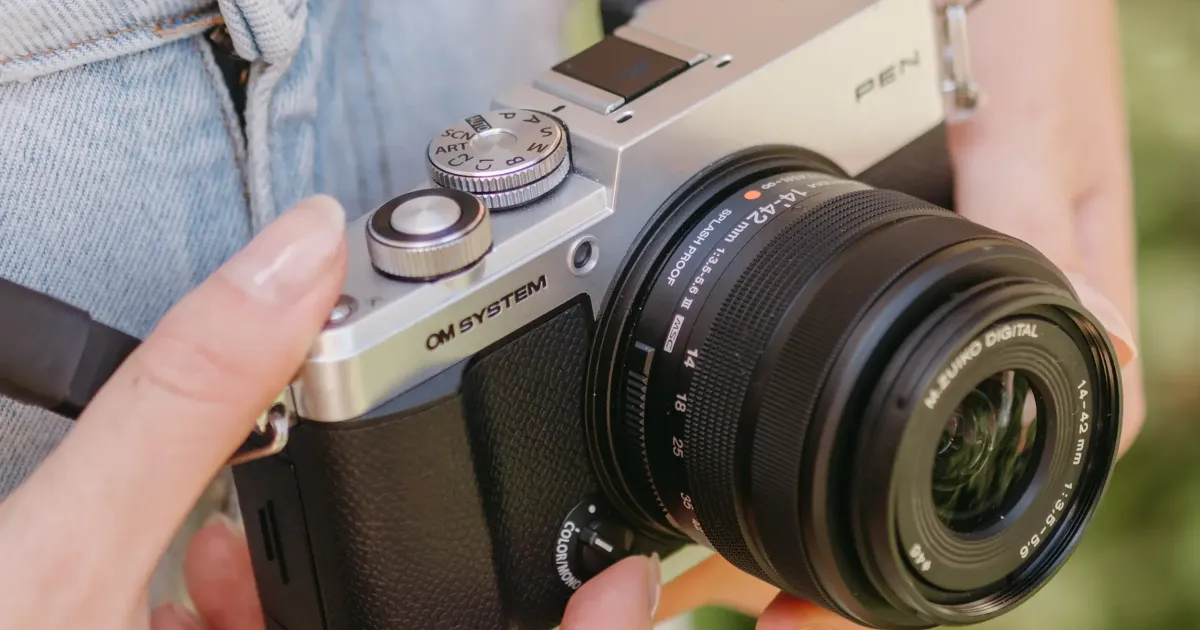
For nearly a decade, street photographers, travel creators, and everyday visual storytellers have held onto a stubborn wish: a true, modern successor to the legendary 2016 Olympus PEN-F. While smartphones have taken over point-and-shoot snapshots, their synthetic algorithms often produce clinical, over-sharpened images that leave creative photographers cold. The original PEN-F proved that photographers crave tactile, mechanical interaction, physical control dials, dedicated film simulation modes, and an integrated corner viewfinder that lets you shoot with both eyes engaged. With the official launch of the new OM SYSTEM PEN, OM Digital Solutions has finally delivered the rangefinder-style mirrorless camera photographers have spent years asking for.
Master photography from start to finish: Explore our foundational Beginner Photography Guide covering essential exposure principles, optics, and camera gear recommendations.
Unlike the screen-only PEN E-P7 from 2021, the new OM SYSTEM PEN reintroduces a crisp 2.36-million-dot OLED electronic viewfinder (EVF), adds on-sensor phase-detection autofocus (PDAF) with intelligent subject recognition, brings IPX1 weather sealing to the PEN family for the first time, and retains the beloved front creative profile dial. Whether you are moving past smartphone photography limitations or seeking an ultra-compact daily carry that rivals fixed-lens cult favorites, this camera demands your attention.
Quick Picks: OM SYSTEM PEN at a Glance
Before diving into our field test and detailed ergonomics teardown, here is how the OM SYSTEM PEN stacks up across primary hardware specifications and capabilities:
| Feature / Metric | Specification | Real-World Advantage |
|---|---|---|
| Sensor & Processor | 20.4MP Live MOS (4:3) + TruePic IX | High dynamic range, low noise, rich color depth |
| Viewfinder (EVF) | 2.36M-dot OLED, 1.10x to 1.23x magnification | Natural corner-mounted eye-level framing in direct sunlight |
| Autofocus | 121-point all-cross phase detection AF | Fast tracking for humans, cats, and dogs |
| Image Stabilization | 5-axis in-body sensor shift (5.5 EV stops) | Sharp handheld shutter speeds down to 1/2 second |
| Weather Sealing | IPX1 certified splashproof and dustproof | Reliable outdoor shooting in rain when paired with sealed lenses |
| Rear Screen | 3.0-inch vari-angle touch LCD (180° flip) | Low-angle framing, vertical shooting, and vlogging |
| Creative Controls | Dedicated front dial: 4 Color + 4 Mono profiles | Instant custom film looks and grain simulation in JPEG |
| Computational Tools | CP button: Live ND (ND2–16), High Res, Focus Stacking | Long exposures and macro stacks without carrying physical filters |
| Weight & Body | 344 g (body) / 393 g (with battery & SD card) | Featherlight everyday carry that slips into small jacket pockets |
| Price (MSRP) | 999 € ($999 body) / 1.099 € ($1,099 with 14-42mm III) | Competitive entry point against fixed-lens alternatives |
Design and Build: The Tactile Joy of Rangefinder Photography
Holding the new OM SYSTEM PEN immediately reminds you why dedicated cameras continue to spark joy. At just 344 grams for the bare body (and 393 grams loaded with battery and SD card), the camera is marvelously compact, measuring 125.8 mm wide, 74.5 mm tall, and 43.3 mm deep. Yet it feels substantial in the hand thanks to precision aluminum top and bottom plates, knurled metal control dials with positive click detents, and a handsome faux-leather textured wrap available in both classic two-tone Silver and stealthy all-Black finishes.
The corner-mounted electronic viewfinder is the headline hardware improvement. By placing the 2.36-million-dot OLED finder in the far upper left corner rather than centered in an SLR-style faux prism, the camera keeps your right eye centered on the scene while your left eye remains open to track incoming pedestrians, changing street light, or your subject’s expression. The EVF delivers approx. 100% frame coverage, a fast refresh rate with zero discernible lag in standard light, and a built-in diopter dial (-4 to +2) for glasses wearers.
For composing from hip level or overhead, the 3.0-inch touch display features a fully articulating vari-angle hinge. You can flip the screen outward to shoot low-angle street candids, angle it upward for tabletop still life, fold it forward for vlogging, or turn it face-in against the camera back to protect the glass from scratches during transit.
Crucially, OM SYSTEM engineered IPX1-certified weather sealing into the PEN chassis. When paired with weather-resistant optics like the new M.Zuiko 14-42mm F3.5-5.6 III kit lens or compact PRO primes, you no longer have to retreat indoors the moment rain starts drizzling. For street photographers and urban travelers, that peace of mind transforms how often you keep the camera on your shoulder.
Sensor Performance and the TruePic IX Engine
At the core of the OM SYSTEM PEN sits a 20.4-megapixel Live MOS Micro Four Thirds sensor coupled with the TruePic IX image processor. While full-frame enthusiasts often fixate on pure sensor surface area, the 4:3 aspect ratio provides distinct compositional advantages, offering more vertical headroom in standard orientation and packing edge-to-edge optical sharpness across the image circle.
In real-world shooting, native ISO spans from ISO 200 to 25,600, with an extended ISO LOW setting at ISO 64 and 100 for high-shutter daylight portraits. Images shot between ISO 200 and ISO 1,600 exhibit outstanding clarity, rich micro-contrast, and clean shadows. Chromatic noise remains tightly controlled up to ISO 3,200, making evening street sessions under café lights and neon signage completely viable without aggressive software reduction.
When dynamic range challenges arise, such as shooting toward a bright sunset down a city avenue, the 12-bit RAW files capture generous highlight recovery margin. Paired with Olympus heritage optical coatings that suppress flare, you get clean, rich tonality that avoids the artificial HDR bloom prevalent in modern smartphone computational captures.
The Front Creative Dial: Mastering Film Looks in Camera
One of the defining signatures of this new camera is the dedicated four-position Creative Dial mounted directly to the right of the lens mount. While standard cameras bury color tuning deep within nested menus, the OM SYSTEM PEN elevates color science to an instinctive physical control:
- Color Profile Control: Offers 4 customizable slots (COLOR 1 through COLOR 4). You can individually tweak the saturation of 12 distinct color hues across 11 levels (-5 to +5), adjust highlight and shadow curves directly via the command wheels, and apply subtle peripheral shading (vignetting) in 11 steps.
- Monochrome Profile Control: Features 4 monochrome memory banks (MONO 1 through MONO 4). Photographers can engage 8 digital color filters (Yellow, Orange, Red, Green, etc.) at three intensity levels to manipulate tonal separation in black-and-white. You can select sepia, blue, violet, or green toning, dial in 11 steps of vignetting, and inject film grain simulation (Low, Medium, High) to replicate classic Tri-X 400 or Ilford HP5 street textures.
- Art Filters: Provides instant access to 16 classic art presets, including Bleach Bypass, Grainy Film, Cross Process, Vintage, and Dramatic Tone.
- Color Creator: Allows free-form 360-degree color wheel hue shifts and saturation adjustments on the fly.
Because these looks render in real time through the OLED EVF, you compose directly with the finished aesthetic in mind. When you hit the shutter, the camera saves both the stylized JPEG and an uncompressed RAW file simultaneously, giving you immediate web-ready film aesthetics without sacrificing digital negative safety. Furthermore, using the companion OM SYSTEM OI.Share mobile app, you can export your custom recipes as profile files to share with friends or download community presets wirelessly.
Autofocus Upgrades: 121-Point Phase Detection with AI Tracking
The biggest operational flaw of earlier entry-level PEN bodies was their reliance on contrast-detect autofocus, which could hunt and wobble in low light or while tracking moving subjects. The new OM SYSTEM PEN completely eliminates this bottleneck by borrowing the high-speed hybrid autofocus system from advanced OM-D bodies.
The camera sports 121 on-sensor phase-detection cross-type AF points paired with intelligent subject recognition algorithms trained to identify:
- Human faces and eyes: Locks accurately onto pupils even when your subject turns sideways or wears sunglasses.
- Cats and dogs: Essential for pet photography and candid animal street portraits.
- Starry Sky AF: An automated astronomical focus algorithm that snaps pinpoint focus onto dim stars in seconds without manual zooming.
Working range extends from -3.5 EV up to 20 EV, allowing the camera to acquire lock in dimly lit alleyways and jazz clubs without requiring the bright orange AF assist illuminator. Continuous AF (C-AF) tracks approaching cyclists and pedestrians with minimal hunting, while silent electronic burst shooting hits up to 30 frames per second in Pro Capture mode. Pro Capture starts buffering frames the instant you half-press the shutter, saving up to 20 images before full actuation so you never miss fleeting street moments.
5-Axis In-Body Image Stabilization and Computational Power
Olympus pioneered modern sensor-shift stabilization, and OM SYSTEM has refined it to a high art. The 5-axis IBIS unit inside this compact body compensates for pitch, yaw, roll, vertical shift, and horizontal shift, delivering up to 5.5 EV stops of stabilization.
In practice, this means you can mount a fast prime lens like the M.Zuiko 17mm F1.8 or 20mm F1.4 PRO and easily shoot handheld exposures at 1/2 second or even 1 full second without camera shake. Moving water, passing bus headlights, and dim interior architectural details blur smoothly while stationary subjects remain razor-sharp, eliminating the need to carry a tripod on city walks.
Furthermore, a dedicated CP (Computational Photography) button on the top plate unlocks advanced multi-shot computational features directly in hardware:
- Handheld High Res Shot: Captures and aligns 16 rapid exposures to produce ultra-detailed 50-megapixel images with reduced noise and increased dynamic range without a tripod.
- Live ND: Simulates physical neutral density filters (ND2, ND4, ND8, and ND16) digitally. You can watch water smooth out live in the viewfinder while standing on a sunlit bridge at mid-day.
- In-Camera Focus Stacking: Blends 3 to 15 bracketed focus shots into a single composite with deep depth of field, ideal for close-up botanicals, product details, and jewelry.
- Live Composite: An indispensable feature for night skies and light painting. The camera only records newly exposed light sources without overexposing the static background over minutes or hours.
Video Features for Everyday Creators
While the OM SYSTEM PEN is unashamedly a photographer’s camera first, its video capabilities are thoroughly modern:
- 4K UHD (3840x2160) up to 30p and Cinema 4K (4096x2160) at 24p with bitrates up to 240 Mbps.
- Slow & Quick (S&Q) video: Full HD capture up to 120 frames per second for smooth slow-motion b-roll.
- Vertical Video: Automatically flags orientation metadata when shooting vertically for instant upload to Instagram Reels, YouTube Shorts, or TikTok.
- Audio: Built-in stereo microphones plus a dedicated 3.5 mm external microphone jack for wireless lavaliers or shotgun mics.
- Picture Profiles: Includes flat picture profiles, OM-Cinema profiles, and OM-Log400 for color grading flexibility.
Thanks to the vari-angle screen and class-leading 5-axis IBIS, walking video clips look remarkably steady without an external gimbal, making the PEN an outstanding travel vlogging tool.
Market Comparison: OM SYSTEM PEN vs. Rivals
To understand where the new PEN fits into the broader mirrorless landscape, let us compare it against its closest compact competitors:
| Metric | OM SYSTEM PEN | Fujifilm X100VI | Ricoh GR IIIx | Sony a6700 |
|---|---|---|---|---|
| MSRP Price | 999 € / $999 | $1,599 | $1,049 | $1,398 (body) |
| Lens System | Interchangeable (MFT) | Fixed 23mm F2 | Fixed 26.1mm F2.8 | Interchangeable (E-mount) |
| Sensor Size | 20.4MP Micro Four Thirds | 40.2MP APS-C | 24.2MP APS-C | 26MP APS-C |
| Viewfinder (EVF) | 2.36M-dot OLED | Hybrid Optical/EVF | None (Screen only) | 2.36M-dot OLED |
| Rear Display | 3.0” Vari-Angle Touch | Tilt-only Touch | Fixed Touch | 3.0” Vari-Angle Touch |
| Image Stabilization | 5-axis IBIS (5.5 EV) | 5-axis IBIS (6.0 EV) | 3-axis IBIS (4.0 EV) | 5-axis IBIS (5.0 EV) |
| Weather Sealing | IPX1 certified | Only with adapter ring | None | Dust/moisture resistant |
| Weight | 393 g | 521 g | 262 g | 493 g |
Key Takeaways from the Comparison:
- Interchangeable Flexibility vs. Fixed Optics: While the Fujifilm X100VI and Ricoh GR IIIx lock you into a single focal length forever, the PEN allows you to mount pancake primes, telephoto bird zooms, fast portrait glass, or vintage adapted lenses.
- Size and Ergonomics Balance: It offers a complete viewfinder, articulating screen, and 5-axis IBIS while remaining more than 120 grams lighter than the Fujifilm X100VI.
- Value Proposition: At 999 € body-only, the PEN undercuts both the X100VI and Sony a6700 significantly, leaving ample budget for high-grade prime lenses.
Recommended Lenses for the OM SYSTEM PEN
Because the camera uses the mature Micro Four Thirds mount, you have access to dozens of remarkably compact lenses. If you want to keep your setup pocketable, these three optics represent ideal pairings:
- M.Zuiko Digital 17mm F1.8 (34mm equivalent): The quintessential street photography lens. Compact metal build, snap-focus manual clutch ring, and a wide F1.8 aperture for low light.
- M.Zuiko Digital 20mm F1.4 PRO (40mm equivalent): For photographers who want professional weather sealing, feathered bokeh, and elite edge-to-edge optical resolution in a tiny package.
- M.Zuiko Digital ED 14-42mm F3.5-5.6 EZ or III: An ultra-slim pancake zoom that collapses flat against the body, making the camera small enough to fit inside a jacket pocket or small sling bag.
If you are just starting out and wondering whether to prioritize expensive bodies or quality optics, read our analysis on lens versus camera body investments for strategic advice.
Final Verdict: The Everyday Rangefinder Reborn
The OM SYSTEM PEN is not designed to replace high-speed wildlife flagships or bulky cinema rigs. Instead, it succeeds brilliantly at what it was created to do: bring pure, unadulterated photographic excitement back to daily life.
By pairing classic 1960s rangefinder aesthetics with a sharp OLED viewfinder, tactile command dials, instant film simulation control, robust 5-axis stabilization, and IPX1 weather sealing, OM SYSTEM has created one of the most compelling compact cameras of 2026. If you want a camera that inspires you to pick it up every morning, slip it over your shoulder, and see the world with deliberate artistic intention, the new OM SYSTEM PEN is worth every penny.
What to Read Next
Related Articles
Why a Great Lens Beats a Pro Camera Body in 2026
Is your camera holding you back, or is it your lens? Learn how a high-quality lens can save a mediocre camera body and why glass is the best investment.
Sensor Sizes: Full Frame vs. APS-C vs. Micro Four Thirds
Choosing the right camera sensor size is the most important decision for your photography workflow. Compare Full Frame, APS-C, and MFT to find your perfect fit.

The Golden Age of $500 3D Printers: Turn-key vs. DIY
Is $500 the sweet spot for 3D printing? We compare modern plug-and-play machines against legendary DIY kits, featuring the Bambu Lab P2S and Creality K2.