
3D Printable Camping Gadgets: 10 Outdoor Must-Haves
Discover the best 3D printable camping gadgets to upgrade your outdoor trip. From TPU lantern diffusers to filament choice tips for heat and UV resistance.

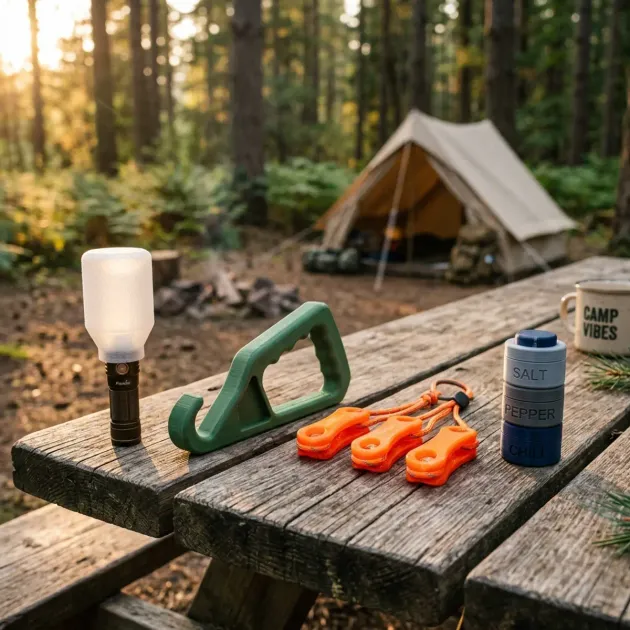
Packing for a camping trip always involves a delicate balancing act between utility, weight, and organization. Commercial outdoor gear is often expensive, locked into proprietary ecosystems, or sold in fixed configurations that do not quite fit your specific backpack layout.
This is where consumer 3D printing shines. Desktop FDM printers allow outdoor enthusiasts to produce customized, lightweight, and surprisingly resilient equipment right at home. Whether you need an emergency repair clip in the backcountry or a dedicated organizer for your camp kitchen, 3D printing offers tailored solutions for a fraction of retail prices.
Master 3D printing from start to finish: Dive into our complete 3D Printing Guide for Beginners covering printers, troubleshooting, and project ideas.
Before hitting the print bed, however, outdoor environments introduce environmental stresses that indoor functional prints rarely face. Direct solar radiation, mechanical impact, dirt, rain, and thermal exposure inside parked vehicles demand deliberate material selection and slicing techniques.
In this guide, we break down the critical material science for outdoor additive manufacturing, list 10 essential 3D printable camping gadgets, and share slicing strategies to ensure your printed gear handles rugged trail conditions.
Outdoor Filament Guide: PLA vs. PETG vs. TPU vs. ASA
Selecting the wrong material is the most common reason 3D printed outdoor gear fails. While Poly Lactic Acid (PLA) is the standard choice for table decor and indoor prototypes, it struggles when exposed to real-world outdoor variables.
| Filament | Glass Transition Temp | UV Resistance | Impact Strength | Best Outdoor Use |
|---|---|---|---|---|
| PLA | 55°C - 60°C | Low | Moderate/Brittle | Temp Prototypes |
| PETG | 80°C - 85°C | High | High | Structural Gear |
| TPU (95A) | -40°C - 80°C | Excellent | Maximum | Flex Seals/Clips |
| ASA | 95°C - 105°C | Superior | High | Hard Hardware |
1. Why PLA Fails Outdoors
PLA softens at around 55°C (131°F). On a sunny summer day, ambient temperatures inside a parked car or sealed storage bin easily top 60°C. A PLA tent clip or flashlight mount left under direct sunlight will sag, deform, and lose structural tension within hours. Furthermore, raw PLA degrades faster under continuous UV light exposure. For more details on material limitations, check out our comprehensive breakdown on PLA vs PETG vs ABS filament choices.
2. PETG: The Outdoor Workhorse
Polyethylene Terephthalate Glycol (PETG) is the go-to filament for camping accessories. It withstands temperatures up to 80°C without deformation, exhibits outstanding layer adhesion, and resists UV degradation. PETG retains slight flexibility under stress, preventing sudden catastrophic snaps when dropping a tool onto rocks.
3. TPU: Flexible and Indestructible
Thermoplastic Polyurethane (TPU) is an elastomer that combines rubber-like flexibility with industrial durability. TPU prints are virtually immune to impact shock, fully waterproof, and highly resistant to chemical exposure and abrasion. It is ideal for gaskets, friction-fit caps, and flexible ties. If you are new to printing flexible materials, review our detailed guide on printing with TPU flexible filaments.
4. ASA: Industrial Weather Resistance
Acrylonitrile Styrene Acrylate (ASA) is an upgraded alternative to ABS engineered explicitly for harsh outdoor weathering. It offers high heat deflection (above 95°C) and superior UV stability. If you plan to print permanent vehicle roof-rack mounts or solar panel hardware, ASA is the top choice, though it requires a heated enclosure to prevent warping during printing. The same heat logic applies inside a parked car, which is why ASA and PETG carry my 3D printable car gadgets guide.
10 Must-Have 3D Printable Camping Gadgets
Here are 10 highly practical 3D printable designs designed to improve organization, comfort, and efficiency on your next outdoor excursion. You can find free 3D models for these designs on popular repositories like Printables, MakerWorld, and Thingiverse. For tips on finding optimized STL files, read our breakdown of the best sites for free 3D models.
1. Flexible Lantern Diffuser for EDC Flashlights
- Primary Function: Converts a directional pocket flashlight beam into soft, 360-degree ambient tent lighting.
- Recommended Material: Natural/Translucent TPU 95A (or White PETG printed in Spiral Vase mode).
- Key Slicing Settings: 0.2mm layer height, 0% infill (vase mode or 2 wall perimeters), 100% cooling fan speed.
| Mode | Beam Pattern | Light Dispersion | Best Application |
|---|---|---|---|
| Bare Flashlight | Focused Narrow Beam | High Glare / Harsh Shadows | Trail Navigation |
| With 3D Diffuser Cap | 360-Degree Omnidirectional | Soft Ambient Glow | Tent Lighting / Campsite Table |
A concentrated flashlight beam is great for navigating trails at night, but inside a tent, it creates harsh shadows and blinding glares. A friction-fit diffuser cap slip-fits over the head of your flashlight. Printing in translucent TPU gives the diffuser drop-proof elasticity so it will not crack when stuffed into a packed backpack pocket.
2. Heavy-Duty Ergonomic Tent Stake Puller
- Primary Function: Provides mechanical leverage to extract stubborn tent pegs from dry soil or rocky ground.
- Recommended Material: PETG or ASA.
- Key Slicing Settings: 5 wall perimeters, 40% Gyroid infill, 0.24mm layer height for layer bonding.
Pulling bent tent stakes out of baked soil using bare fingers or thin guy lines often leads to sore hands or broken cords. A printed ergonomic handle features a hooked nose shaped to grab standard steel or aluminum J-stakes.
Print Orientation Warning: Always orient the model flat on its side on the build plate. This ensures that when you pull upward on the handle, the tension force runs parallel along continuous filament lines rather than pulling layer seams apart horizontally.
3. Spiral Guyline Tensioners & Cord Runners
-
Primary Function: Provides quick-adjusting tension for tent lines, tarp guylines, and rainfly paracord.
-
Recommended Material: PETG.
-
Key Slicing Settings: 100% solid infill (or 5 perimeters), 0.16mm layer height.
-
Threading Path: Tarp Paracord -> Top Friction Hole -> Center Tension Cam -> Bottom Lock Hole -> Ground Anchor Stake.
Metal guyline runners are easy to lose on the forest floor, while knotting ropes by hand in cold weather is frustrating. Printed line tensioners utilize 3-hole friction pathways or dynamic cam teeth to lock 3mm to 5mm paracord securely under heavy winds. Weighing under 3 grams each, printing a dozen spares costs only pennies in filament.
4. Modular Stackable Spice Rocket
- Primary Function: Keeps salt, pepper, garlic powder, and campfire seasonings compact and moisture-free.
- Recommended Material: Food-safe PETG (printed with a clean stainless steel nozzle).
- Key Slicing Settings: 0.16mm layer height for ISO thread accuracy, 3 perimeters, 15% infill.
Carrying individual spice shakers takes up valuable cooler space. A modular spice rocket consists of small cylindrical compartments that screw into one another in a single vertical column. The top cap features a dual-hole shaker lid, while rubber or silicone O-rings placed between threads prevent moisture from clumping dry spices.
5. Dual-Layer Soap Saver Dish
- Primary Function: Elevates bar soap above standing water to prevent it from turning into mush inside your pack.
- Recommended Material: PETG or TPU.
- Key Slicing Settings: 0.2mm layer height, 0.2mm clearance tolerance for snap-fit lids.
Biodegradable bar soap is an eco-friendly choice for outdoor hygiene, but storing a wet bar inside a sealed plastic bag creates a messy slime. A two-piece printed soap dish features a removable internal drainage grate. Water drips through the grate into the lower catch basin, leaving the soap dry and firm for your next wash.
6. Print-in-Place Backpack Carabiners
-
Primary Function: Secures mugs, camp shoes, light lanterns, and dry bags to backpack MOLLE webbing.
-
Recommended Material: PETG or PETG-CF (Carbon Fiber Reinforced).
-
Key Slicing Settings: 4 perimeters, 50% infill, horizontal orientation for optimal spring flex.
-
Integrated Spring Action: Designed with an internal compliant plastic cantilever spring that flexes open and snaps shut without separate metal pins or hinges.
Print-in-place carabiners feature an integrated plastic leaf spring that requires no assembly after printing. While 3D printed carabiners are never rated for climbing or safety loads, high-perimeter PETG carabiners easily support 10 to 15 kg (22 to 33 lbs) of gear hanging off your backpack or canopy poles.
7. Protected 2-Pack Egg Travel Case
- Primary Function: Protects fresh eggs from being crushed by heavy food items inside camp coolers.
- Recommended Material: PETG outer shell with soft TPU inner lining pads.
- Key Slicing Settings: 0.2mm layer height, print-in-place living hinges or slide-latch pins.
Fresh eggs are a luxury at camp, but standard cardboard cartons instantly disintegrate when exposed to melting ice in a cooler. A printed hardshell case holds two or four eggs securely in place. Adding printed TPU internal shock pads cradles eggshells against vibrations during bumpy road travel.
8. Mosquito Coil Safety Burn Stand
-
Primary Function: Keeps burning citronella coils safely elevated off dry leaves and forest debris.
-
Recommended Material: ASA or PETG with a metal coin/washer heat shield insert.
-
Key Slicing Settings: 3 perimeters, 25% infill, high heat deflection orientation.
-
Layered Safety Construction: Lit Citronella Coil -> Elevated Metal Washer (Thermal Barrier) -> Heat-Resistant 3D Printed Dish Base -> Ash Collection Basin.
Mosquito coils are effective at repelling bugs around camp, but placing a lit coil directly on dry ground poses a fire hazard. A 3D printed coil dish holds the center pin elevated above a ash-catching tray.
Safety Note: Always insert a metal washer or coin into the printed mounting slot to separate the hot metal coil holder from direct contact with the plastic base.
9. Ratcheting Cable & Hose Clamps
- Primary Function: Bundles solar charger cords, power bank cables, and inflatable sleeping pad straps neatly.
- Recommended Material: TPU 95A.
- Key Slicing Settings: 3 perimeters, 20% infill, zero support material required.
Managing loose cables around a solar generator station can quickly become messy. Printed flexible TPU cable clamps use interlocking tooth ratchets that wrap around wire bundles of varying diameters. Unlike single-use zip ties, TPU cable straps can be reused indefinitely across hundreds of trips.
10. Table Edge Towel & Trash Bag Holder
- Primary Function: Clamps to wooden picnic tables or tent poles to hang trash bags and paper towels off the ground.
- Recommended Material: PETG for spring retention force.
- Key Slicing Settings: 4 perimeters, 30% Gyroid infill for spring fatigue endurance.
Windy campsites often send paper towel rolls rolling through dirt and blow empty trash bags across the park. A heavy-duty C-clamp bracket clips directly onto campsite picnic table edges, keeping trash bags open for quick waste disposal while keeping paper towels clean and accessible.
Slicing Strategies for Field-Ready 3D Prints
Creating functional 3D prints that withstand outdoor punishment requires adjusting slicing settings beyond default profiles. Standard 2-wall, 15% grid infill prints are fine for desk ornaments, but they will fail under real mechanical loads. For a deeper look at advanced slicer configurations, see our detailed OrcaSlicer setup guide.
| Slicing Parameter | Default Decorative Profile (Fragile) | Heavy-Duty Outdoor Profile (Recommended) |
|---|---|---|
| Perimeter Walls | 2 walls (0.8mm thin shell) | 4 to 5 walls (1.6 to 2.0mm solid shell) |
| Infill Pattern & Density | 15% Grid (Internal crossing stress) | 30% to 40% Gyroid (Isotropic 3D strength) |
| Layer Height | 0.20mm standard | 0.24mm (Higher flow for max layer fusion) |
| Mechanical Resilience | Prone to layer delamination under load | Superior impact, torsion, and pull resistance |
1. Perimeter Walls Over Infill Density
Adding more perimeter walls increases part strength much more efficiently than increasing internal infill percentage.
- A print with 5 perimeter walls and 25% infill is significantly stronger and more impact-resistant than a print with 2 walls and 80% infill.
- Perimeter lines run continuously along the outer boundary of the object, bearing the primary bending and tensile forces.
2. Infill Patterns: Use Gyroid or Cubic
Default grid or rectilinear infill patterns cross over themselves on the same layer, creating internal high-stress friction points during printing.
- Gyroid Infill: Provides equal 3D strength in all directions (X, Y, Z), allows easy liquid drainage, and absorbs multi-directional mechanical shocks.
- Cubic Infill: Creates strong internal 3D pyramids that resist crushing forces while maintaining rapid print speeds.
3. Layer Orientation Alignment
3D prints are anisotropic, meaning they are much weaker along layer lines than within a solid printed line.
- Never print a load-bearing hook or clip vertically if the pulling force will pull the layer lines apart.
- Rotate models in your slicer so that the primary direction of pulling or bending force runs parallel to the build plate.
Food Safety, Hygiene, and Waterproofing Guidelines
Using 3D prints around food, drinks, and personal hygiene products requires careful attention to material safety.
Microscopic Bacteria Traps Sealed Smooth Layer Surface (Raw 3D Printed Wall) (Post-Processed Surface) /\ /\ /\ /\ /\ ======================= / \/ \/ \/ \/ \ ------------------------- [ Dirt/Moisture Trapped ] [ Food-Safe Epoxy Coating ]- Beware of Microscopic Layer Lines: FDM printing creates tiny ridges between layers. These micro-crevices trap moisture, dirt, and food particles, turning them into breeding grounds for bacteria.
- Use Stainless Steel Nozzles: Standard brass 3D printer nozzles often contain small traces of lead. When printing items intended for indirect food contact (like spice containers or cup holders), replace your brass nozzle with a hardened stainless steel nozzle.
- Seal Prints with Food-Safe Epoxy: For items that touch food or drinking water repeatedly, apply a thin coat of FDA-compliant, food-safe epoxy resin (such as ArtResin or Smooth-On XTC-3D). The resin seals layer lines into a glass-smooth, washable surface.
- Waterproofing Prints: To make container walls completely watertight without post-processing, increase extrusion width by 5% to 10% (e.g., set line width to 0.48mm on a 0.4mm nozzle) and raise nozzle print temperature by 5°C to promote maximum layer fusing. For more practical project ideas, check out our guide on useful functional 3D prints.
Frequently Asked Questions
Can I use PLA for 3D printed camping gear?
Standard PLA is generally not recommended for outdoor camping gear used in warm weather. PLA has a low glass transition temperature around 55°C to 60°C (131°F to 140°F), which means prints can warp easily inside a hot car, tent, or direct sunlight. PETG or ASA are much better choices for heat and UV resistance.
Which 3D printing filament is best for outdoor camping gadgets?
PETG is the ideal balance of printability, UV resistance, impact strength, and heat resistance up to 80°C. For flexible accessories like cord ties or diffusers, TPU 95A is practically indestructible and completely waterproof.
Are 3D printed food containers safe for camping?
Raw FDM prints have microscopic layer lines that can trap moisture and bacteria. For dry ingredients like spices, food-grade PETG printed with a stainless steel nozzle is acceptable. For wet foods or repeated liquid contact, coat prints with a food-safe epoxy resin.
How do I make 3D printed camping gear stronger?
Increase wall perimeter count (4 to 5 walls) rather than just infill density. Orient the model during slicing so that mechanical stress runs parallel to the extrusion lines rather than pulling layer seams apart.
Conclusion
Combining 3D printing with outdoor camping allows you to customize your gear, solve trail problems, and organize camp setups with unprecedented flexibility. By stepping away from standard PLA and embracing weather-resistant materials like PETG, TPU, and ASA, your custom prints will hold up against heat, moisture, and rough backcountry use.
Start by printing simple, high-utility items like flashlight diffusers and cord tensioners before moving on to multi-part assemblies like spice rockets or tool holders. With proper slicing orientation and robust wall settings, your 3D printer becomes one of the most powerful outdoor gear workshops at your disposal.
Related Articles
What to Expect Next in 3D Printing: Future Tech Trends
Discover what to expect next in 3D printing, from multi-toolhead printing and high-temp engineering filaments to AI slicing and closed-loop automation.
3D Printable Car Gadgets: 15 Useful Upgrades to Print
Upgrade your drive with the best 3D printable car gadgets in 2026. Discover practical vehicle mods, phone mounts, and heat-resistant filaments.
Best Gifts for 3D Printing Enthusiasts 2026
The best gifts for 3D printing enthusiasts in 2026: filament, must-have tools, upgrades, and clever extras, with picks for beginners and seasoned makers alike.