
What to Expect Next in 3D Printing: Future Tech Trends
Discover what to expect next in 3D printing, from multi-toolhead printing and high-temp engineering filaments to AI slicing and closed-loop automation.

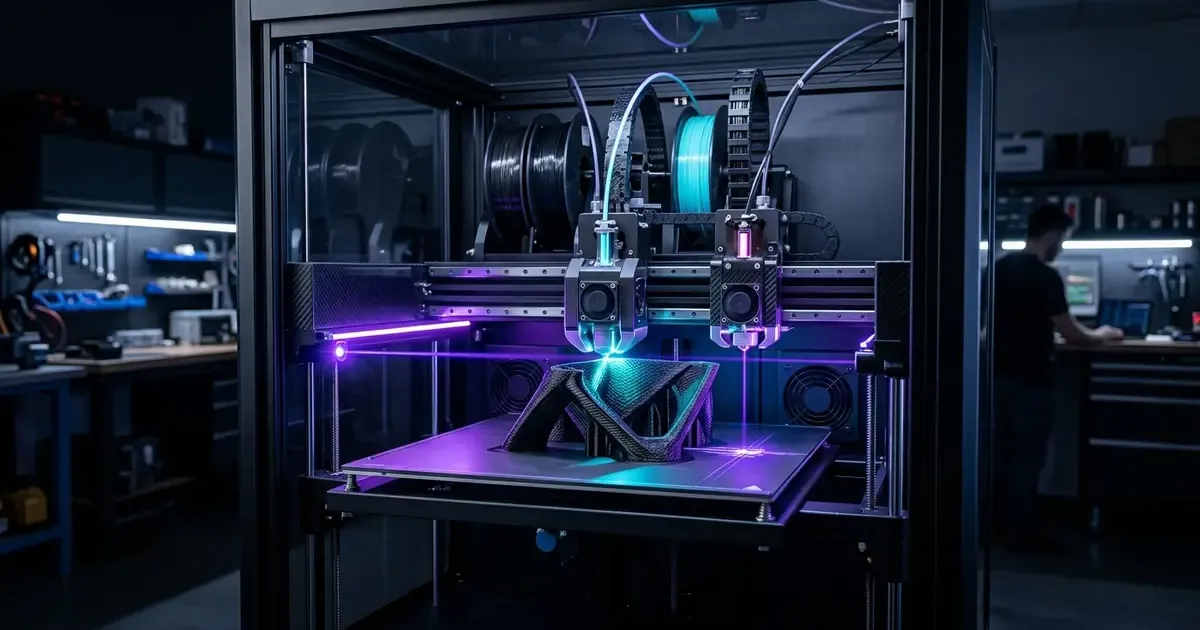
Desktop 3D printing has experienced a seismic transformation over the past five years. We moved from the era of manual bed leveling, tinkering with finicky stepper drivers, and hours of failed prints to plug-and-play CoreXY machines capable of printing flawless models at 500 mm/s right out of the box.
Yet, raw acceleration and automatic bed leveling are no longer the frontiers of additive manufacturing. The speed race has reached physical limits defined by thermal cooling capacity, melt-zone thermodynamics, and the structural laws of fluid plastic dynamics.
So, where is the industry heading next?
The next wave of 3D printing technology is focused on material versatility, zero-waste multi-toolhead architectures, AI-integrated generative slicing, closed-loop optical feedback, on-demand recycling, and workshop-level micro-factories.
In this forward-looking guide, we explore the major technological trends reshaping 3D printing and what makers, engineers, and hobbyists can expect in the coming years.
The Next Frontier: 6 Key Trends Reshaping 3D Printing
| Trend # | Technological Shift | Primary Benefit for Makers |
|---|---|---|
| 1 | Zero-Waste Tool Changers & IDEX | Multi-material printing with zero purge tower waste |
| 2 | Closed-Loop Optical Metrology | LiDAR & computer vision stop failures in real time |
| 3 | Generative AI & Non-Planar Slicing | FEA-optimized infill and curved layer grain alignment |
| 4 | Accessible Engineering Polymers | Active heated chambers enable reliable PA-CF, PC, & ASA |
| 5 | DLP & High-Speed Resin Advancements | 20,000+ hour projector lifespan and wash-free resins |
| 6 | Automated Micro-Factory Farms | Continuous conveyor printing and desktop filament recycling |
1. Beyond the Purge Tower: The Rise of Multi-Toolhead Tool Changers
Single-nozzle multi-material systems popularized multicolor 3D printing for everyday makers. However, these single-nozzle designs carry two massive compromises: excessive filament waste and drastically increased print times.
Every time a single-nozzle printer switches colors or materials, it must retract the active filament, cut it, flush dozens of millimeters of plastic into a purge chute (“poop chute”), prime the new color on a purge block, and resume printing. On intricate multi-color models, the discarded purge waste can weigh twice as much as the finished object, multiplying both print time and material expense.
| Architecture | Material Switching Sequence | Material Waste | Cycle Speed |
|---|---|---|---|
| Single-Nozzle Multi-Spool (AMS) | Retract -> Cut -> Flush Purge Tower -> Prime -> Extrude | High (Up to 60%+ wasted plastic) | Slow (40–90s per swap) |
| Multi-Toolhead Tool Changer | Park Toolhead A -> Instant Dock Pickup of Toolhead B | Zero Purge Waste (0g) | Fast (3–6s instant swap) |
Why Multi-Tool Changers Are the Future
- Zero Purge Waste: Because each toolhead maintains its own dedicated nozzle, heater block, and filament path, tool changes require zero flushing, reducing material waste by up to 60% on complex prints.
- True Incompatible Material Combinations: Single-nozzle systems struggle to switch between materials with drastically different melting temperatures (such as 190°C PLA and 280°C Polycarbonate) because remnants inside the nozzle cause severe clogs. Independent toolheads allow you to combine rigid structural skeletons with flexible TPU grips or chemically soluble PVA supports seamlessly.
- Variable Nozzle Diameters in One Print: Future slicers will leverage a 0.8mm high-flow nozzle for dense interior infill while using an ultra-fine 0.2mm nozzle for crisp outer perimeters and intricate surface text, cutting print duration in half without sacrificing aesthetic detail.
- Independent Temperature Zones: A multi-toolhead setup can keep a support nozzle at standby temperature (e.g., 140°C) and flash-heat it to 210°C in three seconds when called, preventing material cooking or thermal degradation inside the barrel.
Pioneered in open-source platforms by the RepRap Project and Voron Design, automated tool changing is rapidly migrating into mainstream commercial printers from manufacturers like Prusa Research and Bambu Lab.
2. Closed-Loop Feedback and Optical Metrology
Early 3D printers operated purely on “open-loop” control: the microcontroller sent pulses to stepper motors assuming the print head reached its exact coordinate. If a belt skipped or a nozzle caught on curled plastic, the printer blindly extruded into empty air, creating the infamous “spaghetti monster.”
The next generation of printers turns open-loop machines into intelligent, self-correcting manufacturing units:
| Control Layer | Sensing Technology | Autonomous Action |
|---|---|---|
| 1. First-Layer Geometry | Multi-spectral micro-cameras & LiDAR | Scans bed roughness and dynamically adjusts first-layer height |
| 2. Dynamic Flow Feedback | Optical flow & melt-pressure sensors | Detects micro-slippage, clogs, and backpressure drops |
| 3. Failure Interception | Edge-AI computer vision | Automatically halts print upon spaghetti detection |
Key Optical and Sensing Technologies
- High-Frequency LiDAR and Micro-Laser Triangulation: Instead of probing a dozen physical points with a touch probe, high-resolution optical sensors scan the entire build plate with millions of data points in seconds, compensating for micro-warping and thermal bed expansion in real time.
- Computer Vision Failure Interception: Integrated edge-AI cameras analyze each layer as it lays down. If spaghetti formation, layer shifting, or bed adhesion loss occurs, the printer halts immediately and alerts your phone, preventing catastrophic hotend damage.
- Direct Melt-Pressure Sensing: Modern extruders are adopting micro-load cells and piezoelectric sensors positioned directly at the heatbreak. These sensors measure real-time backpressure inside the nozzle, adjusting stepper motor steps instantaneously to eliminate stringing and under-extrusion.
- Vibration Compensation & Accelerometer Tuning: Real-time dual accelerometers mounted on both the toolhead and the print bed dynamically calculate resonant frequencies, adjusting input-shaping algorithms on the fly as the weight of the printed part increases on the bed.
If you have struggled with early adhesion issues on older machines, our guide on how to fix 3D print not sticking explains the mechanics of first-layer calibration.
3. Generative AI Slicing and Adaptive Toolpaths
For decades, slicing software operated on simple geometric slicing: take a 3D CAD mesh, slice it into horizontal 2D planes, and fill the interior with uniform honeycomb or grid patterns.
The next generation of slicing software integrates structural topology optimization and adaptive physics simulation directly into the toolpath generation.
| Traditional Slicing | Next-Generation AI Slicing |
|---|---|
| Uniform Infill Patterns | Stress-oriented variable infill densities based on finite element analysis (FEA) |
| Flat Horizontal Layers | Non-planar, 5-axis, and conformal surface layering for maximum shear strength |
| Static Flow Rates | Dynamic flow modulation mapped to cooling air-velocity and corner acceleration |
| Manual Support Placement | Algorithmic minimal-contact tree supports optimized for organic overhangs |
| Trial-and-Error Orientation | Auto-orientation for optimal anisotropic tensile strength |
Conformal Non-Planar Printing
Traditional FDM prints suffer from anisotropic weakness: parts are significantly weaker along the vertical Z-axis layer lines than in the horizontal X-Y plane due to inter-layer adhesion limits.
Non-planar slicing allows the print head to move across curved, three-dimensional paths rather than rigid flat planes. This produces injection-molding-smooth surface finishes, eliminates the staircase effect on gentle curves, and dramatically increases structural impact resistance:
| Printing Technique | Layer Deposition Geometry | Mechanical Strength & Surface Finish |
|---|---|---|
| Traditional Planar Slicing | Rigid stepped horizontal 2D planes | Visible stair-stepping; shear failure along Z-axis seams |
| Conformal Non-Planar Slicing | Continuous curved 3D toolpaths | Injection-molded smoothness; load distributed along fiber grain |
By generating curved top surfaces, non-planar toolpaths distribute physical loads across continuous strands of extruded plastic rather than distinct laminated sheets. This is particularly transformative for aerodynamic drone components, custom ergonomic mouse grips, and mechanical levers.
To learn the fundamentals of standard slicers before exploring advanced tools, check out our 3D printing guide for beginners.
4. Advanced Engineering Materials on the Desktop
Until recently, high-performance engineering thermoplastics were restricted to industrial machines costing tens of thousands of dollars. As consumer machines adopt actively heated chambers (reaching 65°C to 90°C), hardened steel extruders, and enclosed filtration systems, advanced materials are entering the home workshop:
| Phase | Capability Tier | Key Polymers & Composites | Ideal Application |
|---|---|---|---|
| Phase 1 | Basic Aesthetics | PLA, Silk PLA, Basic PETG | Visual prototypes, decorative desk items |
| Phase 2 | Functional Toughness | ABS, ASA, TPU 95A, Heavy PETG | Outdoor fixtures, flexible seals, tools |
| Phase 3 | High Performance | PETG-CF, PA-CF, Polycarbonate, PEEK | Automotive brackets, continuous carbon drones |
Engineering Polymers to Watch
- Carbon-Fiber and Glass-Fiber Composites: Short-strand chopped carbon fiber embedded in PETG or Nylon drastically increases stiffness, eliminates thermal shrinkage, and provides a gorgeous matte texture that hides layer lines. Learn more in our PETG-CF filament guide and our breakdown of PLA vs PETG vs ABS filament choices.
- Continuous Fiber Reinforcement: Rather than mixing short chopped fibers into filament, next-generation industrial toolheads lay down continuous strands of carbon fiber, Kevlar, or continuous fiberglass alongside thermoplastic matrixes, producing 3D-printed parts with tensile strength exceeding aircraft-grade 6061-T6 aluminum.
- Polycarbonate (PC) and High-Temp Nylon (PA12): Exceptional heat deflection temperatures (exceeding 140°C) allow makers to 3D print durable under-hood automotive brackets, outdoor mounting hardware, and dishwasher-safe kitchen tools without fear of warping under summer sun or hot water.
- Electro-Conductive and Sensor Filaments: Carbon nanotube (CNT) doped filaments enable makers to embed capacitive touch sensors, integrated wiring channels, and EMI shielding directly into the structural walls of 3D-printed enclosures.
If you are looking for practical functional prints you can build right now, explore our curated list of practical desk upgrades you can 3D print and our in-depth Gridfinity 101 guide.
5. Resin Printing Evolution: DLP, Tilt-Release, and Wash-Free Resins
While filament-based FDM printers dominate functional utility, resin (SLA/DLP) printing is undergoing its own quiet revolution.
For years, resin printing was held back by three major pain points: toxic fumes, messy isopropyl alcohol (IPA) washing stations, and agonizingly slow layer exposure times:
| Breakthrough | Technical Innovation | User Advantage |
|---|---|---|
| Digital Light Processing (DLP) | 20,000+ hour micromirror projector | Eliminates monochrome LCD screen burnout |
| Tilt-Release Vats | Dynamic peel-force reduction | Speeds up layer cycles by up to 70% |
| Water-Washable Resins | Plant-based bio photopolymers | Eliminates harsh isopropyl alcohol wash stations |
| CLIP Layerless Curing | Continuous oxygen-permeable curing | Ultra-fast isotropic printing with zero layer lines |
Modern industrial DLP engines project light with microscopic precision through a micromirror chip rather than passing ultraviolet light through a decaying monochrome LCD. This eliminates screen burnout, guarantees uniform light intensity across the entire build area, and allows intricate miniature components and dental models to print in minutes rather than hours.
6. Automated Workshop Farms and Closed-Loop Recycling
As 3D printers achieve industrial-grade reliability, their role in small businesses, maker spaces, and engineering offices is evolving from simple prototyping into full-scale on-demand micro-manufacturing:
| Stage | Automation Step | Mechanism & Outcome |
|---|---|---|
| 1. Ingest | Automated Print Queue | Cloud/Local queue dynamically feeds next job to idle printer |
| 2. Eject | Belt / Bed Sweeper | Finished print dropped into collection bin autonomously |
| 3. Recycle | Granulator & Extruder | Failed prints and support scrap re-extruded into fresh spools |
| 4. Restart | Instant G-Code Trigger | Zero human downtime between print sequences |
The Micro-Factory Revolution
- Automated Part Ejection: Belt-style beds or robotic arm sweepers automatically detach finished prints and drop them into collection bins, restarting the print queue immediately without human intervention.
- Desktop Filament Recycling: Compact desktop granulators and precision filament extruders now allow workshops to take failed test prints, support structures, and empty plastic bottles, shred them into uniform pellets, and re-extrude them into fresh spools with laser-verified diameter tolerances.
- Filament Management and Auto-Spool Switching: Integrated multi-spool dry boxes automatically weld or switch to a fresh spool when filament runs out mid-print, enabling 24/7 continuous operation.
- Local Micro-Manufacturing: Instead of shipping mass-produced plastic parts across oceans, designers sell digital licenses on platforms like Thangs and Printables, allowing local makers to fabricate and deliver customized products within hours. Find top model repositories in our guide to the best sites for free 3D models.
If you love modular furniture upgrades, check out our roundup of IKEA 3D printing hacks.
Summary: What the Future Means for Makers
The golden age of 3D printing is no longer about learning how to fix a broken machine; it is about what you can build when the machine disappears into the background:
- Zero-Waste Tool Changers eliminate purge waste and enable multi-material mixing.
- LiDAR & Optical Flow eradicate failed prints before plastic is wasted.
- AI Slicers optimize interior lattice geometry for extreme strength-to-weight ratios.
- Active Heated Chambers make functional engineering composites standard on desktop setups.
- Desktop Recycling Systems turn scrap plastic into fresh, high-quality filament spools.
Whether you are designing bespoke ergonomic desk gear, custom drone chassis, replacement automotive fittings, or precision organizing systems, the coming wave of additive manufacturing will give every maker the production power of a personal digital factory.
Related Articles

3D Printable Car Gadgets: 15 Useful Upgrades to Print
Upgrade your drive with the best 3D printable car gadgets in 2026. Discover practical vehicle mods, phone mounts, and heat-resistant filaments.

3D Printable Camping Gadgets: 10 Outdoor Must-Haves
Discover the best 3D printable camping gadgets to upgrade your outdoor trip. From TPU lantern diffusers to filament choice tips for heat and UV resistance.

Is the West Losing Its AI Lead? Global Shifts Explained
Explore why open-source breakthroughs, hardware shifts, and efficiency gains are challenging Western AI dominance. Here is what the global race means for 2026.