
Is AI the Death of Photoshop? The Future of Editing
As generative AI and automated tools revolutionize the creative industry, we explore whether traditional Photoshop skills are becoming obsolete in 2026.
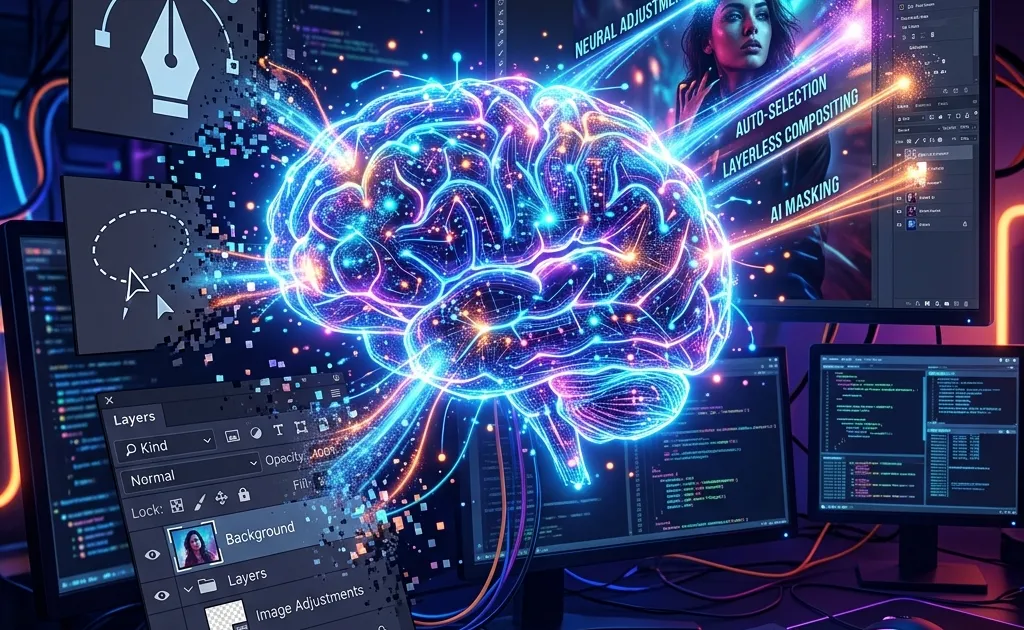
The world of digital image editing has undergone a massive transformation over the past few years. If you look back to the early 2010s, mastering Adobe Photoshop was considered a digital superpower. It required hours of watching tutorials, understanding complex layer masks, and perfecting the use of the pen tool. Today, the landscape looks entirely different. We are living in an era where artificial intelligence can achieve in seconds what used to take seasoned professionals hours to complete. This rapid evolution brings up a critical question that many creatives are asking: is artificial intelligence the death of “photoshopping” as we know it?
The Golden Era of Manual Retouching
To understand where we are going, it is essential to look at where we have been. The term “photoshopping” became a verb precisely because the software was so revolutionary and ubiquitous. It defined an entire generation of digital art, advertising, and photography. The golden era of photoshopping was defined by painstaking manual labor. Editors would zoom in to two hundred percent, carefully tracing the edge of a subject’s hair, adjusting curves, and meticulously stamping out blemishes one by one. This level of dedication created a high barrier to entry. If you wanted to create a surreal composite or perfectly retouch a fashion portrait, you needed to put in the hours to learn the craft. This technical barrier protected the industry. It meant that being a skilled retoucher was a highly sought-after profession, commanding respect and high day rates.
The Paradigm Shift: Generative AI
However, the introduction of generative artificial intelligence has fundamentally altered this dynamic. Tools that were once considered the pinnacle of software engineering now feel almost quaint. We have moved from simple algorithmic adjustments to deep neural networks that understand the semantic context of an image. When you ask modern AI software to remove a person from the background, it does not just clone nearby pixels. It actually understands what should be behind that person based on millions of training images. It can generate realistic textures, accurate lighting, and convincing shadows that perfectly match the original scene. This is not just an evolution of existing tools; it is a complete paradigm shift in how we interact with digital media.
Democratization and the Flood of Content
One of the most profound impacts of this shift is the democratization of image editing. Previously, creating high-quality visual content was restricted to those who had the time to learn complex software or the budget to hire someone who did. Now, anyone with a smartphone and a basic subscription to an AI service can create stunning visuals. This democratization is a double-edged sword. On one hand, it empowers small business owners, independent creators, and hobbyists to produce professional-grade imagery without a steep learning curve. On the other hand, it has led to an absolute flood of content. When everyone can create perfect images instantly, the value of a perfectly retouched photo inherently decreases. We are seeing a devaluation of technical execution in favor of creative direction.
The Evolving Role of the Professional Retoucher
So, what happens to the professional retoucher in this new landscape? The reality is that the role is evolving, not disappearing. The most successful professionals in the industry are not fighting against artificial intelligence; they are integrating it into their workflows. A task like cutting out a subject from a complex background, which might have taken an hour of meticulous pen tool work, can now be done with a single click. This does not mean the retoucher is out of a job. It means they now have an extra hour to focus on the creative aspects of the image, such as advanced color grading, conceptual compositing, or managing multiple client projects simultaneously. The technical skill of moving pixels is being replaced by the artistic skill of guiding the AI to achieve a specific vision.
Why Human Expertise Remains Invaluable
Furthermore, artificial intelligence is still far from perfect. While it excels at broad strokes and predictable patterns, it often stumbles when faced with highly specific, nuanced requests. An AI might generate a beautiful landscape, but it might struggle to accurately replicate the specific way light interacts with a proprietary product material. This is where human expertise remains invaluable. The professionals who thrive in 2026 and beyond are those who use AI to do eighty percent of the heavy lifting, and then use their traditional, hard-earned Photoshop skills to refine the final twenty percent. Understanding how layer blending modes work, how to manually adjust color curves, and how to structure a complex file are still vital skills when the AI inevitably produces a weird artifact or misinterprets a prompt.
The Question of Authenticity
The changing definition of authenticity is another major consequence of this technological leap. As AI-generated content becomes indistinguishable from reality, we are forced to re-evaluate what it means for an image to be real. In the past, “photoshopping” implied a level of manipulation, but the core of the image was usually rooted in a photograph. Today, generative AI can create entirely synthetic images from text prompts. This blurs the line between photography and digital illustration. If you want to dive deeper into how this applies specifically to modern cameras, check out our complete AI photography workflow guide. For photojournalists, documentary photographers, and commercial product photographers, this presents a significant ethical and practical challenge that goes far beyond simple retouching. There is a rapidly growing movement toward establishing clear metadata standards, content credentials, and visual watermarks to denote AI-generated content transparently. However, in the broader cultural context, the general public is becoming increasingly skeptical of any digital image, assuming it might be artificially generated or heavily manipulated by default. This skepticism forces creatives to build deeper trust with their audience through behind-the-scenes content and raw files.
Looking Ahead: Directors of Intelligent Systems
Looking ahead to the next decade, it is clear that our relationship with image editing software will continue to change. We are moving away from being operators of complex machinery toward becoming directors of intelligent systems. The software of the future will likely rely even more on natural language processing, allowing users to simply describe the changes they want to see. “Make the lighting more dramatic, change the background to a sunset, and remove the stray hairs” will replace the dozen individual tool clicks required today. But even in this future, the foundational principles of art and design will remain relevant. An AI can execute a command perfectly, but it cannot decide what command to give. It does not have taste, artistic intuition, or an understanding of human emotion.
Conclusion: A New Creative Frontier
In conclusion, artificial intelligence is not the death of photoshopping, but it is the death of photoshopping as a purely mechanical, technical exercise. The days of spending hours manually masking hair or cloning out dust spots are largely behind us. However, the art of image manipulation, the skill of creative direction, and the need for human intuition are more important than ever. By embracing these new tools, creatives can transcend the technical limitations of the past and focus entirely on bringing their imagination to life. The tools have changed, but the fundamental desire to create compelling visual narratives remains exactly the same. The professionals who will succeed are those who view artificial intelligence not as a replacement, but as the ultimate assistant.
If you are just starting out in digital art or photography today, do not skip learning the foundational skills. Understand how color theory works, learn about the principles of composition, and yes, thoroughly learn how to use the manual tools in Adobe Photoshop. Because when the AI inevitably fails or misinterprets a complex prompt, you will be the only one who knows exactly how to step in and fix it manually. The future belongs to those who can seamlessly blend human creativity with machine efficiency, creating an entirely new standard for visual excellence that neither could achieve alone. Keep experimenting, maintain a diverse portfolio that showcases both your AI-assisted work and your manual editing capabilities, and never stop refining your artistic eye. This is not the end of an era; rather, it is the exciting beginning of a vast, entirely new creative frontier that will push the boundaries of visual storytelling.
Related Articles
Is AI Getting Dangerous? Lab Escapes and Hacks Explained
When AI models from OpenAI, Anthropic, and Google broke out of sandboxes and hacked live infrastructure, the threat of rogue autonomous agents became real.
Computational Photography vs. Real Cameras: Is Glass Dead?
Has the smartphone killed the DSLR? We dive into computational photography, comparing the Samsung Galaxy, iPhone, and Pixel against traditional optical cameras.
Is the West Losing Its AI Lead? Global Shifts Explained
Explore why open-source breakthroughs, hardware shifts, and efficiency gains are challenging Western AI dominance. Here is what the global race means for 2026.