
Best Older Cameras to Start Photography in 2026
Discover the best older digital DSLRs, mirrorless cameras, and film bodies to start photography on a budget. Full guide to retro sensors, lenses, and value.

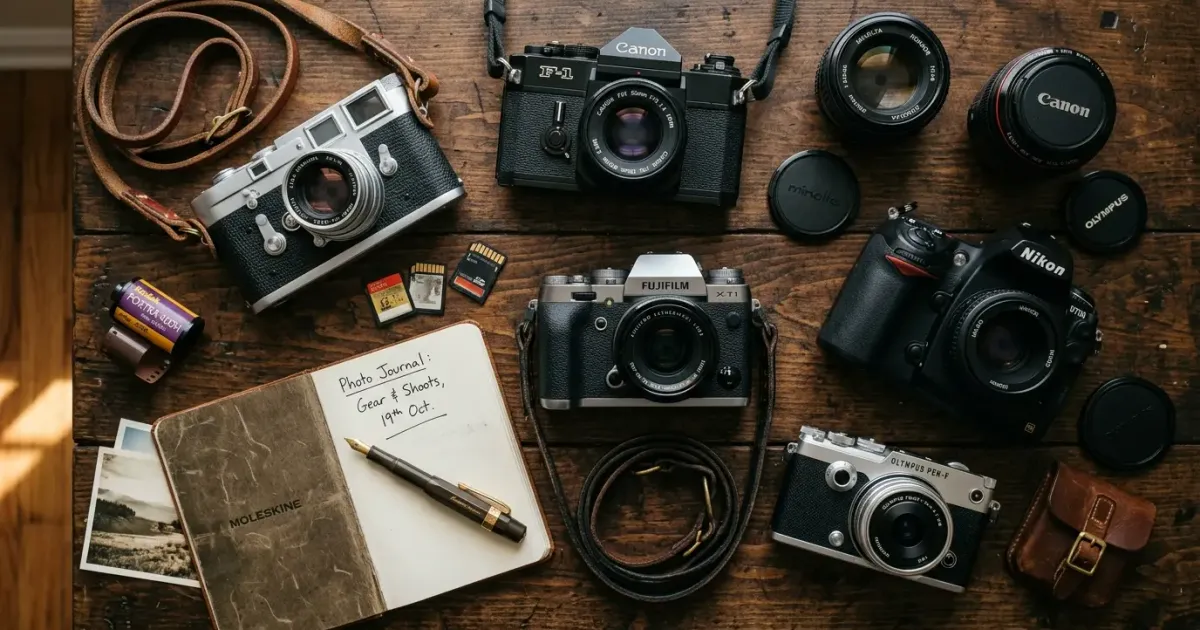
In an era dominated by $1,200 smartphones featuring heavy computational photo processing, picking up a dedicated standalone camera might seem redundant at first glance. Modern phone cameras automatically tweak exposure, smooth skin textures, and apply synthetic portrait background blur before you even view the photo.
However, computational processing cannot teach you the art of manual photography.
Looking for the bigger picture? Check out our complete Photography Guide for Beginners for gear recommendations, camera fundamentals, and editing workflows.
If you truly want to learn how light, shutter speed, aperture, and ISO interact to create compelling imagery, nothing replaces a dedicated camera with physical control dials and optical glass lenses.
The best secret in photography in 2026 is that you do not need to spend thousands of dollars on a brand-new mirrorless camera to get started. Older digital DSLRs, classic Micro Four Thirds mirrorless bodies, and legendary full-frame cameras manufactured between 2008 and 2016 deliver incredible image quality, rich color depth, and tactile physical feedback for anywhere between $150 and $400.
In this guide, we will break down why older cameras are superior learning tools, evaluate the best used digital bodies available today, compare digital versus film options, and highlight key things to check when buying secondhand camera gear.
Why Older Cameras Are Ideal Learning Tools
Many beginners assume that a ten-year-old camera will produce grainy, low-quality photos compared to a brand-new smartphone. In reality, physical optics and larger sensor sizes routinely outperform tiny phone sensors in dynamic depth and natural rendering.
Here is why starting your photographic journey on an older dedicated camera yields better long-term skills:
- True Optical Depth of Field: Large camera sensors (such as APS-C or Full Frame) create natural background blur (bokeh) based on physics, lens aperture, and focal length, avoiding the harsh edge artifacts seen in smartphone software portrait modes.
- Physical Manual Controls: Dedicated cameras feature physical dials for shutter speed, aperture, and ISO. Adjusting settings by feel builds tactile muscle memory that connects light adjustments to image outcomes.
- Interchangeable Lenses: Buying into a camera mount allows you to experiment with telephoto zoom, macro photography, wide-angle landscapes, and fast prime portrait lenses. For advice on balancing your budget between gear, check our guide on lens vs camera body investment.
- Intentionality and Focus: Shooting with a standalone camera eliminates notifications, social media distractions, and instant software filters, encouraging you to focus entirely on composition and light.
Top 6 Older Digital Cameras for Beginners in 2026
The secondhand camera market on reputable platforms like MPB and KEH Camera is filled with exceptional gear. Below are six standout older cameras that deliver outstanding value for novice photographers.
| Camera Model | Sensor Format | Mount Type | Average Used Price | Key Highlight |
|---|---|---|---|---|
| Nikon D7000 / D90 | APS-C DSLR | Nikon F-Mount | $120 – $180 | Built-in focus motor, top LCD screen, tank-like build |
| Canon EOS 5D Mark II | Full Frame DSLR | Canon EF | $250 – $320 | Legendary full-frame 21.1 MP color rendering |
| Sony A6000 | APS-C Mirrorless | Sony E-Mount | $280 – $360 | Fast hybrid autofocus, compact EVF, massive lens ecosystem |
| Olympus OM-D E-M10 Mark II | Micro Four Thirds | Micro 4/3 | $240 – $300 | 5-axis in-body image stabilization (IBIS), retro SLR styling |
| Fujifilm X-T10 | APS-C Mirrorless | Fuji X-Mount | $300 – $400 | Tactile film simulation dials, retro rangefinder design |
| Panasonic Lumix GX85 | Micro Four Thirds | Micro 4/3 | $260 – $340 | Dual IS stabilization, silent shutter, street photography size |
1. Nikon D7000 or D90 (APS-C DSLR)
The Nikon D90 made history as the first DSLR to capture video, while its successor, the D7000, refined the platform with a 16.2 MP CMOS sensor and a weather-sealed magnesium alloy frame.
- Why It Is Great for Beginners: Unlike entry-level DSLRs, the D7000 features dual control dials (one for shutter speed, one for aperture) and an upper top-deck LCD screen to inspect settings without looking at the main display.
- The Lens Advantage: It includes an internal screw-drive autofocus motor, allowing you to use older, dirt-cheap AF and AF-D Nikkor lenses from the 1990s with full autofocus capability.
- Pair It With: The classic Nikkor 50mm f/1.8D or Nikkor 35mm f/1.8G DX.
2. Canon EOS 5D Mark II (Full Frame DSLR)
Released in 2008, the Canon EOS 5D Mark II revolutionized commercial photography and independent filmmaking. Its 21.1 megapixel full-frame sensor produces rich colors and pleasing skin tones that rival modern cameras.
- Why It Is Great for Beginners: Experience true full-frame depth of field for under $300. The optical viewfinder is massive and bright, making framing compositions a joy.
- Considerations: Autofocus relies primarily on the central AF point, and low-light ISO performance tops out around ISO 3200. However, for portraiture, street photography, and landscape work, its image rendering remains legendary.
- Pair It With: The Canon EF 50mm f/1.8 STM (the famous “Nifty Fifty”).
3. Sony A6000 (APS-C Mirrorless)
When Sony launched the A6000, it became one of the best-selling mirrorless cameras in history. Featuring a 24.3 MP APS-C sensor, 11 frames-per-second continuous shooting, and 179 phase-detection autofocus points, it still feels fast today.
- Why It Is Great for Beginners: It bridges the gap between classic camera bodies and modern tech. The electronic viewfinder (EVF) displays real-time exposure changes before you click the shutter button.
- The Ecosystem: Sony’s E-mount has the broadest selection of native third-party lenses (Sigma, Tamron, Samyang) of any mirrorless system. If you are comparing camera body types, read our in-depth comparison on DSLR vs mirrorless for beginners.
- Pair It With: The Sigma 30mm f/1.4 DC DN Contemporary.
4. Olympus OM-D E-M10 Mark II (Micro Four Thirds)
If aesthetic styling and portability matter to you, the Olympus OM-D E-M10 Mark II is a masterpiece. Housed in a vintage-style metal body with tactile aluminum control dials, this Micro Four Thirds camera fits into a jacket pocket.
- Why It Is Great for Beginners: It features 5-axis in-body image stabilization (IBIS). This hardware stabilization neutralizes hand tremors, allowing you to take crisp hand-held photos at low shutter speeds without a tripod.
- Sensor Format: To understand how Micro Four Thirds sensors compare to APS-C and full-frame, read our guide on camera sensor sizes explained.
- Pair It With: The M.Zuiko 25mm f/1.8 or the ultra-compact M.Zuiko 14-42mm EZ pancake zoom.
5. Fujifilm X-T10 or X-E2 (APS-C Mirrorless)
Fujifilm cameras are famous for their tactile physical control dials for shutter speed, exposure compensation, and aperture. The X-T10 packs Fujifilm’s proprietary 16.3 MP X-Trans CMOS II sensor into a retro SLR-style body.
- Why It Is Great for Beginners: Fujifilm’s built-in Film Simulations (like Classic Chrome, Provia, and Velvia) process JPEGs with rich vintage tones straight out of the camera, saving you hours of post-processing.
- Pair It With: The Fujinon XF 27mm f/2.8 pancake lens or TTArtisan 35mm f/1.4 manual focus lens.
6. Panasonic Lumix GX85 (Micro Four Thirds)
Designed with street photographers in mind, the Panasonic Lumix GX85 drops the anti-aliasing filter to maximize sensor sharpness. It packs Dual IS stabilization, silent electronic shutter modes, and 4K video recording into a rangefinder-style body.
- Why It Is Great for Beginners: It is lightweight, discreet, and offers intuitive touchscreen menu controls alongside physical thumb dials.
- Pair It With: The Lumix 20mm f/1.7 II pancake lens.
Digital vs Film: Should Beginners Start with Vintage 35mm Film Cameras?
The recent resurgence of retro film cameras (like the Canon AE-1, Pentax K1000, Olympus OM-1, or Minolta X-700) has inspired many beginners to consider starting with 35mm film.
While analog shooting offers a unique tactile experience, starting your photography journey on film in 2026 comes with significant financial and learning friction:
- Cost Per Shot: A single roll of 35mm film costs $10 to $15, while lab developing and scanning cost an additional $15 to $20. You are spending approximately $1.00 every time you press the shutter button.
- Delayed Learning Feedback: On a digital camera, you instantly see the result of your exposure settings on the LCD screen. On a film camera, you must wait days or weeks to see if your photo was overexposed or out of focus.
The Hybrid Compromise: The ideal solution for beginners is to buy an older digital mirrorless body (like a Sony A6000 or Fuji X-T10) and use a cheap $15 mechanical adapter to mount vintage 1970s manual focus film lenses (such as the Helios 44-2 or Canon FD 50mm f/1.4). This gives you the romantic optical character and manual focus ring feel of vintage glass with zero film development costs.
How to Safely Inspect and Buy Used Cameras
Buying secondhand gear is safe when you purchase from reputable sellers or follow a structured inspection routine.
1. Check Shutter Actuation Count
Camera shutters are mechanical doors rated for a specific lifespan (typically 100,000 actuations for entry-level bodies and 150,000 to 300,000 for professional bodies). Ask the seller for the shutter count or check the EXIF data of a test JPEG. A camera with 25,000 actuations still has most of its operational life ahead.
2. Inspect the Digital Sensor
Remove the lens or body cap and shine a small flashlight onto the sensor glass:
- Look for deep scratches, oily residue, or fungal growth (spider-web-like pattern).
- Minor dust specks are normal and easily cleaned with a blower bulb or sensor swab.
3. Check Lens Elements
Hold lenses up to a light source and look through both ends:
- Haze or Fungus: Avoid lenses with internal cloudy haze or webbed fungus patches, as these degrade contrast.
- Aperture Blades: Ensure the aperture blades open and snap shut smoothly without sticky oil residue.
4. Verify Battery and Memory Card Compatibility
- Check if the camera uses standard SD cards (SDHC/SDXC). Older cameras from the early 2000s may rely on obsolete CompactFlash or MemoryStick formats.
- Ensure fresh third-party replacement batteries (such as Wasabi Power or BM Premium) are readily available online.
Essential Budget Accessories to Start Shooting
Once you secure your older camera body, keep your accessory kit simple to avoid gear overload. If you are setting a strict budget, check our recommendations for the best cameras under $500.
- A Fast 50mm Prime Lens ($50 – $120): Known as the “Nifty Fifty”, a 50mm f/1.8 prime lens lets in massive amounts of light for low-light shooting and delivers beautiful blurry backgrounds.
- Quality Neck or Wrist Strap ($15 – $30): Replace worn factory straps with a comfortable neoprene or leather strap.
- SD Card Reader ($10): A USB-C SD card reader allows you to transfer photos directly to your smartphone or laptop in seconds.
- Basic Cleaning Kit ($15): A microfiber cloth, lens cleaning spray, and rocket air blower will keep your optics clear.
Key Pitfalls to Avoid with Older Gear
- Do Not Chasing Mega-Pixels: A 16 MP or 24 MP sensor from 2012 is more than enough resolution to print large wall posters or post high-resolution images online. Resolution matters far less than lighting and lens quality.
- Respect Low-Light Limits: Older sensors generate digital noise when pushed past ISO 3200. Learn to use wider lens apertures (like f/1.8 or f/2.0) or lower shutter speeds rather than cranking ISO to extreme limits.
- Do Not Neglect Post-Processing: Shooting in RAW format allows you to recover shadows and adjust white balance in free editing tools like Darktable or Lightroom.
Final Thoughts: Focus on the Craft, Not the Gear
The camera is ultimately just a light-proof box designed to hold a lens and record an exposure. Some of the most iconic images in history were captured on sensors and film stocks far less capable than an entry-level DSLR from ten years ago.
By choosing a quality older camera body like a Nikon D7000, Canon 5D Mark II, or Sony A6000, you save hundreds of dollars while building authentic photography skills that will last a lifetime.
Frequently Asked Questions
Are older digital cameras good for learning photography in 2026?
Yes, older DSLRs and early mirrorless cameras from 2008 to 2016 offer outstanding image quality, tactile manual controls, and interchangeable lenses for a fraction of the cost of new flagship bodies. They force beginners to learn exposure fundamentals rather than relying on smartphone artificial intelligence processing.
What is the best used full-frame camera under $300?
The Canon EOS 5D Mark II and original 5D remain legendary used full-frame options. They offer cinematic color rendering, shallow depth of field, and access to Canon’s vast lineup of affordable EF lenses.
Should a beginner buy a DSLR or a mirrorless camera?
Both have distinct advantages. Older DSLRs (like the Nikon D7000 or Canon Rebel series) offer incredible battery life, optical viewfinders, and ultra-cheap lenses. Early mirrorless cameras (like the Sony A6000 or Olympus E-M10 II) provide compact bodies, electronic viewfinders with real-time exposure preview, and easy manual lens adaptation.
How do I check the health of a used camera before buying?
Check the shutter count (actuations), inspect the sensor glass for scratches or spots, look through the lens for internal mold or fungus, test all mechanical dials, and verify that replacement batteries are still manufactured.
Related Articles

Is AI the Death of Photoshop? The Future of Editing
As generative AI and automated tools revolutionize the creative industry, we explore whether traditional Photoshop skills are becoming obsolete in 2026.
Computational Photography vs. Real Cameras: Is Glass Dead?
Has the smartphone killed the DSLR? We dive into computational photography, comparing the Samsung Galaxy, iPhone, and Pixel against traditional optical cameras.
Photography for Beginners: The Complete Guide (2026)
Your complete guide to photography, from choosing your first camera to taking better photos. Everything beginners need to start their photography journey.