
Lumix GX80 Review: Best Budget Street Camera in 2026
Is the Panasonic Lumix GX80 (GX85) worth it in 2026? Full review covering 5-axis IBIS, 4K video, sensor sharpness, lens pairings, and used market value.

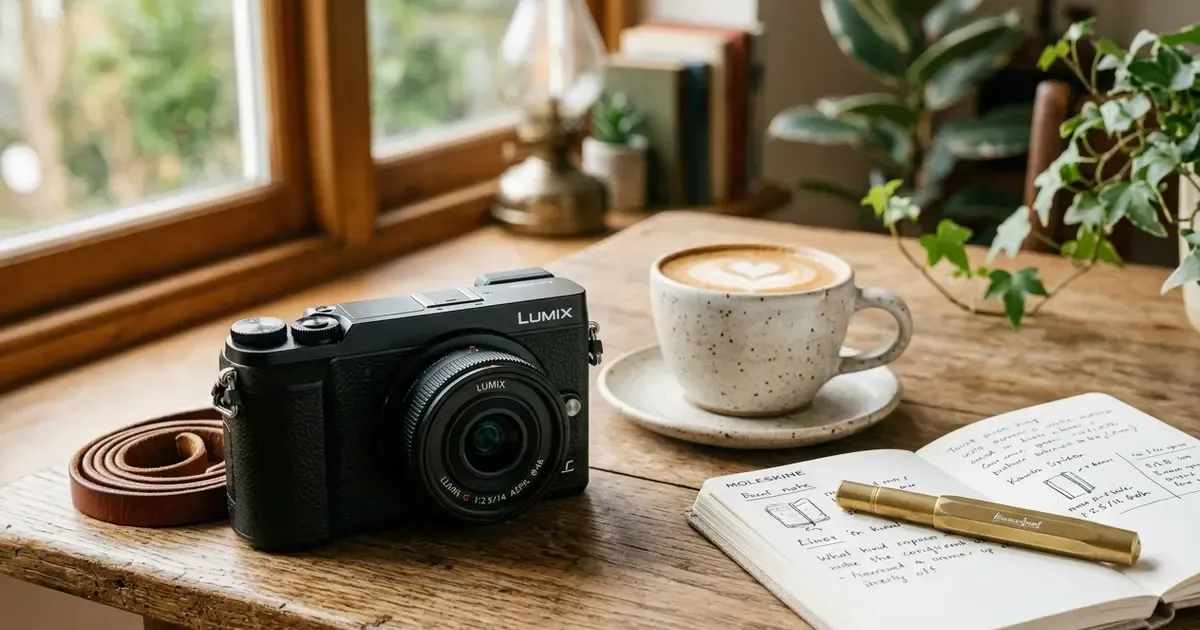
In a photography market saturated with heavy full-frame bodies and expensive $1,500 flagship vlogging tools, the appeal of a pocketable, tactile camera has never been stronger. Smartphones have become capable imaging devices, yet their aggressive computational sharpening, flat artificial depth maps, and lack of physical manual dials leave many creative photographers wanting something genuine.
Enter the Panasonic Lumix DMC-GX80 (marketed as the Lumix GX85 in North America and the GX7 Mark II in Japan).
First released in 2016, this compact rangefinder-style Micro Four Thirds camera was an immediate hit among street photographers, travel shooters, and indie filmmakers. A decade later, it has developed an almost cult-like following on the secondhand market. With prices hovering between $250 and $350 for a clean used body, the GX80 offers features that many contemporary cameras under $800 still lack: 5-axis sensor stabilization, crisp 4K UHD video, an electromagnetic shutter that eliminates shutter shock, and a sharp 16-megapixel sensor free from an optical low-pass filter.
Master the fundamentals: Check out our complete Photography Guide for Beginners for camera setup walkthroughs, composition fundamentals, and lens selection roadmaps.
Is this ten-year-old Micro Four Thirds compact body still worth buying in 2026, or has time caught up with its sensor technology and autofocus? This review goes through image quality, stabilization, video, ergonomics, lens pairings, and secondhand value, drawing on the spec sheet, Panasonic’s documentation, and a decade of owner reports rather than a fresh lab test.
Quick Specs: Panasonic Lumix GX80 at a Glance
Before diving into the shooting experience, here is how the core hardware specifications stack up:
| Feature / Component | Specification | Practical Advantage |
|---|---|---|
| Sensor | 16.0 MP Live MOS (Micro Four Thirds) | No low-pass (AA) filter for enhanced micro-contrast and fine detail |
| Image Stabilization | 5-Axis In-Body (Dual I.S. compatible) | Up to 4.5 stops of stabilization; rock-steady handheld video and slow shutters |
| Shutter Mechanism | Electromagnetic drive unit | Completely eliminates shutter shock; ultra-quiet mechanical operation |
| Electronic Shutter | Up to 1/16,000s | Silent shooting in quiet spaces; wide-open apertures in harsh daylight |
| Autofocus | Contrast-Detect DFD (Depth From Defocus) | 49 AF points, snappy single-point AF, face and eye tracking |
| Video Recording | 4K UHD (3840x2160) at 24p/30p, 100 Mbps | Full pixel readout without line skipping; sharp 1080p up to 60p |
| Viewfinder (EVF) | 2.76M-dot equivalent field-sequential | 16:9 aspect ratio, 0.70x magnification (35mm equivalent) |
| Rear Display | 3.0-inch 1.04M-dot tilting touchscreen | Tilts 80° upward and 45° downward for waist-level shooting |
| Charging | In-camera Micro-USB port | Charge directly from standard power banks and phone adapters |
| Weight & Dimensions | 426 g (with battery and SD card), 122 x 70.6 x 43.9 mm | Fits into small jacket pockets or sling bags with a pancake prime |
| Used Market Price | ~$250 to $350 (Body Only) | Exceptional price-to-performance ratio in the budget tier |
Design and Ergonomics: The Quintessential Rangefinder Form Factor
The first thing you notice when holding the Lumix GX80 is how solid and dense it feels. Unlike many modern plastic entry-level mirrorless bodies, the GX80 features an internal magnesium alloy chassis wrapped in a textured faux-leather grip. Weighing 426 grams with a battery and memory card inserted, it has enough heft to balance comfortably in hand without dragging down your shoulder during a full day of city walking.
Dual Control Dials and Tactile Feedback
For experienced photographers and enthusiastic beginners alike, manual controls make or break a camera. Panasonic equipped the GX80 with front and rear clicky control dials:
- The front dial surrounds the shutter release button, typically handling aperture or exposure compensation.
- The rear thumb dial controls shutter speed and features an integrated push-button function, allowing you to toggle quickly between exposure adjustments and ISO sensitivity.
On the back plate, you find dedicated buttons for exposure lock, quick menu access (Q.Menu), playback, and multiple customizable function keys (Fn1 through Fn4). The power switch sits securely on the top right plate alongside the mode dial, which includes full Manual (M), Aperture Priority (A), Shutter Priority (S), Program (P), and two custom memory slots (C1, C2) to store your preferred street or landscape profiles.
Tilting Touchscreen and Waist-Level Shooting
The 3.0-inch rear LCD tilts upward 80 degrees and downward 45 degrees. For street photography, this tilt mechanism is an absolute game-changer. You can fold the screen flat, hold the camera at your waist, and capture candid moments without pointing the lens directly at people’s faces.
Panasonic’s touchscreen implementation was years ahead of its time. You can tap anywhere on the display to position your focus box, pinch to zoom during playback, and navigate menus smoothly. Even better, the screen supports Touch Pad AF: while looking through the electronic viewfinder, you can slide your thumb across the rear touchscreen to shift the active autofocus point seamlessly without taking your eye away from your subject.
The Pop-Up Flash Tilt Trick
A delightful secret of the GX80 is its built-in pop-up flash. Located discreetly above the sensor, pressing the flash release button springs it upward. While direct forward flash often looks harsh, the spring-loaded mechanism allows you to gently pull the flash head backward with your index finger, aiming the light directly toward the ceiling. This enables natural, soft bounce flash off white walls in dimly lit rooms, a trick almost unheard of on modern compact cameras without an external speedlight.
Sensor Performance and Image Quality: The AA Filter Removal Advantage
The GX80 is powered by a 16.0-megapixel Live MOS Micro Four Thirds sensor. While 16 megapixels might sound modest in an era of 24 and 40-megapixel sensors, Panasonic made a crucial engineering choice: they completely omitted the optical low-pass (anti-aliasing) filter.
In traditional digital cameras, low-pass filters were placed over the sensor to slightly blur the incoming image and prevent moiré patterns on fine fabrics. By removing this filter, the GX80 resolves exceptional micro-contrast and fine detail, squeezing roughly 10% more perceived resolution out of the 16 MP sensor. When paired with sharp optics like the Lumix 20mm f/1.7 or the Leica 15mm f/1.7, the level of crispness in architectural masonry, hair strands, and textured foliage rivals older 20-megapixel and 24-megapixel sensors.
| Specification | Details |
|---|---|
| Sensor Size | 17.3 x 13.0 mm (Micro Four Thirds) |
| Crop Factor | 2.0x (35mm equivalent field of view) |
| Aspect Ratio | Native 4:3 (switchable to 3:2, 16:9, 1:1) |
| Optical Filter | No Optical Low-Pass Filter (sharper details) |
| ISO Sensitivity | ISO 200 - 25,600 (extended down to ISO 100) |
| Sweet Spot ISO | ISO 200 - 1,600 (clean, punchy micro-contrast) |
Color Science and the L.Monochrome Profile
Panasonic’s Venus Engine image processor delivers pleasant, natural colors. Skin tones are balanced without the greenish tint of early Sony models, while greens and blues remain rich and saturated for travel and landscape work.
Special praise must be given to L.Monochrome, a dedicated black-and-white picture profile introduced with the GX80. Unlike generic monochrome filters, L.Monochrome emulates classic black-and-white street film:
- Deep, inky blacks with punchy shadow contrast
- Smooth mid-tone transitions across grays
- Crisp specular highlight retention
- Built-in digital yellow, orange, and red filter simulations to darken skies and emphasize dramatic clouds
If you love black-and-white street photography, shooting straight-out-of-camera JPEGs with L.Monochrome enabled is an inspiring and addictive experience.
Dynamic Range and Low-Light Realities
Because the sensor uses the Micro Four Thirds format (with a 2.0x crop factor compared to 35mm full frame), dynamic range and high-ISO performance have inherent physical limits:
- At base ISO 200: Dynamic range measures approximately 12.5 stops. RAW files contain plenty of shadow recovery latitude for high-contrast sunsets and backlit street scenes.
- Up to ISO 1600: Images remain clean, sharp, and detailed, with fine luminance grain that is easy to manage in editing software.
- At ISO 3200: Chroma noise becomes noticeable, and fine edge sharpness begins to soften.
- At ISO 6400 and above: High-ISO noise is prominent, and color saturation drops significantly.
For nighttime street photography, pairing the GX80 with a fast prime lens (such as f/1.7 or f/1.4) allows you to keep ISO values under 1600, taking full advantage of the camera’s image stabilization. For an analysis of how sensor sizes and optical designs interact, see our comparison on computational photography versus real cameras.
Dual I.S. Image Stabilization: Sharp Shots in Low Light
One of the standout achievements of the Lumix GX80 is its 5-axis sensor-shift image stabilization (IBIS). When paired with stabilized Panasonic Lumix O.I.S. lenses, the camera activates Dual I.S., combining 2-axis optical stabilization inside the lens barrel with 5-axis sensor stabilization inside the camera body.
Real-World Stabilization Benefits
In daily shooting, the stabilization system delivers approximately 4 to 4.5 stops of compensation:
- Slow Shutter Street Photography: With an unstabilized prime lens like the 20mm f/1.7 (40mm equivalent), you can consistently shoot handheld down to 1/4s or even 1/2s without camera shake ruining the shot. This enables you to blur moving crowds, capture smoothed traffic trails, or shoot in dim alleyways at ISO 200 without carrying a tripod.
- Stable Manual Lens Adaptation: Because the IBIS system works directly on the sensor, every vintage manual lens attached via an inexpensive mechanical adapter receives full stabilization. When you mount a vintage Canon FD 50mm f/1.4 or Helios 44-2, you simply enter the focal length in the camera menu, and the sensor stabilizes your manual viewfinder feed instantly.
- Smooth Handheld Video: Dual I.S. turns handheld walking shots and static framing into remarkably steady footage, largely eliminating micro-jitters without introducing ugly digital warping artifacts.
The Electromagnetic Shutter: No More Shutter Shock
Before the GX80, several compact mirrorless cameras (including the earlier Lumix GX7 and Olympus E-M5) suffered from an issue known as shutter shock. Traditional spring-loaded focal-plane mechanical shutters released with a sudden mechanical snap. At intermediate shutter speeds (typically between 1/60s and 1/200s), that sudden vibration caused subtle blur across fine details.
Panasonic solved this problem on the GX80 by designing a brand-new electromagnetic drive shutter unit:
- Instead of violent mechanical springs, the shutter curtains are driven smoothly by electromagnetic coils.
- Shutter vibration is reduced by approximately 90% compared to the GX7.
- Shutter sound is reduced to a soft, refined whisper that is barely audible from two feet away.
For stealthy street photography in quiet cafes, museums, or peaceful train stations, the GX80 is one of the most discreet mechanical cameras ever produced. If absolute silence is required, switching to the electronic shutter enables completely silent shooting up to 1/16,000s.
4K Video and 4K Photo Modes
Despite being released in 2016, the GX80 was an early pioneer in accessible 4K video. It records 4K UHD video (3840 x 2160 pixels) at 24p and 30p at a robust bit rate of 100 Mbps in MP4 format.
| Video Recording Mode | Resolution & Framerate | Bitrate & Crop Factor |
|---|---|---|
| 4K UHD | 3840 x 2160 at 24p / 30p | 100 Mbps, 1.1x sensor crop |
| Full HD 1080p | 1920 x 1080 at 60p / 50p / 30p | 28 Mbps, full sensor width (0x crop) |
| High Speed / Slow Mo | Full HD up to 60 fps | Smooth action playback |
| Autofocus Pipeline | Contrast DFD (Face Tracking, Single, Continuous) | Continuous autofocus with subject tracking |
| Audio Capture | Internal stereo microphone array | Stereo AAC audio (no 3.5mm external jack) |
Video Quality and Clarity
Unlike many competitors from the same era that line-skipped or pixel-binned, the GX80 reads the entire pixel area within its video crop and downsamples it to crisp 4K. The resulting video footage is razor-sharp, with rich textures and minimal color moiré.
There is a minor 1.1x additional crop applied during 4K video recording, which slightly tightens your field of view (a 12mm wide-angle lens behaves like a 26mm equivalent rather than a 24mm). However, Full HD 1080p video records from the full sensor width with zero crop.
Innovative 4K Photo Modes
Panasonic leveraged its 4K video engine to create creative photographic tools that still feel modern in 2026:
- 4K Burst Mode: Fires continuous 8-megapixel stills at an astonishing 30 frames per second for as long as you hold the shutter button. You can scrub through the frames on the rear touchscreen and save the decisive moment as a clean JPEG.
- Post Focus Mode: The camera records a 1-second burst while sweeping focus across the entire scene from near to far. After taking the shot, you simply tap the screen on any part of the image to pick your focus point and export a sharp photograph.
- Focus Stacking: The camera combines multiple frames captured in Post Focus mode into a single image with front-to-back depth of field, ideal for macro photography of watches, jewelry, and flowers.
The Best Lenses to Pair with the Lumix GX80
The biggest strength of the Micro Four Thirds system is its mature, compact lens ecosystem. Jointly developed by Panasonic and OM System (Olympus), the Micro Four Thirds mount offers dozens of tiny, affordable lenses that match the compact ethos of the GX80 body.
For detailed advice on how to build a flexible lens kit, explore our camera lens types guide as well as our deep dive on lens versus camera body budgeting.
Below are the four best lenses to unlock the GX80’s potential:
| Lens Model | Equivalent Focal Length | Aperture | Weight | Best Use Case |
|---|---|---|---|---|
| Panasonic Lumix 12-32mm f/3.5-5.6 O.I.S. | 24–64mm | f/3.5–5.6 | 70 g | Everyday carry, street landscapes, pocket travel kit |
| Panasonic Lumix 20mm f/1.7 II ASPH | 40mm | f/1.7 | 87 g | Low-light street photography, documentary, portraits |
| Leica DG Summilux 15mm f/1.7 ASPH | 30mm | f/1.7 | 115 g | Premium street shooting, fast autofocus, physical aperture ring |
| Olympus M.Zuiko 45mm f/1.8 | 90mm | f/1.8 | 116 g | Flattering portraiture, subject isolation, headshots |
The Ultimate Two-Lens Travel Kit:
- 1. Panasonic Lumix 12-32mm f/3.5-5.6 Pancake (Daylight): Total kit weight: 496 grams (Camera plus lens).
- 2. Panasonic Lumix 20mm f/1.7 II Pancake (Evening/Night): Total kit weight: 513 grams.
- Packability: Fits comfortably into a compact 2-liter sling bag with room to spare.
1. Lumix G Vario 12-32mm f/3.5-5.6 Mega O.I.S. (The Pancake Zoom)
Often bundled as the original kit lens, this tiny collapsing zoom lens is a miracle of optical engineering. When retracted, it measures just 24mm in thickness and weighs 70 grams. It covers a versatile 24mm wide angle to 64mm portrait field of view, features built-in optical stabilization that links with the GX80’s IBIS, and delivers surprising sharpness across the frame.
2. Lumix 20mm f/1.7 II ASPH (The Street Photographer’s Darling)
Providing a natural 40mm equivalent focal length, this pancake prime turns the GX80 into a pocketable street powerhouse. The bright f/1.7 aperture produces creamy background blur and allows you to shoot in dark bistros and evening streets at ISO 400. Its autofocus motor is slightly slower than modern linear motors, but its optical rendering and pocketable size make it a must-have pairing.
3. Leica DG Summilux 15mm f/1.7 ASPH (The Premium Standard)
Engineered in partnership with Leica, this 30mm equivalent lens offers fast autofocus, contrasty micro-detail, and a physical clickable aperture ring on the lens barrel. For street documentary work, this is widely considered one of the finest optics ever made for the Micro Four Thirds system.
4. Olympus M.Zuiko 45mm f/1.8 (The Budget Portrait King)
Costing roughly $150 used, this 90mm equivalent short telephoto lens weighs just 116 grams and delivers gorgeous portrait compression and creamy bokeh. Despite being an Olympus lens, it autofocuses instantly on the Panasonic GX80 body.
Flaws and Limitations: What to Know Before Buying
No camera is perfect, especially one available for under $350. To make an informed buying decision in 2026, you should understand the GX80’s trade-offs and compromises:
1. No 3.5mm Microphone Input
The most significant limitation of the GX80 is the complete absence of a microphone jack. If you are looking for an all-in-one vlogging camera to record YouTube talking-head videos with a shotgun mic or wireless lavalier, the GX80 cannot accept external audio directly. You must record sound separately onto an external pocket recorder (such as a Zoom H1n or DJI Mic) and sync the audio in editing.
2. The 16:9 Field-Sequential Electronic Viewfinder
The built-in EVF features a sharp 2.76M-dot equivalent resolution, but it uses a field-sequential display with a 16:9 native aspect ratio:
- When shooting standard 4:3 photographs, black bars appear on the left and right sides of the viewfinder, making the effective image feel somewhat small.
- Because field-sequential displays cycle through red, green, and blue colors rapidly, a small percentage of users who are sensitive to color breakup may notice subtle “rainbow tearing” artifacts when rapidly panning their eye across high-contrast scenes.
3. Contrast DFD Autofocus vs. Phase Detection
The GX80 relies on Panasonic’s proprietary Depth From Defocus (DFD) contrast-detection autofocus system.
- In Single AF (AF-S) mode for still photos, focus acquisition is virtually instantaneous (under 0.07 seconds), locking onto subjects accurately even in low light.
- In Continuous AF (AF-C) during 4K video recording, the system exhibits characteristic contrast-detect “hunting” or pulsing as it checks focus depth. For fast action sports or tracking erratic toddlers, it cannot match modern phase-detection autofocus found in contemporary Sony bodies.
4. Modest Battery Life
The compact DMW-BLG10 lithium-ion battery is rated for approximately 280 to 290 shots per charge (CIPA standard). While adequate for casual afternoon strolls, intensive shooting days or prolonged 4K video recording will drain the battery within a few hours. Fortunately, third-party replacement batteries are inexpensive, and the camera supports in-camera Micro-USB charging, allowing you to top up power on the go using a portable power bank.
Lumix GX80 vs. Key Rivals on the Used Market
If you are shopping for a budget mirrorless camera in 2026, the GX80 competes against several popular used models. Here is how it compares:
| Comparison Metric | Panasonic Lumix GX80 | Olympus OM-D E-M10 II | Sony A6000 | Fujifilm X-T10 |
|---|---|---|---|---|
| Sensor Format | Micro Four Thirds (16 MP) | Micro Four Thirds (16 MP) | APS-C (24.3 MP) | APS-C (16.3 MP) |
| In-Body Stabilization (IBIS) | Yes (5-Axis Dual I.S.) | Yes (5-Axis IBIS) | No (Lens only) | No (Lens only) |
| Video Capability | 4K at 100 Mbps | 1080p Full HD only | 1080p Full HD only | 1080p Full HD only |
| Shutter Type | Electromagnetic (Quiet) | Mechanical / Electronic | Mechanical (Loud) | Mechanical / Electronic |
| Autofocus Tech | Contrast DFD | Contrast AF (81 points) | Fast Hybrid Phase AF | Contrast / Early Phase |
| Body Styling | Compact Rangefinder | Retro SLR Center Prism | Compact Flat Top | Retro SLR Center Prism |
| Average Used Price | ~$280 – $340 | ~$240 – $300 | ~$280 – $350 | ~$320 – $400 |
For more budget camera alternatives and used market benchmarks, check our roundups on the best cameras under $500 and the best older cameras to start photography in 2026.
2026 Buyer’s Guide: What to Check on a Used Lumix GX80
When purchasing a pre-owned Lumix GX80 from platforms like MPB, KEH, or eBay, perform these crucial checks to ensure you receive a healthy unit:
- Check the Shutter Actuation Count: Panasonic cameras feature a hidden service menu that reveals the total shutter count. Pressing a combination of buttons (Disp + AF/AE Lock + Right Arrow while powering on) displays the shutter actuation total. GX80 mechanical shutters are rated for well over 100,000 actuations; a used body with under 20,000 cycles has decades of life remaining.
- Inspect the Sensor Glass: Remove the body cap and examine the exposed sensor glass under direct light. Ensure there are no scratches from careless sensor swabs or internal moisture spots.
- Test the Rear Ribbon Cable: Tilt the LCD screen fully up and down while the camera is powered on. Ensure the live preview does not flicker or blank out, confirming the flexible display ribbon cable is intact.
- Verify Sensor Stabilization Calibration: Turn on the camera and listen closely. You should hear a faint, smooth hum as the 5-axis IBIS electromagnets energize. Shake the camera gently; the live preview on the screen should visibly dampen your hand tremors.
- Check Dial Sensitivity: Rotate the front and rear command dials through their full range. Ensure values increment smoothly without skipping numbers or jumping backwards, a common sign of dust in optical encoders.
Verdict: Should You Buy the Panasonic Lumix GX80 in 2026?
The Panasonic Lumix GX80 is a testament to purposeful camera design. While technological trends have pushed the camera industry toward larger full-frame sensors and higher megapixel counts, they have also resulted in bulky camera bodies and expensive lenses that many hobbyists leave sitting on a shelf at home.
The GX80 represents the exact opposite philosophy:
- It is small enough to slip into a coat pocket with a 12-32mm or 20mm pancake lens.
- Its 5-axis Dual I.S. stabilization delivers sharp handheld exposures that beat unstabilized APS-C bodies.
- Its lack of an optical low-pass filter ensures that its 16-megapixel images look crisp and detailed.
- Its 4K video recording produces clean, detailed footage for travel documentaries and creative projects.
- Its access to the Micro Four Thirds lens library means you can build a versatile three-lens travel kit for less than the cost of a single new full-frame zoom lens.
If you need a dedicated vlogging rig with microphone inputs or you frequently photograph high-speed field sports in pouring rain, modern bodies with phase-detection autofocus and audio ports will serve you better.
However, if you are looking for an affordable, tactile everyday carry camera for street photography, city travel, documentary shooting, and visual learning, the Panasonic Lumix GX80 remains one of the finest secondhand bargains in photography today.
Frequently Asked Questions
What memory card should I use with the Lumix GX80?
The Lumix GX80 has a single UHS-I SD card slot located inside the battery compartment. For reliable 4K video recording at 100 Mbps and smooth 4K Photo burst performance, use a standard UHS-I U3 / V30 SDXC card (such as a SanDisk Extreme or Kingston Canvas Go! Plus) with a capacity between 64 GB and 256 GB. Expensive UHS-II cards are not required because the slot operates at UHS-I speeds.
Can the Lumix GX80 shoot tethered to a computer?
No, the GX80 does not support official USB tethering for live studio shooting into software like Lightroom or Capture One. However, it features built-in Wi-Fi and connects seamlessly to the Panasonic Image App on iOS and Android smartphones, allowing for wireless remote shooting, live viewfinder monitoring, and quick JPEG file transfers.
Does the Lumix GX80 have weather sealing?
No, the Lumix GX80 does not have rubber gaskets or environmental weather sealing. While its magnesium chassis easily handles everyday use and light humidity, it should be protected from heavy rain, snowstorms, and sandy beaches. If you require weather sealing in a similar Micro Four Thirds rangefinder form factor, consider the higher-end Panasonic Lumix GX8 or Olympus OM-D E-M5 Mark II.
Related Articles

Camera Lens Types Explained: A Beginner Guide (2026)
Confused by focal lengths, primes, zooms, and apertures? Learn how camera lens types work and choose the best lens for your photography style in 2026.

Why a Great Lens Beats a Pro Camera Body in 2026
Is your camera holding you back, or is it your lens? Learn how a high-quality lens can save a mediocre camera body and why glass is the best investment.
Canon EOS R100 vs Nikon Z50 II: Which Beginner Camera Is Better?
Canon R100 or Nikon Z50 II? We compare these popular beginner mirrorless cameras head-to-head on image quality, autofocus, features, and value.