
Best Resin 3D Printers for Beginners 2026 (Detail Kings)
The best resin 3D printers for beginners in 2026: Elegoo Mars 5 Ultra, Anycubic Photon Mono 4, and Saturn 4 Ultra compared with full safety and wash setup.

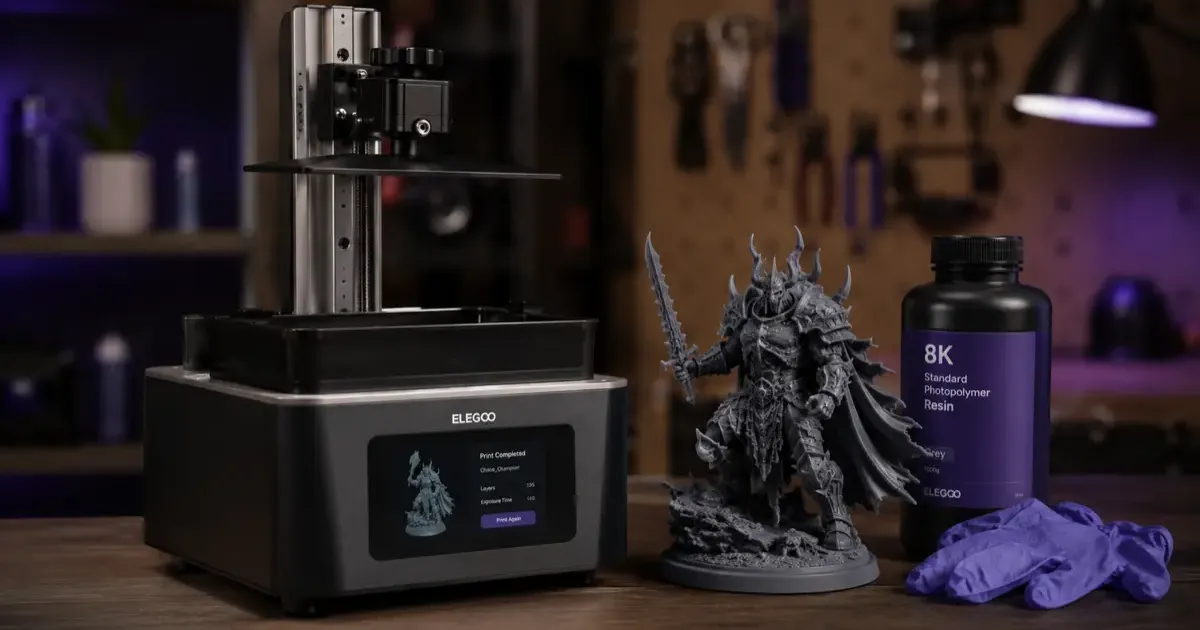
For most beginners, the Elegoo Mars 5 Ultra ($269 as of November 2026) is the best first resin 3D printer because its automatic leveling and tilt-release vat eliminate the two biggest causes of failed beginner prints. If you want the lowest entry price, pick the Anycubic Photon Mono 4 ($169 on sale, $240 list). If you want a larger build volume for multi-part statues or full miniature squads, step up to the Elegoo Saturn 4 Ultra ($399 for the 12K version, or $499 for the Saturn 4 Ultra 16K with a heated resin tank).
If your goal is jaw-dropping surface detail for tabletop RPG miniatures, wargaming armies, scale model kit parts, or custom keycaps, MSLA resin 3D printing beats filament (FDM) printing every single time. At 14 to 18 microns of XY resolution and 0.02 to 0.05 mm layer heights, layer lines practically vanish under a coat of primer.
The catch is that resin printing is a chemical process, not a plug-and-play desktop appliance. Liquid photopolymer resin is toxic, sticky, and sensitive to room temperature. Below, we compare the best beginner resin printers available in November 2026, break down the exact hardware specs from each manufacturer, and walk through the wash, cure, and safety setup you must budget for on day one. (Still deciding between plastic spools and liquid resin? Start with our FDM vs resin printing breakdown or our 3D printing beginner guide.)
Quick Picks: Best Beginner Resin 3D Printers at a Glance (November 2026)
| Model | Price (Nov 2026) | LCD Screen & XY Resolution | Build Volume | Leveling & Peel System | Best For |
|---|---|---|---|---|---|
| Elegoo Mars 5 Ultra | $269 | 7” 9K Mono (8520 x 4320, 18 µm) | 153.36 x 77.76 x 165 mm | Auto-leveling + Tilt-Release (150 mm/h) | Best Overall for Beginners |
| Anycubic Photon Mono 4 | $169 (list $240) | 7” 10K Mono (9024 x 5120, 17 µm) | 153.4 x 87 x 165 mm | 4-point manual + standard Z-lift (70 mm/h) | Best Under $200 Budget Entry |
| Elegoo Saturn 4 Ultra (12K) | $399 | 10” 12K Mono (11520 x 5120, 19x24 µm) | 218.88 x 122.88 x 220 mm | Auto-leveling + Tilt-Release (150 mm/h) | Best Mid-Size Army & Statue Printer |
| Elegoo Saturn 4 Ultra 16K | $499 | 10” 16K Mono (15120 x 6230, 14x19 µm) | 211.68 x 118.37 x 220 mm | Auto-leveling + Tilt-Release + Heated Vat | Best Cold-Garage & Prosumer Pick |
1. Elegoo Mars 5 Ultra ($269): The Best First Resin Printer for Most Beginners
The Elegoo Mars 5 Ultra ($269 on Elegoo’s US store as of November 2026) is the machine that finally made compact resin printing approachable for first-timers. Historically, 80% of beginner resin failures happened during the first five layers because the build plate was slightly crooked or the suction force tore the soft print off its supports. Elegoo solved both hardware bottlenecks in this generation.
Why Tilt-Release and Auto-Leveling Matter
On a traditional MSLA printer, the metal build plate pulls straight up after every cured layer to rip the print off the clear release film at the bottom of the resin vat. That vertical tug acts like a plunger, creating high suction forces. The Mars 5 Ultra instead tilts the resin vat itself at a slight angle after each exposure, peeling the release film away from one edge to the other like removing a sticker.
This mechanical Tilt-Release system delivers two huge benefits for beginners:
- Fewer failed prints: Because peel forces are drastically lower, delicate miniature supports are far less likely to snap mid-print.
- Double the print speed: The Mars 5 Ultra reaches vertical print speeds up to
150 mm/h(compared to50 to 70 mm/hon standard lift printers) because it does not need slow, tall Z-axis retraction lifts between every single layer.
Combined with out-of-the-box automatic leveling (via a pressure-sensing build plate that requires zero paper shims or hex wrenches) and a mechanical residue sensor that stops the plate from crushing cured debris into the glass LCD, it removes the scariest beginner mistakes.
Key Specifications (Elegoo Mars 5 Ultra)
- Screen & Resolution: 7-inch 9K Monochrome LCD (
8520 x 4320pixels) with18 x 18 µmXY resolution - Build Volume:
153.36 x 77.76 x 165 mm(fits 5 to 8 standard 28mm miniatures per plate) - Connectivity & Monitoring: Built-in Wi-Fi transfer plus an internal AI camera for real-time monitoring, empty-plate checks, and warp detection
- Downsides: Still uses a traditional lift-off UV hood (unlike the Saturn’s flip-up hinge), which requires vertical clearance and two hands to remove while wearing gloves.
2. Anycubic Photon Mono 4 ($169 on Sale): The Best Budget Entry Under $200
If you want to test whether you enjoy miniature painting and resin post-processing without spending $500 on your complete setup, the Anycubic Photon Mono 4 ($169 on promotion as of November 2026, $240 MSRP) is the price floor for a modern, high-resolution resin printer.
10K Sharpness Without the Smart-Sensor Tax
Even at $169, the Photon Mono 4 does not compromise on optical sharpness. It packs a 7-inch 10K monochrome LCD (9024 x 5120 pixels) backed by Anycubic’s LighTurbo matrix light source, achieving an XY pixel size of 17 x 17 µm. In side-by-side prints of 32mm tabletop figures, a print from the $169 Photon Mono 4 is visually indistinguishable from a print off a $500 machine. It also offers a slightly deeper Y-axis build plate (153.4 x 87 x 165 mm, about 2.2 liters of volume) than the Mars 5 Ultra.
What You Give Up at $169
To hit this price, Anycubic leaves out the automated conveniences of the Mars 5 Ultra:
- Manual 4-point leveling: You have to loosen four screws, press the laser-engraved build plate against a leveling sheet, and tighten the screws evenly by hand. Done carefully on a sturdy desk, you only need to re-level every few months, but rushing this step will cause prints to stick to the vat film instead of the plate.
- Standard vertical Z-lift: Without tilt-release, print speeds top out at
50 mm/hwith standard resin and70 mm/hwith high-speed resin. - No Wi-Fi or camera: You slice files in Anycubic Photon Workshop, Lychee Slicer, or Chitubox and carry them to the printer on a USB drive.
3. Elegoo Saturn 4 Ultra ($399 for 12K / $499 for 16K): The Step-Up Pick
One quirk of MSLA resin printing surprises every newcomer coming from filament printers: print time depends only on the height (Z-axis) of the tallest object, never on how many items are on the build plate. Because the UV LCD flashes the entire cross-section of the build plate simultaneously, printing ten miniatures takes the exact same 2 hours as printing one miniature.
That makes build plate area the single biggest productivity multiplier in resin printing. If you plan to print full tabletop squads, terrain buildings, 1/6 scale display statues, or functional engineering prototypes, the 7-inch plates on the Mars 5 Ultra and Photon Mono 4 will quickly feel cramped.
Saturn 4 Ultra (12K) vs. Saturn 4 Ultra 16K
Elegoo sells two versions of the 10-inch Saturn 4 Ultra as of November 2026:
- Elegoo Saturn 4 Ultra (12K) ($399): Gives you a massive
218.88 x 122.88 x 220 mmbuild volume (nearly triple the total volume of the Mars 5 Ultra),19 x 24 µmXY resolution (11520 x 5120pixels), Tilt-Release (150 mm/h), auto-leveling, Wi-Fi, and a flip-up hinged hood that lets you open the printer one-handed without setting a resin-contaminated lid on your desk. - Elegoo Saturn 4 Ultra 16K ($499): Upgrades the 10-inch panel to
15120 x 6230pixels (14 x 19 µmXY resolution, build volume211.68 x 118.37 x 220 mm), adds an illuminated chamber light for the AI camera, and most importantly includes smart resin tank heating.
Why Tank Heating Is a Game Changer: Liquid photopolymer resin thickens rapidly below 20°C (68°F), causing viscosity spikes and layer separation. If your ventilated printing spot is an unheated garage, basement, or shed in winter, the Saturn 4 Ultra 16K’s built-in vat heater warms the resin to an optimal 30°C before lowering the build plate, saving you from buying third-party fermentation belts or mini chamber heaters.
Head-to-Head Specification Comparison
| Specification | Anycubic Photon Mono 4 | Elegoo Mars 5 Ultra | Elegoo Saturn 4 Ultra (12K) | Elegoo Saturn 4 Ultra 16K |
|---|---|---|---|---|
| US Price (Nov 2026) | $169 (MSRP $240) | $269 | $399 | $499 |
| Screen Size & Type | 7-inch 10K Mono LCD | 7-inch 9K Mono LCD | 10-inch 12K Mono LCD | 10-inch 16K Mono LCD |
| Pixel Resolution | 9024 x 5120 px | 8520 x 4320 px | 11520 x 5120 px | 15120 x 6230 px |
| XY Pixel Size | 17 x 17 µm | 18 x 18 µm | 19 x 24 µm | 14 x 19 µm |
| Build Volume | 153.4 x 87 x 165 mm | 153.36 x 77.76 x 165 mm | 218.88 x 122.88 x 220 mm | 211.68 x 118.37 x 220 mm |
| Peel Mechanism | Vertical Z-lift | Tilt-Release Vat | Tilt-Release Vat | Tilt-Release Vat |
| Max Print Speed | Up to 70 mm/h | Up to 150 mm/h | Up to 150 mm/h | Up to 150 mm/h |
| Bed Leveling | Manual (4 screws) | Automatic (sensor) | Automatic (sensor) | Automatic (sensor) |
| Integrated Vat Heater | No | No | No | Yes (~30°C auto-preheat) |
| Enclosure Lid | Lift-off cover | Lift-off cover | Flip-up hinged hood | Flip-up hinged hood |
| File Transfer | USB drive only | Wi-Fi + USB | Wi-Fi + USB | Wi-Fi + USB |
How the 3-Stage Resin Workflow Actually Works
Before clicking “buy” on a $169 or $269 printer, understand that the printer is only Stage 1 of a mandatory three-stage chemical workflow. Every single print comes off the build plate dripping in toxic, uncured liquid resin and must go through solvent washing and UV curing before you can touch it with bare skin.
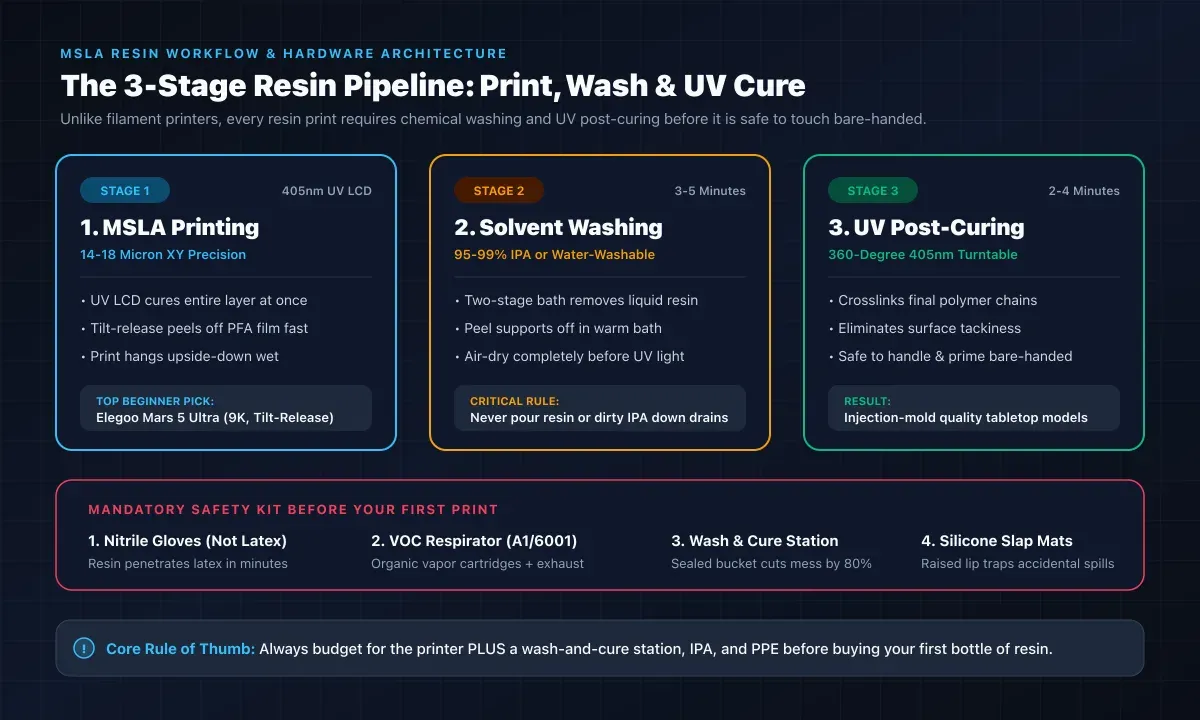
Stage 1: Printing (MSLA Exposure)
You slice your 3D model in Chitubox or Lychee Slicer, angling the model at 30 to 45 degrees and adding thin tree-like support structures so overhangs do not cure in mid-air (known as “islands”). During printing, the build plate dips into the resin vat and a 405nm UV LED array shines through the monochrome LCD mask, solidifying one 0.05 mm slice every 1.5 to 2.5 seconds.
Stage 2: Solvent Washing (Removing Uncured Resin)
When the print finishes, you put on nitrile gloves and a respirator, scrape the models off the build plate over a silicone mat, and submerge them in a bath of 95% to 99% Isopropyl Alcohol (IPA).
- Pro Tip (The Two-Stage Wash): Keep a “dirty” Tupperware container of IPA for a 60-second pre-rinse that strips 90% of the liquid resin off the model, then transfer the print into your wash-and-cure station’s sealed bucket for a 3-minute vortex spin. This keeps your main wash tank clean four times longer.
- Removing Supports: Remove supports after washing (or after dipping the washed model in warm tap water inside a dedicated bowl for 20 seconds to soften the tips), but before UV curing. Once cured under UV light, supports harden and leave pockmarks when snapped off.
Stage 3: UV Post-Curing (Final Crosslinking)
Let the washed print air-dry completely on a paper towel for 20 to 30 minutes. If you cure a print while wet IPA is still pooled in its crevices, the alcohol reacts with trace resin to leave chalky white streaks that ruin fine detail. Once dry, place the model on the rotating 405nm UV curing turntable for 2 to 4 minutes. After curing, the plastic is fully polymerized and safe to handle bare-handed, sand, and prime.
True Starter Budget: What Else You Must Buy on Day One
Many beginners buy a $269 printer and get stuck when the box arrives because they lack the wash, cure, and safety supplies. Here is the realistic all-in shopping list (with US prices checked in November 2026):
| Item | Typical Cost | Why It Is Mandatory |
|---|---|---|
| 2-in-1 Wash & Cure Station (Elegoo Mercury XS Bundle or Anycubic Wash & Cure 3.0) | $99 to $159 | Replaces messy open tubs with a sealed magnetic-impeller wash bucket and a 360-degree UV curing chamber. |
| Nitrile Gloves (Box of 100, 5-mil+) | $12 to $18 | Never use latex or vinyl gloves; liquid acrylates penetrate latex within minutes. |
| Organic-Vapor Respirator (3M 6000 + 6001 Cartridges) | $28 to $38 | N95 dust masks only block particles, not chemical VOC fumes from resin and evaporating IPA. |
| 99% Isopropyl Alcohol (1 Gallon / 4 Liters) | $24 to $32 | Needed to fill the wash bucket. Denatured alcohol (methylated spirits) also works well. |
| Silicone Slap Mats (2-Pack with Raised Lip) | $14 to $18 | Protects your desk surface; any spilled resin cures cleanly under a UV flashlight and peels right off silicone. |
| ABS-Like Photopolymer Resin (1 kg Bottle) | $18 to $26 | Skip brittle “Standard” resin; ABS-Like Resin (such as Elegoo ABS-Like 3.0 or Sunlu ABS-Like) bends slightly before snapping, saving miniature swords and spears when dropped. |
| Total Essential Add-Ons | ~$195 to $290 | Realistic all-in day-one budget: ~$365 (with Photon Mono 4) or ~$465 (with Mars 5 Ultra). |
For a broader look at how uncured photopolymers, VOCs, and particulates affect indoor air quality, read our in-depth guide on the dangers of 3D printing and how to ventilate safely, plus our roundup of must-have 3D printing accessories.
Resin vs. Filament (FDM): Make Sure You Are Buying the Right Technology
Before ordering a resin setup, ask yourself two questions: What am I printing? and Where will the printer live?
Choose Resin (MSLA) if:
- You print Dungeons & Dragons characters, Warhammer proxies, bust sculptures, jewelry masters, or high-detail scale train and aircraft parts.
- You have a garage, basement, workshop, or spare room with window exhaust ventilation where pets and children cannot reach the vat.
Choose Filament (FDM) instead if:
- You want to print desk organizers, Gridfinity bins, tool holders, helmets, cosplay armor, brackets, or toys that need mechanical strength and UV sunlight durability.
- The printer has to sit in your bedroom, living room, or main home office desk. Modern enclosed filament printers like the Bambu Lab P1S or open-frame machines like the Bambu Lab A1 Mini (covered in our best 3D printers under $500 guide and 3D printers under $300 roundup) require zero chemical baths and let you pull finished parts straight off the magnetic build plate.
The Bottom Line
If you have the workspace for resin and want miniature quality that rivals commercial plastic kits:
- Buy the Elegoo Mars 5 Ultra ($269) if you want the smoothest learning curve. Auto-leveling and Tilt-Release save beginners hours of troubleshooting.
- Buy the Anycubic Photon Mono 4 ($169 on sale) if keeping your total all-in starter budget (printer + wash station + PPE) around $360 is your top priority.
- Buy the Elegoo Saturn 4 Ultra ($399 for 12K, $499 for 16K) if you want a 10-inch build plate for printing entire squads at once, a flip-up hood, or an integrated vat heater for cold-garage printing.
Related Articles
FDM vs Resin 3D Printing: Which One Should You Choose?
FDM vs resin 3D printing, we compare cost, print quality, safety, and ease of use with real examples to help you pick the right technology for your project.
Best 3D Printers Under $300 in 2026
Find the best budget 3D printer without the guesswork. We tested Bambu Lab A1 Mini, Creality Ender 3 V3, Anycubic Kobra, and more. See our top pick.
Bambu A1 Mini vs Creality Ender 3 for Beginners
Bambu Lab A1 Mini or Creality Ender 3 V3? The ultimate comparison of the two most popular beginner 3D printers in 2026 with all pros and cons.