
Bambu Lab H3C vs Prusa INDX: Tool-Changer Showdown
Bambu Lab H3C vs Prusa CORE One+ INDX 8-Tool: We compare multi-material tool-changing speed, build volume, waste elimination, TPU support, and pricing.

For the past three years, desktop multi-color 3D printing has been defined by a single, glaring compromise: filament waste and endless print times.
Systems like the Bambu Lab AMS and the Prusa MMU3 democratized multi-color printing for millions of makers. However, routing four to sixteen filaments through a single shared hotend created notorious “filament poop.” On complex multi-color models, users routinely watched 60% to 80% of an entire spool get purged into the trash bin. More critically, switching between chemically incompatible materials (like rigid PETG and flexible TPU, or high-temp engineering Nylon and water-soluble support PVA) was either unreliable or completely impossible due to cross-contamination within a single melt zone.
In late 2026, the additive manufacturing industry reached its long-awaited tipping point. Single-nozzle filament pushers are taking a back seat to high-speed physical tool-changers.
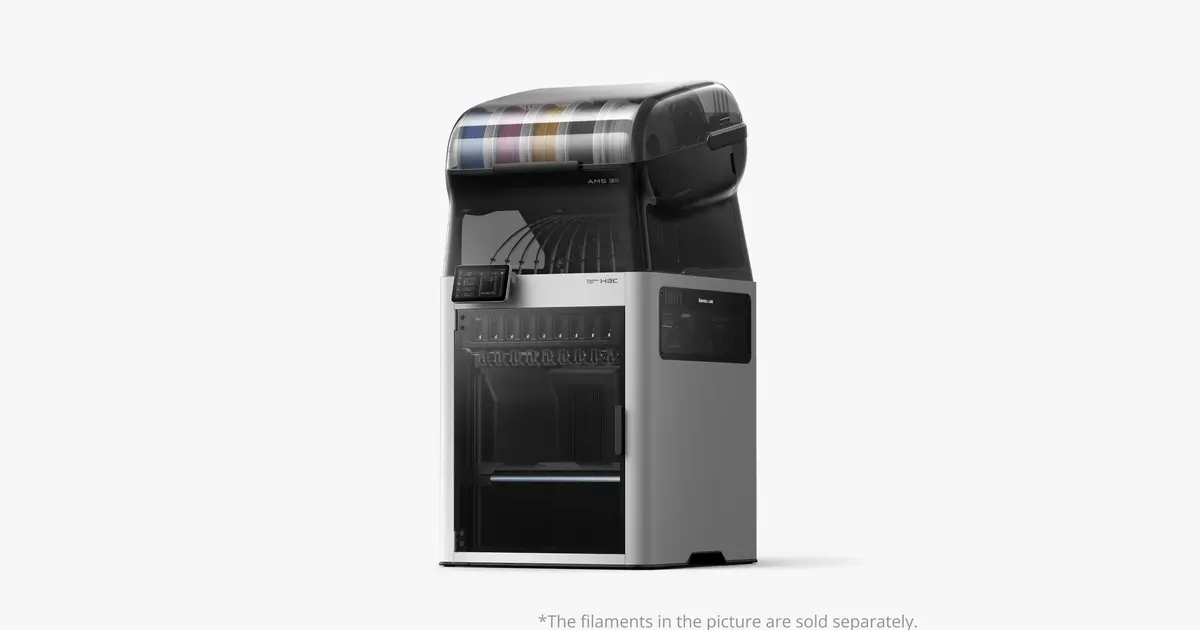
Leading this revolution are two heavyweight flagships: the Bambu Lab H3C, featuring its 9-tool SwapTek™ ecosystem, and the Original Prusa CORE One+ (Gen 2) INDX, powered by Bondtech’s passive 8-toolchanger technology.
If you are evaluating whether to invest in a multi-tool workstation for functional engineering, rapid prototyping, or small-batch manufacturing, this comprehensive technical showdown compares mechanics, thermal envelopes, toolhead kinematics, and real-world costs.
Quick Picks: Bambu Lab H3C vs. Prusa CORE One+ INDX at a Glance
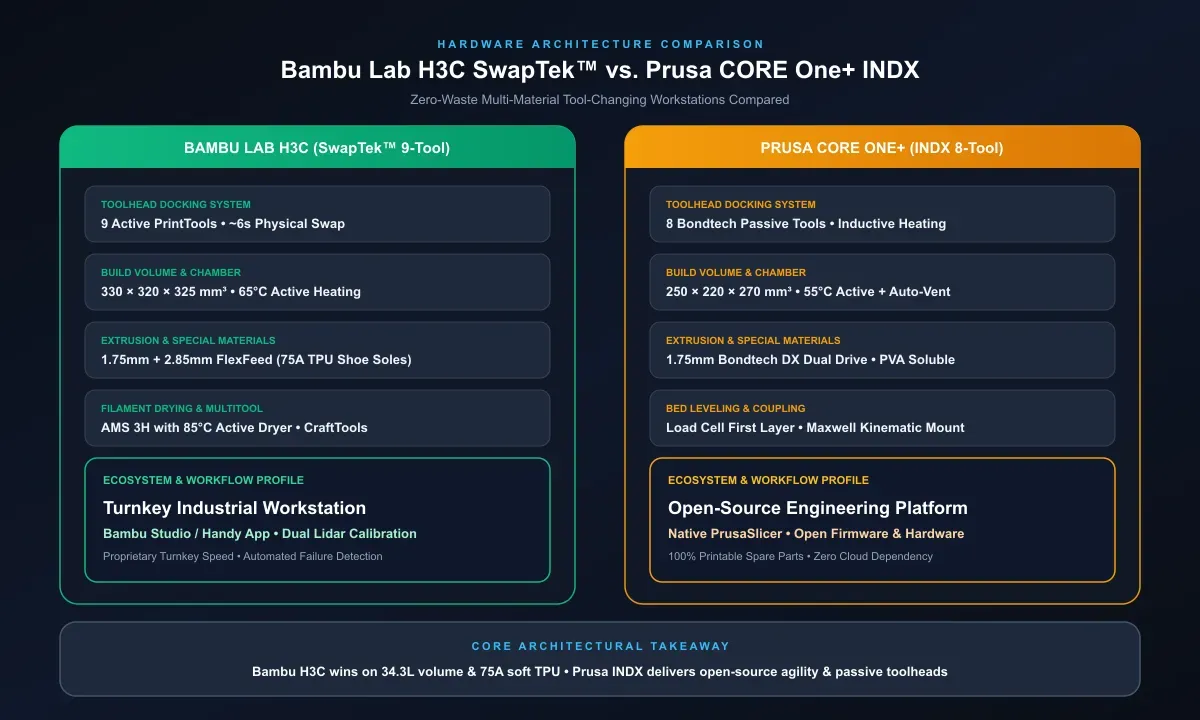
Before examining the engineering details, here is how the two flagship tool-changers compare across core technical metrics (all specifications and prices verified as of November 2026):
| Feature & Specification | Bambu Lab H3C | Prusa CORE One+ (Gen 2) INDX |
|---|---|---|
| Tool-Changer Architecture | SwapTek™ Active Tool Dock (9 PrintTools) | Bondtech INDX Passive Tool Dock (Up to 8 Heads) |
| Toolhead Swap Time | ~6 seconds physical swap | ~5 to 7 seconds kinematic docking |
| Usable Build Volume | 330 × 320 × 325 mm³ (~34.3 Liters) | 250 × 220 × 270 mm³ (~14.8 Liters) |
| Chamber Temperature | Actively heated up to 65°C | Actively regulated up to 55°C (Auto-venting) |
| Nozzle & Bed Max Temp | 350°C Nozzle / 120°C Bed | 300°C Nozzle / 120°C Bed |
| Filament Compatibility | 1.75 mm and 2.85 mm (Dedicated FlexFeed) | 1.75 mm standard (Bondtech DX Dual Drive) |
| Soft TPU Capabilities | Ultra-soft TPU (down to 75A, shoe soles) | Standard flexible TPU (down to ~85A/90A) |
| Filament Management | AMS 3H with integrated 85°C active dryer | Modular spool holders / drybox integration |
| Multifunctional Tooling | Supports CraftTools (cutting, drawing, foil) | Focused strictly on high-precision FFF extrusion |
| Bed Leveling System | Dual Lidar + Eddy current auto-calibration | Integrated Load Cell hardware mesh leveling |
| Ecosystem & Software | Proprietary firmware, Bambu Studio / Handy | Open-source philosophy, native PrusaSlicer |
| Price (as of Nov 2026) | $2,499 (Turnkey Combo) | $1,949 (DIY Kit) • $2,289 (Assembled) |
The Root Problem: Why Single-Nozzle Systems Hit the Wall
To understand why machines like the Bambu H3C and Prusa INDX represent such a massive leap, you must look at the mathematical penalty of single-nozzle multi-material systems:
The Single-Nozzle Cycle (AMS / MMU):1. Finish layer color -> 2. Retract 800 mm of filament -> 3. Select next spool-> 4. Feed 800 mm forward -> 5. Purge 150-300 mm³ of molten plastic into waste bin-> 6. Wipe nozzle on silicone brush -> 7. Resume printing (Takes 45-90 seconds per swap)On a 1,200-layer miniature figurine with four colors per layer, a single-nozzle printer must execute 3,600 filament retractions and purges. That translates to:
- Over 45 hours added to print time purely for filament swapping and nozzle purging.
- Hundreds of grams of plastic wasted, often weighing three times more than the finished model itself.
- Mechanical wear on gears, PTFE Bowden tubes, and cutting blades.
By contrast, a physical tool-changer leaves each filament pre-loaded in its own dedicated hotend. Swapping colors or materials requires simply parking the current tool, picking up the next tool from the dock, and immediately resuming the toolpath. The entire process takes roughly six seconds, uses zero purge plastic, and saves dozens of printing hours per project.
1. Toolhead Architecture: SwapTek™ vs. Bondtech INDX
While both machines eliminate filament waste, they achieve tool-changing through radically different engineering philosophies:
Bambu Lab H3C: Active SwapTek™ PrintTools
The Bambu Lab H3C employs an active toolhead dock array accommodating up to 9 independent PrintTools. Each toolhead is a self-contained extrusion unit:
- Independent Motors and Cutters: Each PrintTool carries its own hardened steel drive gears, ceramic heater, hotend fan, and automatic filament cutter.
- Active Pre-Heating: While Tool #1 is laying down perimeter lines, Tool #2 begins pre-heating in its parking slot. When the swap occurs, Tool #2 is already at operating extrusion temperature, eliminating thermal lag.
- Mixed Nozzle Combinations: Because each PrintTool is independent, you can mix nozzle diameters in the same print job. You can lay down heavy internal infill at high volumetric speed using a 0.8 mm nozzle on Tool #1, while simultaneously printing crisp 0.08 mm cosmetic exterior perimeters using a 0.2 mm nozzle on Tool #2.
Prusa CORE One+ (Gen 2): Passive Bondtech INDX System
Prusa partnered with legendary Swedish extruder manufacturer Bondtech to develop the INDX system. Instead of packing heavy motors and electronic boards onto every toolhead, Prusa chose a passive toolhead design:
- Contactless Inductive Heating: The parked toolheads do not have tethered wiring harnesses. Instead, high-frequency induction coils on the moving carriage wirelessly heat the nozzle the moment it docks.
- Kinematic Maxwell Coupling: The mechanical interface uses three-point magnetic kinematic Maxwell couplings. This ensures micro-metric repeatability: every time the carriage grabs an INDX tool, it locks into the exact same spatial coordinate without mechanical play.
- Ultra-Low Moving Mass: Because the parked tools do not carry stepper motors or heavy aluminum heatsinks, the moving print carriage remains exceptionally lightweight. This allows the CoreXY motion system to accelerate at blazing speeds with zero ghosting or ringing artifacts.
2. Build Envelope and Chamber Thermal Control
For functional mechanical parts, scale and thermal stability determine which materials you can successfully print without warping or layer delamination:
Build Volume: Bambu Takes the Crown
- Bambu Lab H3C: 330 × 320 × 325 mm³ (~34,320 cm³)
- Prusa CORE One+ INDX: 250 × 220 × 270 mm³ (~14,850 cm³)
The Bambu Lab H3C provides more than double the usable print volume of the Prusa. A 330 mm build plate allows engineers to print full-scale mechanical enclosures, automotive intake pipes, and large industrial jigs in one piece. For makers designing modular storage or furniture modifications, like the projects featured in our IKEA 3D printing hacks, the H3C accommodates full-width drawer organizers and structural brackets without cutting models in half.
Chamber Heating: Engineering Polymer Envelopes
Both printers feature enclosed, actively managed chambers designed to tame warp-prone engineering plastics like ABS, ASA, Polycarbonate (PC), and Carbon-Fiber Polyamides (PA-CF):
- Bambu H3C Chamber: Features dedicated PTC active heating elements capable of maintaining 65°C internal air temperature. Paired with a 120°C heated bed and 350°C hotend, it handles high-temp composite materials with minimal layer split risk. It also incorporates dual HEPA H11 and activated carbon filters to scrub styrene VOCs and ultrafine particles.
- Prusa CORE One+ Chamber: Regulates chamber heat up to 55°C and introduces an automatic top ventilation system. When printing engineering materials (PC, ASA, Nylon), the top louvers seal tightly to trap ambient heat. When you switch to low-temperature filaments like PLA or PETG, the printer automatically opens the ceiling vents to prevent heat creep and nozzle clogging.
For a detailed breakdown of how temperature tolerances affect layer adhesion across these filaments, read our guide on PLA vs PETG vs ABS.
3. The Soft TPU and Wearable Breakthrough: Bambu FlexFeed
One of the most surprising revelations of the Bambu Lab H3C is its aggressive push into wearables, footwear, and ultra-soft elastomers.
Traditional 3D printers struggle with flexible filaments softer than 95A durometer. Attempting to push soft 85A or 75A TPU through a standard extruder is like trying to push wet spaghetti through a straw: the filament buckles, wraps around the drive gears, and jams instantly.
Dual-Diameter 1.75 mm and 2.85 mm Support
To solve this, the H3C introduces a dedicated FlexFeed extruder tool that uniquely accommodates 2.85 mm filament, alongside standard 1.75 mm paths.
By utilizing thick 2.85 mm spools for flexible materials, the cross-sectional column stiffness of the filament increases dramatically, preventing buckling even when feeding ultra-soft 75A durometer TPU.
This allows users to print:
- Functional Footwear: Lattice shoe midsoles, orthopedic insoles, and wearable elastic outsoles printed directly in one piece.
- Hermetic Soft-Touch Seals: Industrial watertight gaskets fused directly onto rigid polycarbonate housings without manual O-ring assembly.
- Vibration Dampeners: Custom silicone-like shock absorbers for robotics and drone gimbals.
While the Prusa INDX handles standard 1.75 mm flexible TPU (down to roughly 85A) with its Bondtech DX Dual Drive, Bambu’s specialized 2.85 mm FlexFeed system establishes a clear technological advantage for footwear designers and elastomer specialists.
4. Filament Conditioning: AMS 3H vs. Modular Dryboxes
Multi-material printing is only as reliable as your filament conditioning. Engineering materials like Nylon, PVA support material, and TPU are notoriously hygroscopic: left exposed to room humidity for even six hours, they absorb water molecules, resulting in popping sounds, stringing, and weak layer adhesion.
Bambu Lab AMS 3H
The H3C ships with the AMS 3H unit mounted directly on top of the printer frame:
- Active 85°C Filament Drying: Unlike previous passive desiccant boxes, the AMS 3H integrates an active heater and forced-air blower reaching up to 85°C. It can actively bake moisture out of carbon-fiber PA and PC spools while feeding filament directly into the toolheads.
- Automated Desiccant Regeneration: Smart humidity sensors automatically track atmospheric dew points inside the bay, providing real-time moisture telemetry via the touchscreen and mobile app.
Prusa Spool Management
Prusa approaches spool management with a modular design:
- Bayonet Spool Mounts: The CORE One+ uses external bayonet mounts designed to integrate with standalone dryboxes (such as the Prusa Drybox or custom DIY heated enclosures).
- Direct Short Filament Routing: Because the INDX toolheads dock inside the upper chamber, the filament routing tubes are kept short and direct, minimizing friction when loading stiff carbon-fiber spools.
If you are setting up your workspace for high-temp filament management, explore our foundational 3D printing guide for storage tips and our seasonal advice in how to prepare for the dark season to maintain controlled workshop ambient conditions.
5. Software Ecosystem, Openness, and Repairability
Beyond raw hardware specifications, the long-term ownership experience hinges on software philosophy and community openness:
The Prusa Open-Source Advantage
Prusa Research remains the gold standard for open-source integrity, repairability, and long-term hardware support:
- 100% Native PrusaSlicer: Zero cloud requirements, no mandatory account logins, and open firmware repositories.
- Repairability and Modding: Every plastic component on the CORE One+ is printable on another machine. Replacement screws, bearings, and belts follow standard industrial metric specifications, meaning you can source spare parts locally decades from now.
- Kit Building Option: For makers who want to master every screw and bearing of their machine, Prusa offers the INDX system as a complete DIY assembly kit for $1,949, saving $340 over the factory-assembled $2,289 version while providing deep mechanical intimacy.
The Bambu Lab Turnkey Experience
Bambu Lab approaches 3D printing like Apple approaches consumer electronics:
- Effortless Out-of-the-Box Setup: The H3C arrives fully assembled. You unbox it, plug in power, complete the automated vibration resonance and camera calibrations, and start multi-material printing within thirty minutes.
- Advanced AI Vision: Dual Lidar sensors and high-resolution chamber cameras automatically detect spaghetti failures, verify first-layer squish, and monitor toolhead docking alignment.
- Proprietary Ecosystem: Firmware updates and cloud connectivity are controlled centrally by Bambu Lab. While the software experience is polished, community modification of core electronics is heavily restricted.
6. Real-World Applications: Who Wins Where?
To decide which machine fits your workshop, evaluate your primary use cases:
Buy the Bambu Lab H3C If:
- You Need Maximum Build Volume: Printing helmets, cosplay armor, large drone frames, or batch manufacturing dozens of parts in a single plate.
- You Prototype Footwear and Soft Elastomers: The 2.85 mm FlexFeed system printing 75A TPU is unmatched in the desktop market.
- You Want Turnkey Speed and High-Temp Engineering: An active 65°C chamber combined with the 85°C AMS 3H dryer makes printing carbon-fiber nylon seamless for commercial studios.
- You Want Multifunctional Crafting: Swapping from a 3D printing nozzle to a vinyl cutter or plotting tool via CraftTools expands your workshop capability.
Buy the Prusa CORE One+ INDX If:
- You Demand Open-Source Sovereignty: You refuse cloud tethers, closed firmware, or proprietary hardware architectures.
- You Value Lightweight Kinematic Precision: Bondtech’s passive toolhead coupling keeps moving mass tiny, producing museum-grade surface finishes on mechanical prototypes.
- You Print Complex Functional Overhangs with PVA: The INDX system excels at printing mechanical assemblies with water-soluble support interfaces that rinse away cleanly in warm water.
- You Love the Build-It-Yourself Journey: Buying the DIY kit saves money while giving you complete mastery over your tool’s mechanics.
The Verdict: The Death of the Purge Tower
The arrival of the Bambu Lab H3C and Prusa CORE One+ INDX marks the end of an era. Single-nozzle multi-material systems served their purpose by proving consumer demand, but physical tool-changing is the indisputable future of multi-material manufacturing.
- The Bambu Lab H3C ($2,499) is an absolute powerhouse. By combining 9 active PrintTools, a colossal 330×320×325 mm³ build volume, and specialized 2.85mm ultra-soft TPU extrusion, Bambu has built the most capable all-in-one desktop production center on the market.
- The Original Prusa CORE One+ INDX ($1,949 kit / $2,289 assembled) represents the pinnacle of open-source engineering. By teaming up with Bondtech to create an ultra-lightweight passive docking system, Prusa delivers blistering speed, pinpoint accuracy, and uncompromised user freedom.
Whichever path you choose, one thing is certain: you will never have to watch an expensive spool of filament turn into a mountain of purge poop ever again.
For more technical insights into the evolving hardware landscape, browse our analysis on what to expect next in 3D printing or explore our workstation ergonomic tips in our desk upgrade guide.
Related Articles
Bambu Lab A2L: Specs, Price & Who It's For (2026)
Bambu Lab's A2L brings a 330mm large-format build to the A-series for $469. Here's what the specs actually mean and who this budget big-bed printer is for.
Bambu Lab X2D Review: $649 Dual-Nozzle Heated Chamber
Bambu Lab X2D review: $649 base / $899 AMS Combo. Dual-nozzle mechanical switching, 65°C heated chamber, 256mm build, and 31 sensors. Is it worth it?
The Golden Age of $500 3D Printers: Turn-key vs. DIY
Is $500 the sweet spot for 3D printing? We compare modern plug-and-play machines against legendary DIY kits, featuring the Bambu Lab P2S and Creality K2.