
Environmental Impact of 3D Printing: Eco-Hero or Waste?
Is 3D printing green or just more plastic waste? Explore PLA biodegradability, energy use, microplastics, circular recycling, and eco-friendly maker tips.

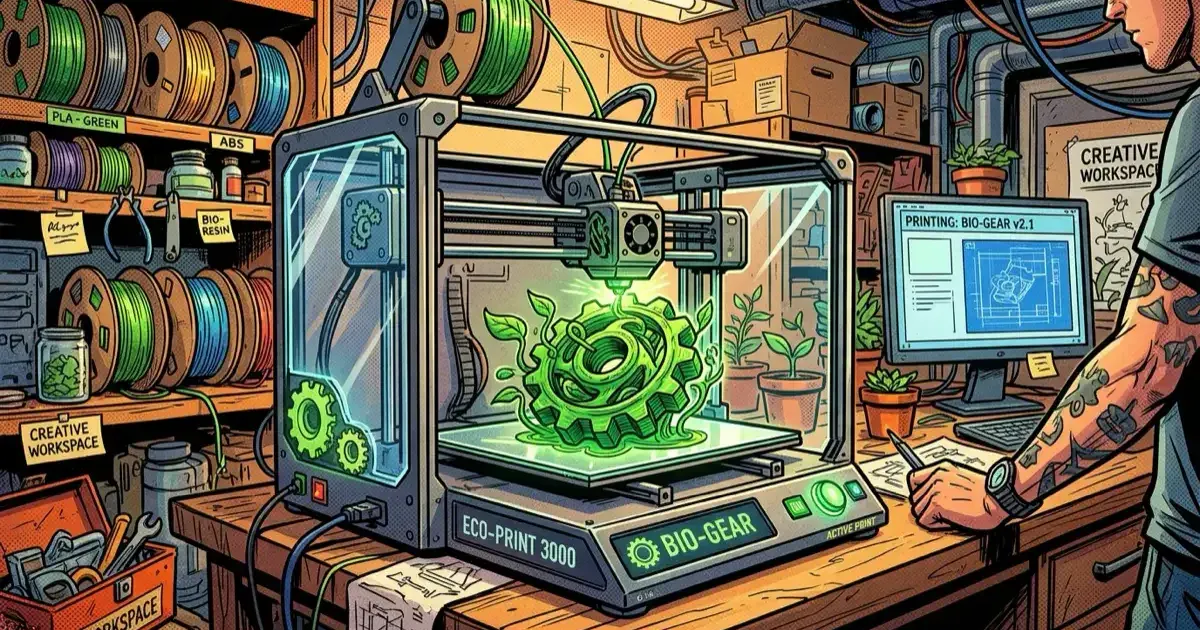
Walk into any maker space, garage workshop, or 3D printing enthusiast’s den, and you will see a fascinating paradox.
On one desk, a high-precision FDM printer creates a $0.40 replacement hinge that rescues a $600 dishwasher from a landfill, single-handedly proving the power of localized, circular manufacturing.
On the desk right next to it sits a cardboard box overflowing with neon-colored failed prints, throwaway calibration cubes, hollow articulated dragons, and brittle support material destined for the local municipal dump.
This tension sits at the heart of additive manufacturing in 2026: Is 3D printing an environmental revolution that reduces global manufacturing emissions, or is it just another machine that turns electricity into microplastic clutter?
To understand the true ecological footprint of desktop 3D printing, we must look past marketing buzzwords like “plant-based plastic” and examine the hard data behind energy consumption, material lifecycles, microplastic emissions, and localized repair dynamics.
Mastering sustainable printing workflows? Explore our comprehensive 3D Printing Beginner Guide and learn how to optimize slicer settings in our OrcaSlicer Guide to eliminate failed prints.
Quick Summary: The Ecological Balance Sheet
In a hurry? Here is how desktop 3D printing stacks up environmentally:
- The Green Advantages: Localized production eliminates long-distance cargo shipping emissions; on-demand spare parts extend the lifespan of consumer appliances; additive manufacturing generates up to 70% less raw material waste than CNC milling.
- The Dirty Realities: PLA does not degrade in natural soil or landfills; failed prints and purge waste create persistent microplastics; melting filaments emit Ultra-Fine Particles (UFPs) and Volatile Organic Compounds (VOCs).
- The Eco-Maker Formula: Print functional replacement parts instead of decorative clutter, use cardboard-spool recycled filaments (rPLA / rPET), calibrate slicers to minimize purge waste, and enclose printers with HEPA/carbon filtration.
3D Printing vs. Traditional Manufacturing: Environmental Comparison
| Environmental Factor | Desktop 3D Printing (Additive) | Traditional Injection Molding / CNC (Subtractive) |
|---|---|---|
| Material Efficiency | High (Additive: builds only the exact object geometry) | Low in CNC (up to 80% material shaved into scrap) |
| Supply Chain Logistics | Zero shipping (Digital file downloaded, printed locally) | High emissions (Raw materials shipped, manufactured overseas, container freight) |
| Spare Parts & Lifespan | On-demand custom repairs for discontinued appliances | Obsolete stock discarded in warehouses; broken items trashed |
| Energy Consumption | ~100W–150W per machine (Ideal for small batches) | Extremely efficient per unit, but only at 10,000+ volume |
| Material Biodegradability | Limited (PLA requires industrial high-heat composting) | Virtually zero (Petroleum-based ABS, Polycarbonate, Nylon) |
| Post-Consumer Waste | Failed prints, support struts, and purge towers | Factory sprues, packaging blister packs, and unsold retail overstock |
1. The Great PLA Myth: “Plant-Based” Does Not Mean Backyard Compostable
The vast majority of desktop 3D printing in 2026 relies on PLA (Polylactic Acid). Filament manufacturers heavily market PLA as an “eco-friendly bioplastic derived from fermented cornstarch or sugarcane.”
While it is true that PLA utilizes renewable agricultural feedstocks rather than crude petroleum, the claim that your discarded PLA prints are “biodegradable” is dangerously misleading.
The Reality of PLA Breakdown:
- Industrial Composting Facility (Controlled): Requires continuous 55°C to 60°C (130–140°F) temperatures, 90% relative humidity, and specific thermophilic microorganisms. Under these exact conditions, PLA breaks down into water, CO2, and biomass within 60 to 90 days.
- Backyard Garden Soil / Forest Floor: Ambient soil temperatures rarely reach 30°C. In real-world outdoor tests, a PLA benchy or calibration cube shows zero structural degradation after 5 to 10 years.
- Ocean / Marine Environments: In cold seawater, PLA behaves almost identically to petroleum-based plastics, breaking down into persistent microplastic fragments that harm marine life.
If you throw failed PLA prints into regular household trash, they end up in an airtight municipal landfill where lack of oxygen prevents organic decomposition, preserving the plastic for decades.
2. The Power of “Right to Repair” and Distributed Manufacturing
Where 3D printing achieves its greatest environmental triumph is in carbon-avoidance through repair and localized fabrication.
Consider the lifecycle of a modern household appliance, such as a washing machine, lawnmower, or office chair. When a small $2 plastic gear or latch snaps after three years of use:
- The Traditional Consumer Path: The manufacturer has discontinued the spare part. The consumer throws the entire 150-pound washing machine into a landfill and buys a new one, triggering hundreds of kilograms of CO2 in metal extraction, factory assembly, and transoceanic container shipping.
- The 3D-Printed Repair Path: A maker downloads a 3D model from print repositories or designs a custom replacement in CAD using our CAD Software for 3D Printing Guide. For $0.50 worth of PETG filament and 40 minutes of printer electricity, the appliance remains in active service for another five years.
Carbon Lifecycle Comparison (Repair vs. Replacement):
- Traditional Replacement Cycle: Broken $2 part leads to scrapping the entire 70kg appliance, mining raw metals, factory assembly, and transoceanic container shipping (emitting ~250kg to 450kg of CO2).
- 3D-Printed Repair Cycle: Download 3D file, print a 25g PETG replacement part locally in 40 minutes, and reassemble the appliance (emitting ~0.08kg of CO2, a 99.9% carbon reduction).
Furthermore, digital distribution completely eliminates the carbon emissions of shipping finished plastic goods across oceans. Transporting a 1MB digital .STL file over fiber-optic cables uses negligible energy compared to trucking physical plastic boxes across continents.
3. Energy Consumption: How “Green” Is the Electricity?
A common criticism of 3D printing is that running a motorized heated machine for 16 consecutive hours consumes excessive electrical grid power.
In reality, modern FDM 3D printers are remarkably energy-frugal:
- Initial Heat-Up Phase: The printer draws 250W to 350W for the first 3 to 5 minutes to heat the aluminum bed to 60°C and the nozzle to 210°C.
- Steady-State Printing: Once at temperature, the machine only requires 80W to 140W to keep the bed warm and run the stepper motors. That is roughly equivalent to a standard desktop PC or an older incandescent television.
- 10-Hour Print Energy Cost: Consumes approximately 1.0 to 1.4 kWh. On a clean solar or wind energy grid, the carbon footprint of the electricity is near zero.
If you want to dive deeper into practical workshop safety and machine hazards, see our breakdown of the hidden dangers of 3D printing.
4. The Microplastic and Indoor Air Quality Factor
Environmental impact is not just about landfills; it is also about the indoor air environment in your home office or workshop.
When 3D printers melt thermoplastic filaments at 200°C to 280°C, they generate two primary airborne byproducts:
- Ultra-Fine Particles (UFPs): Microscopic aerosol particles (smaller than 100 nanometers) that can penetrate deep into human lung tissue and enter the bloodstream.
- Volatile Organic Compounds (VOCs): Chemical gases released during thermal degradation. While PLA emits relatively mild lactide vapors, engineering materials like ABS, ASA, and Nylon emit hazardous styrene and caprolactam gases.
Resin (SLA) Printing: The Chemical Waste Challenge
While FDM printing produces solid plastic scrap, resin (SLA) 3D printing generates hazardous liquid chemical waste.
Liquid photopolymer resins are toxic to aquatic ecosystems. Uncured resin, contaminated isopropyl alcohol (IPA) wash baths, and disposable nitrile gloves cannot be washed down the drain. They must be fully UV-cured into solid inert plastic or disposed of through certified hazardous waste facilities. If you are starting with resin, read our guide on the best resin 3D printers for beginners for essential chemical safety protocols.
5. Five Actionable Rules for Sustainable 3D Printing
You do not have to stop printing to be an eco-conscious maker. Follow these five practical strategies to reduce your workshop’s environmental footprint:
The Eco-Maker Action Checklist:
- Prioritize Functional Utility Over Plastic Trinkets: Print replacement brackets, tool holders, and organizers before printing disposable fidget toys.
- Switch to Cardboard Spools & Refill Systems: Avoid single-use plastic spools by buying filament on biodegradable cardboard cores or using master-spool refill bundles.
- Optimize Slicer Infill & Wall Counts: Drop infill from 40% to 15% (using Gyroid patterns) and add 1 extra wall loop. This achieves identical structural strength while using 30% less raw plastic.
- Buy Recycled rPLA and rPET Filaments: Support circular brands (like FormFutura ReFill, Polymaker PolyTerra, or Prusament Recycled) that reuse industrial waste streams.
- Collect and Store Print Scraps for Recycling: Never throw failed prints in the trash. Store clean PLA/PETG scraps in separated bins for local recycling initiatives (such as RecyclingFabrik or DIY filament extruders).
Eliminate the “Purge Tower” Waste
If you use multi-color or multi-material 3D printers, slicer “purge towers” and waste poops can easily exceed the actual weight of the printed model.
- Enable “Flush into Object Infill” in your slicer settings.
- Print functional purge objects (like a workshop storage bin) alongside your decorative multi-color model so waste plastic becomes useful structure rather than landfill scrap.
Summary: Designing a Sustainable Maker Future
Desktop 3D printing is neither purely green nor inherently evil. It is a powerful distributed manufacturing tool whose environmental impact depends entirely on how intentionally you use it.
When we use 3D printers to bypass global shipping, repair aging machinery, and manufacture custom long-lasting tools, additive technology represents one of the greatest ecological advancements of the 21st century.
By dialing in your slicer settings to prevent failed prints, choosing recycled filaments on cardboard spools, and prioritizing functional repairs over disposable plastic dust-collectors, you can enjoy the magic of digital fabrication with a clean environmental conscience.
Related Articles
- 3D Printing Guide for Beginners: The Complete Roadmap
- Is 3D Printing Worth It? Real Costs & Hidden Realities
- The Dangers of 3D Printing: Fumes, Fires, and Safety Guide
- Best CAD Software for 3D Printing: Free & Paid Tested
- Best Resin 3D Printers for Beginners: Safe Setup & Models
- OrcaSlicer Guide: Advanced Calibration & Slicing Mastery
Related Articles

Best Gifts for 3D Printing Enthusiasts 2026
The best gifts for 3D printing enthusiasts in 2026: filament, must-have tools, upgrades, and clever extras, with picks for beginners and seasoned makers alike.

The Real Dangers of 3D Printing: Fumes, Fires & Safety
Understand the hidden hazards of 3D printing. Learn about VOCs, ultrafine particles, fire risks, resin toxicity, and essential home workshop safety.

AI Tools for 3D Printing: Revolutionize Your Workflow
Discover the best AI tools for 3D printing in 2026, from AI-assisted CAD and intelligent slicing to automated print monitoring for faster, reliable prints.